
Defence Minister A K Antony on Thursday described the maiden test flight of the Inter-Continental Ballistic Missile Agni 5 as an "immaculate success" and a "major milestone". "The nation stands tall today. We have joined the elite club of nations (to possess the ICBM capability)," Antony told Defence Research and Development Organisation chief Dr V K Saraswat on the phone after the test flight of the missile was declared successful today.
The Indian army will have to wait four to five years to acquire Inter-Continental Ballistic Missile Agni-5, which was successfully tested on 19 April by the Defence Research and Development Organisation. Sheela Bhatt reports
India will join the elite club of nations having ICBM with the Defence Research and Development Organisation planning to carry out the launch of over 5,000 km-range Agni-5 missile in April.
India on Thursday successfully test-fired its nuclear capable Agni-I strategic ballistic missile, with a strike range of 700 km, as part of the Army's user trial from the test range at Wheeler Island off Odisha coast.
After three successful ballistic missile tests during the last fortnight, the Defence Research and Development Organisation is finalising preparations for the big one.

'When I stepped down from the (United Nations) secretary general's race, the first visitor I had was a former minister of the Vajpayee government inviting me to the join the BJP.'
Once Agni-3 and Agni-5 are inducted into the forces, all the cities in China and Pakistan will be in India's range, Defence Research and Development Organisation Chief V K Saraswat said.
The test came a day after Pakistan's army took possession of the nuclear capable medium-range surface-to-surface Hatf missile (range-1,500 km).

India on Monday successfully test-fired its nuclear-capable strategic missile Agni-IV, with a strike range of about 4,000 km, from a test range off the Odisha coast.
India is on course to test-fire the over 5,000 km range nuclear-capable Agni-5 missile next year and a successful mission would put the country in an elite club of nations with Inter-Continental Ballistic Missile (ICBM) capabilities.

Pakistan should also be accorded the same 'privilege', the Global Times said.
Defence Research and Development Organisation Director General Vijay Kumar Saraswat on Friday said the Agni-V missile, which took 30 years to be developed, was the best such thing in the 21st century. Agni-V is an intercontinental ballistic missile developed by the DRDO. It is part of the Agni series of missiles, one of the missile systems under the original Integrated Guided Missile Development Programme.
Sharpening its missile teeth, India on Thursday successfully test-fired its medium range nuclear capable Agni-II missile with a strike range of 2000 km as part of a user trial by the army from the Wheeler Island off Odisha coast.
Adding teeth to its nuclear deterrence, India on Tuesday successfully test-fired an advanced variant of nuclear-capable Agni-II ballistic missile with a strike range of 3,000 km from an island off Odisha coast.
It was the missile's third test flight. The first was on April 11, 1999 and second on January 17, 2001.
India is developing a 5,000 km-range Agni ballistic missile, Defence Minister A K Antony said on Monday.

The indigenously made Agni V missile was test-fired from off the Odisha coast.
Prime Minister Mir Zafarullah Khan Jamali said Pakistan was not cowed down by the test and added that "nobody in the world has appreciated India for its issile test."
The failure of the Agni-III was a major dampner to defence scientists as it came even as Pakistan went ahead with a series of successful missile tests of its clandestinely acquired Hatf, Gauri and Shaheen range of missiles in 2006.
India on Thursday test-fired its nuclear-capable Agni-I strategic ballistic missile, with a range of 700 kms, as part of the army's user trial from the Integrated Test Range at Wheeler Island off Orissa coast.
Reacting cautiously to India's test of the Agni 5 missile, China on Thursday said the two countries are not rivals and enjoy "sound" relations.
This is the first time Agni-III has been test-fired.
A high performance on-board computer with distributed avionics architecture and high speed reliable communication bus and a full Digital Control System were used to control and guide the missile to the target.
India on Friday successfully test-fired the indigenously developed nuclear capable Agni-I ballistic missile, with a strike range of 700 km, as part of the Indian Army's user trial from a test range at Wheeler Island off Odisha coast.

'It was like an 'agni pariksha' for me. I had to go through a test by fire twice'
The maiden test-firing of Agni-5 Inter-Continental Ballistic Missile, scheduled for Wednesday, was postponed at the last moment till Thursday due to bad weather conditions at the test range off the coast of Odisha in the Bay of Bengal.
The maiden test-firing of Agni-5 Inter-Continental Ballistic Missile, scheduled for Wednesday, was postponed at the last moment till Thursday due to bad weather conditions at the test range off the coast of Odisha in the Bay of Bengal.
Scientists of the Department of Aerospace Engineering at the Indian Institute of Science in Bangalore have developed a new innovative technology, which increases the range of Agni type of missiles. The new technology will increases the range of the inter-continental missile by reducing the drag it encountered during its last flight on Wednesday.

Although the credit for acquiring the technological skill must be given to India's outstanding nuclear scientists, the decision to go nuclear was a political one that entailed clarity of vision, courage and resolve, points out Rup Narayan Das.
The test firing took place at around 8.47 am \n\nfrom the launch complex of the Wheeler's Island located in the Bay of Bengal, off the Orissa coast.
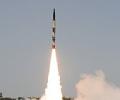
The surface-to-surface missile was test-fired from a mobile launcher at about 0830 hrs from launch pad-4 of the Integrated Test Range (ITR) at Wheeler Island, about 100 km from Balasore in Odisha, defence sources said.
"The scientists have produced results. It is excellent...up to the point," he said.
This will be the second launch of the 3,000-km range missile after an unsuccessful test on July nine last year from the integrated test range at Wheeler Island near Balasore in Orissa, defence officials said.

"I am a son of Assam and if a single person who has not applied for NRC in the state gets citizenship, I will be the first to resign," the chief minister said on the sidelines of a programme at Sivasagar.
The first launch of the missile last year was a failure.
The nuclear-tipped Agni-III has all cities in both Pakistan and China, including Beijing, within its striking range and will be India's second strike deterrent.

Preparations are in the final stages by the Chennai-headquartered space-tech startup Agnikul Cosmos for the maiden launch of India's first-ever private launchpad and the second rocket launch by a private sector player.
Continuing its tirade against the successful launch of Agni V, Chinese state media has again accused New Delhi of buckling under pressure from the North Atlantic Treaty organisation to cut down the missile's range from 9,000 km to 5,000 km.
Range preparation for the maiden test of India's indigenously developed nuclear capable 'Agni-V' ballistic missile with a strike range of over 5,000 km is "near complete" and the trial is likely to be held from Wheeler Island off Odisha coast this Wednesday.
 © 2026 Rediff.com - Advertise with us - Disclaimer - Privacy Policy - Sitemap - Feedback - About us - Terms of use - Grievances