
AAERB's permission for RAPP-7 paves the way for the subsequent phases of reactor commissioning leading to its commercial electricity generation.

'Bharat Small Reactors are essentially similar to the existing 220 MWe Pressurised Heavy Water Reactors. The existing regulations are applicable for BSRs.'
With this, the unit has exited the construction phase and began the operational phase.
'When the cause of the leak is identified, is the AERB going to order a shutdown of all the other pressurised heavy water reactors in the country to fix the underlying problem?'

India's nuclear regulator on Friday said it has granted permission for loading of fuel into the much-delayed Kudankulam atomic power plant.
Union minister Jitendra Singh assured the members of the Rajya Sabha on Thursday that there is better nuclear safety in India as compared to many other countries and there are enough safeguards in the Indian nuclear plants.
The Atomic Energy Commission and its subordinate organisations have the mandate to put in place a comprehensive plan to ensure nuclear safety in the country, but that does not seem to have been done, writes Dr A Gopalakrishnan, former chairman of the Atomic Energy Regulatory Board.
The Atomic Energy Regulatory Board has withdrawn the permission given to Delhi University to use any radioactive source in its labs as it failed to submit its final reply on the radiation exposure incident at Mayapuri scrap yard in Delhi within stipulated period, the Board said.
Fearing presence of more radioactive sources in Delhi scrap yard Mayapuri, National Disaster Management Authority and Atomic Energy Regulatory Board (AERB) plan to carry out a multi-pronged approach survey in the area.

While nuclear engineers cheer KNPP's first full operation, on nine other sites which house atomic reactors, scientists spend sleepless nights.

A radiation scare at Delhi's Indira Gandhi International Airport forced the suspension of cargo operations, but nuclear regulator and Delhi authorities said there was no leak of radioactive substance from a consignment unloaded from a Turkish Airlines plane.
Scientists are puzzled by what caused the mysterious nuclear leak at the Kakrapar Nuclear Power Plant in Gujarat last year, reveals Pallava Bagla.
'The leak is likely to continue for some time before it becomes stable, but this is something that NPCIL, who is the plant operator, will have to do. For this, we have to plan very carefully.'
'Decisions on nuclear power have so far been taken by a small select group, primarily interested in profiteering from their actions, stating 'secrecy' as necessary from the national security point.' 'This argument is false, because we are dealing with the 'civilian' nuclear power sector, which is open even to the IAEA,' says Dr A Gopalakrishnan, former chairman of the Atomic Energy Regulatory Board.
The Supreme Court on Monday sought response from the Centre and Atomic Energy Regulatory Board on implementation of safety guidelines issued by it for the Kudankulam Nuclear Power Plant in Tamil Nadu.
India's nuclear regulator the Atomic Energy Regulator Board is carrying out a thorough review of the first unit of the much-delayed Kudankulam atomic power plant as directed by the Supreme Court last month. "We are reviewing the safety aspects of Unit 1 at Kudankulam as directed by the Supreme Court," an AERB official said
India's nuclear operator has started loading enriched uranium fuel in the first reactor of the Kudankulam Nuclear Power Project after getting the final clearance from the Atomic Energy Regulatory Board (AERB) on Tuesday.
The first unit of the Koodankulam nuclear power project is expected to start generating electricity in the next 40 days, Minister of State in the Prime Minister's Office V Narayanasamy said on Monday. He said the Atomic Energy Regulatory Board officials were at the Koodankulam project site and inspecting the plant.
Minister of State in PMO V Narayanasamy said the 'cold run' of the power plant will begin in the presence of Atomic Energy Regulatory Commission officials within ten days time and the tests will go on for 15 days from then.
The police is yet to trace the origin of Cobalt-60, the radioactive material that caused serious injuries to six persons and are awaiting the recovery of the owner of the scrap shop from where it was found three days ago to get more clarity.
India's first report on safety of civilian nuclear power plants was presented on Thursday at the Convention of Nuclear Safety at Vienna by Atomic Energy Regulatory Board Chairman S K Sharma. India's complete compliance with obligations under all the relevant articles of the convention in a 206-page report was presented by Sharma at the International Atomic Energy Agency, AERB Secretary Om Pal Singh told PTI in Mumbai.

The Kundankulam Nuclear Power Plant attained its full generation capacity and became the first nuclear plant in the country to generate 1,000 MW of power on Saturday, its site director R S Sundar said.
Sustained campaign forces NPCIL to issue statement on Kakrapar fuel leak. But there is still not clarity on what went wrong.
The Kudankulam Nuclear Power Plant will attain criticality by mid-night on Saturday, Atomic Energy Commission Chairman S K Sinha announced in Tirunelveli.
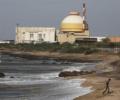
A petition has been filed in the Madras High Court against commissioning of the Kudankulam Nulcear Power Plant on the ground that authorities had not complied with all the directions issued by the Supreme Court while giving the green signal to the controversial project.

Bihar has ranked on top among the BIMARU states registering highest growth rate of 9.3 per cent

Those worried say Kakrapar was lucky to have witnessed leakage of heavy and light water from the coolant channel without any serious damage to fuel bundles in the reactor.

India's nuclear establishment is continuing its march of folly at the expense of safety in the false belief that atomic power is the energy of the future. It's not. Nuclear power is in relentless global decline, says Praful Bidwai.

'I would like to request the AERB, UCIL and DAE to introspect. The world is changing, so is India. The wave of development and modernity will not stop for those who continue to live in the past. The future belongs to the youth who believe in the values of honesty, transparency and efficiency.'
The first two units of the Kudankulam nuclear plant will discharge 6.3 billion litres of waste water every day right onto the beach. This discharge will trigger a slow-motion disaster that will poison beaches, devastate near-shore fisheries and choke the livelihood of fisherfolk in the vicinity, says Nityanand Jayaraman.

During the talks with Prime Minister Narendra Modi, French President Francois Hollande reassured reliable, uninterrupted and continued access to nuclear fuel supply throughout the entire lifetime of the plants while acknowledging India's need for the same.

With the spectre of nuclear terrorism growing, the international community is concerned about the security of India's nuclear facilities. The worry has grown since 2010, when radioactive Cobalt-60 surfaced in a New Delhi scrapyard, killing one person and hospitalising eight others.
 © 2026 Rediff.com - Investor Information - Advertise with us - Disclaimer - Privacy Policy - Sitemap - Feedback - About us - Terms of use - Grievances