
Tata Electronics has surpassed Taiwanese giant Foxconn in assembling iPhones for export from India during the FY22-FY26 PLI scheme period, with exports valued at $26.3 billion compared to Foxconn's $25.6 billion.

The Tata group is close to acquiring Wistron's $600-million factory in southern Karnataka by next month, according to reports. The Wistron unit makes iPhones for the Cupertino-based company. Sources said that Wistron will continue to provide the Tatas technical know-how on assembling the phone and keep back some personnel during the transition process.

'The workers's dance of wilful destruction has the potential to kill all investments planned in India by any foreign entity,' argues Dr Sudhir Bisht.

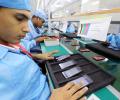
iPhone SE 2020 is one of the popular phones like Apple 11, which is the biggest seller in the domestic market.

The government's target of hitting $52 billion to $58 billion in mobile phone exports in FY26 has been faltering; an Indian corporate group with financial muscle will help.
A week after violence broke out at its Narasapura facility in Karnataka, contract manufacturer Wistron on Saturday said it has fired its vice-president who was heading India operations even as iPhone maker Apple placed the Taiwanese firm on probation. Wistron, which assembles the latest version of the iPhone SE at the violence-hit plant, admitted that there were faults in its wage payment processes. A section of workers at Wistron Corporation's facility in Narasapura Industrial Area in Kolar district near Bengaluru went on rampage last week over non-payment of their wages.
Taiwan-headquartered Wistron Corporation has said that it had suffered a loss worth Rs 437.40 crore in the violence in its facility unleashed by a section of workers over salary issues at its plant in Kolar district in Karnataka.

Wistron, which earlier pegged the losses at Rs 437 crore, later notified the Taiwan stock exchange that the total losses were around Rs 50 crore.

Apple Inc's leading contract manufacturer, Taiwanese giant Wistron, has exceeded its investment obligation in India in just eight months, although the government's production-linked investment (PLI) scheme allowed it to complete the investment in four years. Between August 2020 and end March 2021, Wistron made an investment of Rs 1255 crore - 25 per cent more than the total investment it had committed to the government. Under the PLI scheme for mobile devices, the government had stipulated that each of the five participating global companies needed to invest Rs 250 crore every year for the first four years, totalling Rs 1,000 crore.

Shut since December following violence owing to labour unrest at its Karnataka facility, Wistron, Taiwanese contract manufacturer for Apple Inc, said on Tuesday its operations in Bengaluru will start soon, as the state government asserted it was ready to extend all cooperation. "We are looking forward to restarting our operations and welcoming back team members," David Shen, CEO Wistron Smart Devices, said in a statement. He said since the violent incident at their Narasapura facility in Kolar district in December last year, the company has been working hard on improving across the board to raise standards and fix the issues.

India's smartphone exports have set a new benchmark, surging past the $2 billion mark in October - the highest monthly total ever recorded. This milestone, according to estimates from the Indian Cellular and Electronics Association (ICEA), an industry body representing both global and domestic mobile device manufacturers, underscores the country's growing prominence in global mobile supply chains.

Tata Group is set to become India's first homegrown iPhone maker after Taiwan's Wistron Group agreed to sell a plant in Bengaluru to India's largest conglomerate. Wistron's board approved the sale of Wistron InfoComm Manufacturing (India) Private Ltd to Tata Electronics for $125 million, the Taiwanese electronics manufacturer said in a statement on Friday. The unit operates an iPhone assembly plant near Bengaluru.

The Tamil Nadu government on Tuesday cleared the Rs 13,180 crore project by Yuzhan Technology, part of Taiwan's Foxconn Group, at Kancheepuram. The unit is reportedly expected to assemble smartphone display modules, which will be one of the first such units to cater to Apple's growing presence in the country. The unit is expected to generate at least 14,000 jobs. Of the 14 existing manufacturing units in the Apple supply chain, seven are based in Tamil Nadu.

In FY22-23, Samsung exported $4.09 billion smartphones from India -- an increase of 42 per cent over 2021, when it was $2.8 billion -- accounting for 35 per cent of all smartphone exports.

In a sign of the expanding Apple supplier ecosystem in India, American multinational Jabil Inc will set up an electronics manufacturing facility in Tiruchirappalli, Tamil Nadu with an investment of Rs 2,000 crore. Jabil is one of the 14 Apple suppliers in India, of around 200 globally, while another 14 have reportedly received preliminary clearance to form joint ventures with Indian companies to set up facilities. Interestingly, of the 14 existing manufacturing units in the Apple supply chain, seven are already in Tamil Nadu.

Smartphones have been a key success story of the government's production-linked incentive scheme, helping India become the second-largest mobile phone manufacturing country, after China.
Technology giant Apple Inc has pushed the pedal on exporting iPhones from India by racking up exports valued at over $2 billion in the first two months of the current financial year (FY25), according to the data provided by vendors to the government. This accounts for 81 per cent of the country's total production of iPhones worth $2.6 billion. In May, Apple repeated its performance of April and once again crossed $1 billion of iPhone exports.

'The facility works on Apple's iPhone and everything is damaged -- CNC machines, computers and CCTVs worth crores.'

Tech giant Apple on Monday said it is undertaking a detailed investigation following the violent incident at its supplier Wistron's Narasapura facility in Karnataka last week.

Local residents say until about two months ago, this board carried the name of Motorola, which once had a manufacturing unit in Sriperumbudur, 40-odd km from Chennai in Tamil Nadu. In May 2020, Luxshare Precision Industry Co, a China-headquartered AirPods and iPhone assembler, had entered into a deal with the Tamil Nadu government to take over the defunct Motorola unit.

If reports that Apple Inc plans to triple its iPhone production in India come true, it is likely to help the country become a supply hub for the American company. There are some 190 Apple suppliers globally, but only 12 have manufacturing facilities in India now. Apple's strategy is to focus on India and a clutch of other countries as it diversifies its supply chain out of China.
Apple Inc is expected to produce iPhones worth $12 billion (freight on board value) in India during 2023-24, according to discussions between the company's vendors and the government. This would account for around 12 per cent of Apple's global iPhone production-higher than the earlier plan of shifting around 9 per cent of the total to India by FY24, which is the third year of the PLI (production-linked incentive) scheme.

Apple's three vendors in the country have hit the milestone of creating 30,000 new direct jobs since the production-linked incentive (PLI) scheme for mobile devices kicked off in April 2021. Based on the government's estimate that one direct job in the electronics industry helps to generate three indirect ones, Apple's vendors, Foxconn Hon Hai, Wistron and Pegatron, are close to creating 100,000 direct and indirect jobs. The direct jobs that the vendors have created account for a fourth of Apple's commitment to generate 60 per cent of the new direct jobs out of the 200,000 jobs targeted by the government under the PLI scheme within five years.

Even as top Pegatron executives went to the factory near Chennai on Tuesday to make an assessment of the fire damage to decide on a possible date for resuming operations, sources said the impact of the closure will be minimal for Apple's iPhone production. Late in the evening sources said that the factory might be operational soon-but said they are waiting for a final update. It will also not impact the availability of the newly-launched iPhone 15 and iPhone 15 Plus, they said.

The Tata group is planning to invest $90 billion in new industries such as mobile components plant, semiconductor, electric vehicles, batteries, renewables energy and e-commerce by 2027. The Tata group's investment in India is far higher than the $75-billion investments planned by Mukesh Ambani-owned Reliance Industries and $55-billion investment planned by the Adani group in the next five years in the country, the Economist reported recently. The investment by the Tata group is a shift in its strategy to focus more in the home markets instead of international markets where the group lost money.

The government is likely to extend fiscal incentives for production of toys, bicycles and leather and footwear in the forthcoming budget as it looks to expand production linked incentive (PLI) scheme to cover more high-employment potential sectors, sources said. The government has already rolled out the scheme with an outlay of about Rs 2 lakh crore for as many as 14 sectors, including automobiles and auto components, white goods, pharma, textiles, food products, high efficiency solar PV modules, advance chemistry cell and speciality steel. The scheme aims to make domestic manufacturing globally competitive and create global champions in manufacturing, and it is yielding solid results, sources said.

It started out as a Production Linked Incentive (PLI) scheme to make India an export hub. But after many a twist and turns, the latest 2.0 PLI for IT hardware, for which the 40 eligible candidates have applied till its deadline, is now focused on 'import substitution'. The scheme will help in reducing India's over-dependence on imports (80 per cent of laptops are imported), especially from China which include laptops, tablets and servers.

Apple Inc is commencing assembly of its iPhone 12 model in the country, a move that is expected to help the US tech giant further consolidate its position in the burgeoning smartphone market in India. Apple has partnered with third-party manufacturers like Foxconn and Wistron to make some of its phones in India. These include iPhone SE, iPhone 10R and iPhone 11.

Till recently, iPhone production in India was limited to older models at a lower price tag. So far, Apple has localised production of five smartphone models - iPhone SE (1st Gen), 6S, 7, XR and 11.

In the run-up to Apple CEO Tim Cook's visit to India, government officials are finalising the talk points with the Cupertino-headquartered tech major. Officials said that the government would like Apple to "deepen" the company's engagement in the manufacturing and assembly of iPhones in the country and not limit itself only to the minimum commitments made under the production-linked incentive (PLI) scheme for mobile devices. The conversations between the two sides are likely to focus on that.

The company is planning to invest Rs 1,100 crore in the new mobile phone manufacturing facility.

At a time when Apple delivered its flagship line of new products on schedule despite battling a year of supply-chain turmoil, India could account for at least 12 per cent of the free-on-board (FoB) value of Apple Inc's iPhones manufactured by its vendors globally by 2025-26 (FY26). The number represents a significant shift for the Cupertino-based company's over-dependence on China, where 95 per cent of its phones are still being made. India's growing importance can be seen from the fact that in 2021-22 (FY22) - the first year of the production-linked incentive (PLI) scheme (the scheme was extended by a year due to the pandemic) - the FoB value of iPhones made in the country was $1.75 billion, translating into less than 2 per cent of the global value.

While 100 per cent FDI is allowed in single-brand retail, if the foreign investment exceeds 51 per cent, the 30 per cent mandatory local sourcing norm kicks in.

"Lady candidates need not apply." So read the postscript in a job notice from Telco (now Tata Motors) on a notice board in the corridors of the Indian Institute of Science, Bangalore (now Bengaluru), in 1974. Irked, Sudha Murty, who was then pursuing her masters in computer science at the institute, wrote a postcard to JRD Tata, expressing her surprise at this gender discrimination, especially since the Tata Group were pioneers on many fronts. Shortly, Murty became the first woman on the firm's shop floor.

Allowing 12-hour shifts for all and night-time work for women was meant to benefit software firms, but is said to have clinched Foxconn's Rs 80 billion investment.

The US-based company, in collaboration with partners like Wistron and Foxconn, had recently started assembling iPhone 11 in India.

Apple is hoping to assemble in India 25 per cent of all iPhones produced globally to reduce its heavy dependence on China.
India's stiff labour laws were one key issue that Apple CEO Tim Cook discussed with Prime Minister Modi on his recent visit.

Seven months after it was launched in India, Apple is expected to start manufacturing the iPhone 13 at the Foxconn plant in Sriperumbudur near Chennai from April, according to sources. The phones will be for both the domestic and export market. The production of the iPhone 13 in the Chennai plant was meant to start from January but had to be postponed after Apple suspended production following protests in December by women workers about food poisoning. An Apple spokesperson did not respond to an e-mail query.

The new mantra was to align Apple's ambition with the government's, focusing on Modi's favourite themes of Make in India, employment generation and India as a high-tech export hub.
