
There is little to suggest inflation levels will come down since you hardly see the same levels of seasonality in prices that were there earlier.

RBI has cut policy rate thrice during 2015.

Last week, the Consumer Price Index-based inflation for the month had contracted to 4.4 per cent.

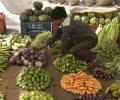
Vegetable prices which had witnessed a 21.16 per cent contraction in June, shot up by 21.95 per cent in July.

The rupee has depreciated 2.35 per cent in the past three months and one per cent in the past month, despite strong capital flows and falling oil prices.
Chief economic adviser to the finance ministry Arvind Virmani on Wednesday said the retail price-based inflation, which is ruling above the wholesale price index, will come down with a lag but would not fall as much as the rate of rise in wholesale prices is falling.
The increase by more than three per cent is largely due to jump in the rate of inflation in the case of WPI for fuel, power, light and lubricants

Prime Minister's Economic Advisory Council (PMEAC) Chairman C Rangarajan may have found the Reserve Bank of India (RBI)'s inflation projections on the higher side, but independent experts agree with the central bank and expect both wholesale and retail prices to remain high.

Overall slowdown in the economy and growing volumes of unbranded generic medicines in the domestic market are behind poor sales.
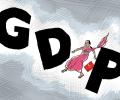
Though the ministry is considering 2017-18 as the new base year, no decision has been taken as the committees of experts are awaiting some more data before finalising their opinion.

D&N cites positive changes in momentum in certain segments of economy, but says some areas of concern remain

Stock markets will remain closed on Tuesday

The Central bank primarily factors Consumer Price Index while deciding on policy rate.

Top losers in the Sensex pack include Bharti Airtel, Infosys, Asian Paints, RIL, Coal India, HDFC Bank, HDFC, TCS, ONGC and M&M, falling up to 3.09 per cent.
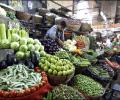
In February last year, it was (-)2.17 per cent.

Reiterating his earlier stance, BJP's Rajya Sabha member Subramanian Swamy has written a letter to Prime Minister Narendra Modi, asking him to sack RBI Governor Raghuram Rajan.

Changes the base year and included more sectors.
The 30-share Sensex ended up 257 points or 1.2% at 21,289 and the 50-share Nifty ended up 79 points or 1.3% at 6,321.

Sensex may remain under pressure this week due to weak global factors.

RBI watchers are going to be on tenterhooks for the next 3 weeks.

India's wholesale prices declined at a faster-than-expected annual rate of 2.33 per cent in March.
Inflation based on the wholesale price index rose marginally to 4.55 per cent for the week ended December 3 from 4.54 per cent in the previous week due to the increase in prices of food items.
Spiraling prices of vegetables, non-food items and manufactured products pushed up inflation to 4.75 per cent for week ended October 29 from 4.49 per cent in the previous week.

Former finance minister P Chidambaram on Friday rejected Finance Minister Arun Jaitley's contention in Lok Sabha that UPA government left behind double digit inflation.
'We will likely be buffeted by tailwinds from the global economy, geopolitical shifts and robust domestic demand.'

India's gross domestic product growth, which had fallen under 5 per cent, is expected to be between 5.4 per cent and 5.9 per cent this fiscal.
RBI Governor Raghuram Rajan on Friday said repo rate has been hiked as inflation pressures remain high.
The CPI and WPI data for December 2013 holds the key for the third-quarter monetary policy review to be announced later this month.
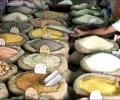
Inflation moderates, but a rate cut is unlikely.
But lower growth numbers in the quarters to come may not mean renewed weakness in the economy at the ground level, says Pranjul Bhandari.
Richard Illey, chief economist, (Asia, ex-Japan) at BNP Paribas, talks to Business Standard on inflation and related issues ahead of the Reserve Bank's annual review of monetary policy.

Street expects RBI to keep CRR unchanged, opt for open-market operations to ease liquidity

India's economic growth rate is expected to be at least 6 per cent in the 2013-14 fiscal, Prime Minister's Economic Advisory Council (PMEAC) Chairman C Rangarajan said.
The chief statistician feels there should be a rebound after companies integrate and adopt the GST system

Food articles inflation at 8.43% compared to 8.14% m-o-m.

Costlier food items, including vegetables, pushed the October wholesale inflation to 7 per cent, the highest in the current financial year.
However, prices of most agricultural items, barring potatoes, onions and wheat, continued to rise.
As per official data released on Wednesday, WPI inflation in the food articles category rose to double digits at 11.91 per cent, driven mainly by price rise in onion, cereals and rice.
However, risks to the outlook stems from possible sub-normal monsoon and higher crude oil prices (on account of the crisis in Iraq)," the Economic Survey 2013-14 tabled in Parliament by Finance Minister Arun Jaitley said.
Inflation targeting framework is now enshrined as a formal agreement by the government and the RBI; thus, it may seem that we are flogging a dead horse, says Soumya Kanti Ghosh.
