
The two sides held diplomatic talks through video conference on the border standoff in midst of fresh details emerging that China has strengthened its position in several areas in eastern Ladakh including Galwan Valley where a violent clash on June 15 left 20 Indian soldiers dead.

India on Thursday once again called for completion of the disengagement process at the remaining friction points in eastern Ladakh to pave the way for both the Indian and Chinese troops to consider de-escalation and ensure full restoration of peace and tranquillity in border areas.
The top military brass reviewed the situation in eastern Ladakh and deliberated on key issues to be flagged at the talks on Monday, the sources said. Army Chief General M M Naravane and several top military officials were present in the meeting.
The two countries reviewed the situation in the region during a fresh round of online diplomatic talks under the framework of the Working Mechanism for Consultation and Coordination (WMCC) on border affairs.
Two days after the India-China military talks, the joint statement, issued in New Delhi by the Indian Army said both sides had a 'candid and in-depth exchange' relating to disengagement along the Line of Actual Control (LAC) in the Western Sector of India-China border areas.

The talks between India and China on the border row in eastern Ladakh have helped 'build trust' and the situation in the region has been normal since the disengagement in the Pangong Tso areas in February, Chief of Army Staff General M M Naravane said on Thursday, exuding confidence of resolution of the 'remaining issues'.
As the border standoff entered the sixth month, an early resolution to the row appeared dim with close to 100,000 Indian and Chinese troops remaining deployed in the high-altitude region and showing readiness for a long-haul. There is no official word on the talks yet but sources said the agenda was to finalise a roadmap for disengagement of troops from all the friction points.

The Wednesday talks took place amid a war of words between the two sides on perception of the LAC, the de-facto Sino-India border spanning a length of nearly 3,500 km.
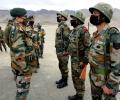
India and China have agreed to soon hold the 10th round of Corps Commander-level talks to take forward the de-escalation process in eastern Ladakh, the Ministry of External Affairs (MEA) said on Thursday.
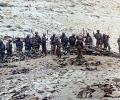
India on Thursday blamed China's actions of amassing a large number of troops close to the border and attempts to unilaterally alter the status quo along the Line of Actual Control (LAC) last year for the continuing military standoff in eastern Ladakh, and asserted that these acts were in violation of Sino-India bilateral agreements.
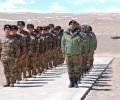
The two sides agreed that the next round of military dialogue should be held at an early date.

After a gap of over two-and-half months, India and China on Sunday held the ninth round of military talks specifically focusing on ways to move forward on the long-negotiated disengagement process in eastern Ladakh as thousands of their troops remained deployed at friction points under freezing conditions.

The names of 20 Indian Army personnel, who were killed while valiantly fighting Chinese troops in Galwan Valley in eastern Ladakh in June last year, were inscribed on the National War Memorial ahead of the Republic Day, official sources said.
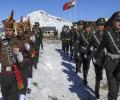
'They also agreed that for the overall development of bilateral relations it was essential to maintain enduring peace and tranquillity in the border areas,' the MEA said in a statement.
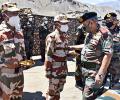
India and China should be able to achieve status quo in eastern Ladakh in a gradual manner as both sides understand that it is in the best interest of ensuring peace and tranquillity in the region, Chief of Defence Staff General Bipin Rawat said.
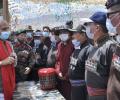
The dedication of Indian soldiers and veterans towards the country is an 'exemplary example', Defence Minister Rajnath Singh said on Sunday soon after arriving in Ladakh on a three-day visit aimed at taking stock of India's military preparedness in the region in the face of a prolonged border row with China.

The frontline troops of China and India have "completed" disengagement at most locations of their border, a senior Chinese official said on Tuesday, adding the situation on the ground is easing.

India and China on Friday held 'in-depth' discussions on addressing the remaining issues along the Line of Actual Control (LAC) in eastern Ladakh, holding that disengagement in the North and South banks of Pangong lake provided a good basis to work towards their early resolution.
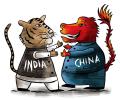
India and China achieved a major milestone this year when their bilateral trade crossed the landmark figure of $100 billion but it did not generate any fanfare in both capitals as the two Asian giants are going through a "particularly bad patch" in their relations due to a set of actions by Beijing in violation of agreements that led to the military standoff in eastern Ladakh. Starting with a modest $1.83 billion in 2001, the bilateral trade crossed $100 billion-mark in the first 11 months this year, a significant milestone for which the two countries carried out campaigns to boost trade and build it as a major stakeholder to improve the relations between two nations, whose ties otherwise remained frosty over the festering boundary dispute and strategic rivalry. According to last month's data from China's General Administration of Customs (GAC), the India-China bilateral trade totalled $114.263 billion, up 46.4 per cent year-on-year from January to November 2021.
China's national legislature -- the National People's Congress (NPC) -- on October 23 adopted the new law on the protection and exploitation of the land border areas which drew sharp reaction from India as it was passed amid the protracted military standoff between the two sides in eastern Ladakh region.
The Indian delegation at Thursday's talks is likely to be led by Naveen Srivastava, Joint Secretary (East Asia) in the external affairs ministry, they said.
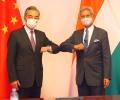
Jaishankar said full restoration and maintenance of peace and tranquillity in border areas was essential for the development of the bilateral ties.
Another round of diplomatic talks under the framework of the Working Mechanism for Consultation and Coordination is expected to be scheduled soon.

The Chinese military has already completed moving back its troops from the face-off sites in Galwan Valley, Gogra and Hot Springs in line with the first phase of the disengagement process from the friction points on the LAC in eastern Ladakh, sources said. The main focus now shifts to Pangong Tso. India has been insisting that China must withdraw its forces from areas between Finger Four and Eight.
India has told China not to "shift goalposts" and "confuse" managing the border affairs and restoring peace at the frontiers with the larger issue of the resolution of the boundary question, which is dealt with by different designated mechanisms.

It is learnt that the Indian delegation insisted on a time-bound implementation of the agreement finalised during the extensive talks between External Affairs Minister S Jaishankar and his Chinese counterpart Wang Yi in Moscow on September 10 on the sidelines of a Shanghai Cooperation Organisation(SCO) meet.

The agenda of the talks will be to firm up a roadmap for disengagement of troops from all the friction points in eastern Ladakh, the sources said.

At an online media briefing, External Affairs Ministry Spokesperson Anurag Srivastava gave a run down of the events along the LAC in the eastern Ladakh region and held China responsible for the Galwan Valley clashes off June 15.
The decisions were mentioned in a joint statement issued by the two armies late Tuesday, a day after the sixth round of Sino-India Corps commander-level talks that lasted for 14-hours.

China's highest ranking defence officer will visit India next month, the first such visit in a decade as the Chinese military seeks to expand relations with its Indian counterpart.

From the standoff with China to the government's response to the farmers' protest, Defence Minister Rajnath Singh holds a freewheeling talk.
