
India was the flavour of the year, at least in the FMCG sector, as multinationals hiked stakes in their subsidiaries lured by long term potential of the country, while homegrown executives made their way to top hierarchy of global firms in 2013.

Bilderberg, which has been called the high priests of glabalization, is accused of running a shadowy global government.

In five years, royalty payments have grown 31.1% yearly, much faster than rise in revenue and profit.

While green shoots are beginning to emerge, with June sales rebounding to pre-Covid levels thanks to a rural revival, most FMCG chief executives have voiced concerns about localised lockdowns that began in July and have extended into August in some states.

The problem is with the broking model and what brokers are allowed to do, notes Debashis Basu.

Ajit Mishra, vice president, Research, Religare Broking, answers your queries

FMCG CEOs indicate that the market should stabilise post the general elections and that some growth should make its way back especially in rural areas

From its all-time peak of 38,989.65 scaled on August 29 this year, the Sensex has fallen by 2,921.32 points, or 7.5 per cent, to 36,068.33.

Automobile company Tata Motors, metals and mining major Vedanta, oil marketing firm Bharat Petroleum Corporation (BPCL), private sector IndusInd Bank, and two-wheeler major Bajaj Auto have witnessed their market cap slip below the Rs 1-trillion mark this year.

The highest salary rose by 14.22 per cent from last year.

Markets ended lower for the fifth consecutive session and were down 2.4% for the week.

"From time to time, we do India-specific innovations through products and benefits. Our studies showed that Indian women want a blemish-free skin," says Richa Singh, marketing manager, Garnier India.

Firm regains volume growth via focus on market share, market development, margins and consumers' mood

Market experts say that of the total 600,000 villages in India, under two per cent or around 10,000 villages contribute to about half of the rural consumption in the country. Targeting these villages and ensuring that penetration is strong is key for most consumer goods companies.

At the BSE, 1,791 stocks declined, while 948 advanced, 110 stocks remained unchanged.
The government is in the process of finalising guidelines which have been drafted to deter the advertising industry from making unsubstantiated and misleading claims about their products.The guidelines are based on the recommendations of the committee set up by the Food Safety and Standards Authority of India to investigate claims made by Hindustan Unilever Ltd about 'Kissan Amaze'.

Company may look at 5-6 launches a year as the market for premium and niche products grows
.jpg)
Samsung which leads the global list takes the 10th spot in India.

Cigarettes to hotel major ITC entered the consumer products business in 2007. In three years, it has managed to corner a two per cent market share.

Infosys was the top Sensex loser along with other index heavyweights ITC and HDFC.

But, Madras HC not happy with P&G disclaimer for Tide Naturals' ad.

Investors indulged in profit booking at attractive and higher valuations

Investment in market leaders with a safety-first approach could yield reasonable returns across sectors.

There was broad-based rally with participation across sectors creating enormous wealth for investors but starting 2018, the rally got concentrated into select large-cap companies with under performance in broader markets.

Group of ministers to review progress every fortnight.

Hindustan Unilever Chairman Harish Manwani, MD & CEO Nitin Paranjpe and CFO R Sridhar speaks to Business Standard after the announcement of the financial results of the company in Mumbai on Tuesday.

The Sensex ended at at 27,676, lower by 210 points and the Nifty broke the psychological level of 8,400 to end at 83877 down 70 points.
Manwani said HUL was using technology across the value chain from manufacturing to distribution, marketing and advertising in its endeavour to be future-ready.

Names such as Danone, Dabur, Mondelez and Abbott Healthcare have also figured on the list of suitors.

Move could be aimed at integrating operations with Indian subsidiary.

Forty-four per cent management students graduating in 2010 have voted the FMCG sector as the most preferred industry to work in, terming giants like Hindustan Unilever Ltd and Proctor & Gamble as "dream companies", a survey said.

The telecom majors should focus on improving service quality with a strong partner, and not on one-shot stake sales.
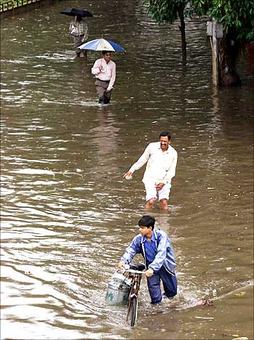
Two days ahead of the high tide warning, corporate houses here are busy drawing plans to meet any possible recurrence of the 26/7, 2005 deluge in the metropolis.

Top global brands such as Goldman Sachs, Deutsche Bank, Microsoft, Facebook and Texas Instruments visited the campus.

Companies like Dabur India, Colgate-Palmolive and Jyothy Labs, however, spent less than profits on these counts.

More than a hundred years ago, Hindustan Unilever launched a soap called Lifebuoy in India.
Even as large fast moving consumer goods companies like Hindustan Unilever and ITC struggle with their volume growth, mid-tier FMCG companies like Godrej Consumer Products, Marico, Dabur and Nestle have reported strong spurts in volumes as they focus on inorganic growth and rural markets, according to industry experts.

Globally, companies like Coca Cola, P&G and Unilever have adopted the performance-based model. In India, the trend is gradually catching on. A Coca Cola India spokesperson said the company is in the process of moving from an input-cost based compensation system for its agency partners towards a value-based one. This model is about paying agencies for results, not activity. HUL refused to comment, citing policy constraints on speaking about remuneration.
Hindustan Unilever, GlaxoSmithkline Consumer Healthcare, Godrej Consumer Products, Dabur, Nestle and other FMCG companies are lining up initiatives to maximise returns from modern trade channels including hypermarkets and supermarkets.

Sofia Ashraf, along with a guitarist and three other women, stormed Sasikala's residence and sang the song, protesting her elevation.
