
At a time when fuel prices across the country are going through the roof with no sign of it moderating, electric vehicles seem the likely choice for car buyers who are looking at saving fuel costs. And add to it the negligible maintenance of electric vehicles. Continuing with this revolution with their 2nd offering in the EV segment, Tata Motors now offers the 2021 Tigor EV to its customers. Tigor petrol with its style-back design has always been a stunner since its launch and it still is.

Tata Motors on Wednesday unveiled Tigor EV, its second electric model in the personal mobility space after Nexon EV. The auto major has tasted success with Nexon EV, which currently commands about 70 per cent market share in the domestic electric vehicle segment. The Tigor EV comes powered by the company's high voltage electric architecture - Ziptron - and has been developed based on three pillars of technology, comfort and safety.

Tata Motors on Tuesday launched its second electric vehicle -- Tigor EV, catering to the personal segment in the domestic market, priced between Rs 11.99 lakh and Rs 13.14 lakh (ex-showroom). The model comes in three variants, priced at Rs 11.99 lakh, Rs 12.49 lakh and Rs 12.99 lakh. A dual tone top-end trim is tagged at Rs 13.14 lakh. The auto major has already achieved success with its first electric model, Nexon EV and now commences deliveries of Tigor EV from around 150 sales outlets in 70 cities across the country.

Shailesh Chandra, MD and CEO of Tata Motors Passenger Vehicles (TMPV), stated that the uncertainty surrounding how long commodity costs will remain elevated is a greater concern for the company than the actual price increases. He noted that commodity prices have risen significantly over the past five to six months, impacting margins and necessitating faster cost-reduction efforts, though no major production or supply-side issues are currently foreseen.

Tata Motors on Wednesday launched its Tiago EV with introductory prices for first 10,000 customers ranging between Rs 8.49-11.79 lakh
Tata Motors plans to set up separate sales network for its electric passenger vehicles in current fiscal year as it looks to give differentiated experience to the buyers opting for the environment-friendly models, according to a top company official. The Mumbai-based auto major, which on Thursday introduced all-new versions of its Nexon EV and Nexon (internal combustion engine), said it will start experimenting with new outlets in some of the cities where EV volumes have gone up. "We'll have to separate them (sales outlets for EVs and ICE) given that we have different requirements of customers and also a growing portfolio (of EVs)" Tata Motors Passenger Vehicles managing director Shailesh Chandra told PTI in an interaction.
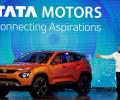
Homegrown auto major Tata Motors on Tuesday said it will raise $1 billion (Rs 7,500 crore) in its passenger electric vehicle business from TPG Rise Climate at a valuation of up to $9.1 billion. Tata Motors Ltd (TML) and TPG Rise Climate, the dedicated climate investing strategy of private investment firm TPG, have entered into a binding agreement in this regard. Under the agreement, TPG Rise Climate along with its co-investor ADQ, will invest in a subsidiary of Tata Motors that will be newly incorporated, the company said in a statement.

Tata Motors is looking to ramp up the production of electric vehicles as demand continues to outpace the manufacturing activity by a huge margin, according to a top company official. The Mumbai-based automaker, which led the passenger electric vehicle space in the domestic market in last fiscal year, has been receiving an average of 5,500-6,000 bookings in the past two months for its EV range. The company sells three electric products -- Nexon EV, Tigor EV and XPRES-T -- in the domestic market.

Tata Motors on Wednesday expanded its electric vehicle range in the country with the launch of Nexon EV MAX, priced between Rs 17.74-19.24 lakh (ex-showroom). Equipped with a 40.5 kWh lithium-ion battery pack, the Nexon EV Max offers 33 per cent higher battery capacity than the Nexon EV, delivering ARAI certified range of 437 km (under standard testing conditions), ensuring uninterrupted inter-city travel. ARAI refers to Automotive Research Association of India. The model produces 105 kW (143 PS) of power and delivers a torque of 250 Nm, resulting in 0 to 100 sprint times in under 9 seconds.

Why is Shailesh Chandra, managing director of Tata Motors Passenger Vehicles and Tata Passenger Electric Mobility, not worried about the competition?
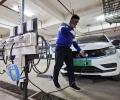
The government on Friday approved an electric-vehicle policy, under which duty concessions will be given to companies setting up manufacturing units in the country with a minimum investment of $500 million, a move aimed at attracting major global players like US-based Tesla. According to an official statement, the companies setting up manufacturing facilities for e-vehicles will be allowed to import a limited number of cars at lower customs duty. The policy seeks to promote India as a manufacturing destination for EVs and attract investment from reputed global EV manufacturers, it added.

Delhi-based electric vehicle (EV) ride-hailing firm Evera Cabs, which grabbed headlines after acquiring 500 cars from the now-defunct cab service BluSmart, is stepping up its presence in the EV cab segment. The company is aiming for revenue of Rs 100 crore in the ongoing financial year (2025-26), up from Rs 18 crore in 2024-25.
Tata Motors group's investment for this fiscal is pegged at Rs 28,900 crore, mostly for its British arm Jaguar Land Rover (JLR), company chairman N Chandrasekaran said on Friday. The company will also look to raise capital separately for its electric vehicles (EV) business at an appropriate time. It is looking to have 25 per cent of its sales coming from EVs in the medium to long term, up from 2 per cent at present, he said while addressing the company's virtual AGM.

Tata Motors on Wednesday said it remains confident about the long-term prospects of the electric vehicle segment and termed the fall in sales numbers a "short-term" issue. In an interaction with PTI at the launch of the company's first mid-sized electric SUV, Curvv.ev, at a starting price of Rs 17.49 lakh (with 45 kWh battery) Shailesh Chandra, managing director of Tata Motors Passenger Vehicle and Tata Passenger Electric, said that the company is looking to achieve one-lakh electric vehicle sales this financial year. Curvv EV is the second car based on the advanced Pure EV architecture - acti.ev, which marks Tata Motors' entry into the highly competitive mid-size SUV segment and will be competing with the likes of MG ZS EV, Hyundai Creta and Maruti Suzuki Grand Vitara, among others.

With the theme 'Smart Mobility, Smart Cities', the company's display at the Auto Expo is focusing on intelligently-connected cities designed to offer convenience, safety, security, and efficiency to its customers.

From the customer point of view too, LFP batteries are safer and offer a longer life.
Tata Motors plans to have 10 new battery electric vehicles (BEVs) in its domestic product portfolio by 2025 as it looks to drive its business model towards sustainable mobility going ahead, as per Tata Motors chairman N Chandrasekaran. In his message to the shareholders, he noted that the auto major aims to be amongst the world leaders in sustainable mobility solutions and as part of that it is also exploring tie-ups in cell and battery manufacturing to secure supplies for its portfolio of green vehicles. "In India, EV penetration in our portfolio has now doubled to 2 per cent this year and we expect penetration to increase exponentially in the coming years. "Tata Motors will lead this change in the Indian market. By 2025, Tata Motors will have 10 new BEV vehicles and as a Group, we will invest proactively to set up charging infrastructure across the country," Chandrasekaran informed shareholders in the company's Annual Report for 2020-21.

India will not tailor its policies to suit US EV maker Tesla, and its laws and tariff rules will be formulated to attract all-electric vehicle manufacturers from across the world to set up a base in the world's fastest-growing economy, Commerce and Industry Minister Piyush Goyal said. Tesla has been seeking an initial tariff concession that would allow it to offset 70 per cent customs duty for cars priced less than $40,000, and 100 per cent for cars of higher value.

India's electric mobility goal, which has so far been riding on two wheels, is all set to graduate to four wheels. At least, the journey has begun. Hyundai Motor India said it would invest Rs 4,000 crore till 2028 to launch half-a-dozen electric vehicles (EVs) in India. It would eventually straddle premium and mass segments. The first of these - the electrified version of an internal combustion engine (ICE)-powered model - will go on sale as early as next year.

'We are seeing one of the highest discounts in recent years across companies.' 'October is a crucial month with several festivals coming up.'
The business will also see a change of guard. Shailesh Chandra, president of EV and corporate strategy, will replace Mayank Pareek as president of PV business, including EV, with effect from April 1. Pareek will be superannuating from the company after a six-year stint at the end of February 2021. Chandra and Pareek will work on transition over the next few weeks.

'Primary buyers are commercial taxi and fleet operators and small businessmen.' 'CNG prices have been remarkably stable unlike petrol.'

'SUV is a very intensely fought category, unlike hatchbacks and cars.'

Please send your queries to getahead@rediff.co.in with the subject line 'Cars' and experts from CarJasoos.com will answer your queries related to buying new or used cars.

The company, which rents cars by the hour, day, week and month, has Mahindra E2O Plus and Tata E Tigor available on the platform for which it charges a subscription fee of Rs 15,000-20,000 per month.

Among the cars unveiled at the Auto Expo on Wednesday was Mahindra and Mahindra's e-KUV for Rs 8.2 lakhs ex-showroom Delhi. With a single charge range of 150 km and a 55 min fast charging upto 80 pc, it was both a head-turner and a conversation-starter.

Gujarat, Telangana to roll out policies to encourage manufacturing
