
The India-US ties witnessed a major downturn after President Trump slapped a whopping 50 per cent tariff on Indian goods, including a 25 per cent punitive levy over Russian oil purchases.

US President Donald Trump on Thursday claimed that India has offered to drop all tariffs on American goods. Speaking at a business roundtable in Doha, Trump also said he had a "little problem" with Tim Cook, and he told the Apple CEO that he does not want him to build iPhones in India.
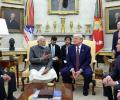
'No retaliatory tariffs now. You can retaliate after a few months.' 'Today, there is no need to retaliate because it is a question of long term benefits.'
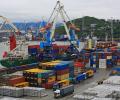
The country's exports rose marginally by 0.61 per cent to $36.56 billion in January, while trade deficit widened to a three-month high of $34.68 billion, government data showed on Monday.

'The statistical confidence bands of the fan charts of the forecasts will provide a better sense of the potential variability of outcomes.'

The Indian government has imposed import restrictions on all forms of gold, silver, and platinum articles to prevent misuse of free trade agreements (FTAs). The restrictions apply immediately, regardless of prior contracts or commitments.

The deal shifts the US posture towards India from hostile to neutral, and that matters for growth, points out T T Ram Mohan.

'There is a lot of euphoria in the country after a trade agreement is signed. But it is an illusion for us. What is more important is making it real.'

India has completely protected the interests of its agriculture and dairy sector in the India-US trade agreement.
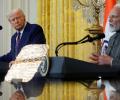
India and the US have entered a new phase in their relationship, marked by greater parity, point out Harsh V Pant and Vivek Mishra.
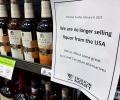
'We have to be prepared for the larger disruption that is likely to take place.'

The United States did not accept India's request for consultations under an agreement of the World Trade Organisation (WTO) concerning American tariffs on steel, aluminium, and related derivative products, Parliament was informed on Tuesday.
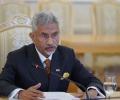
The relations between New Delhi and Washington are on a downturn after Trump doubled tariffs on Indian goods to a whopping 50 per cent, including 25 per cent additional duties for India's purchase of Russian crude oil.

'At the first sign of real trouble, that money will move. There will be a run.'

Indian drugmakers supply 47 per cent of the generic medicine requirements in the US, and tariffs would have increased prices in the US domestic market for patients, who are already dealing with drug shortages.

Stock market benchmark indices Sensex and Nifty ended 2.5 per cent higher on Tuesday after India and the US agreed to a trade deal under which Washington will bring down the reciprocal tariff on Indian goods to 18 per cent.

Textiles, pharmaceuticals, chemicals, engineering goods, gems and jewellery exports will receive a boost from the free trade agreement between India and the 27-nation European Union, according to exporters.
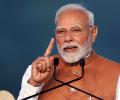
Prime Minister Narendra Modi on Friday said India will never compromise the interests of its farmers, fishermen and dairy farmers, asserting that he would be ready to pay any price.
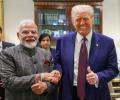
Trump announced that India and the US agreed to a trade deal under which Washington will charge a reduced reciprocal tariff on Delhi, lowering it from 25 per cent to 18 per cent.

Israeli Prime Minister Benjamin Netanyahu says the foundation of India-US relationship is "very solid" and both sides should find common ground to resolve the tariff issue. He also highlighted the strong defense cooperation between India and Israel.

Former Central Command chief David H Petraeus suggests the US and Iran are likely to extend their ceasefire beyond the initial two-week period, citing willingness from both sides to continue negotiations.

India's pharmaceutical exports have shown robust growth, reaching over USD 28 billion, despite global economic challenges. The sector is projected to reach USD 130 billion by 2030.

'Based on the joint statement, a formal agreement will be drafted, which may take a month or month-and-a-half to finalise. We aim to sign the formal agreement by mid-March.'

Uncertainties stemming from the West Asia crisis and its potential impact on inflation and economic growth were key factors in the Reserve Bank of India's Monetary Policy Committee (MPC) decision to maintain the status quo on interest rates, according to the recently released MPC meeting minutes.

India has clarified its position on the proposed interim trade agreement with the US, stating that the joint statement remains the basis for mutual understanding. Amendments to a White House fact sheet reflect shared understandings, with both sides working towards finalizing the agreement.
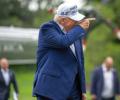
Trump has repeatedly claimed that he "helped settle" the tensions between India and Pakistan and that he told the nuclear-armed South Asian neighbours that America would do a "lot of trade" with them if they stopped the conflict.

The India-US trade deal has offered a much-needed breather for the Indian information technology (IT) industry, which has been grappling with global macroeconomic uncertainty and subdued client spending over the past few years.
Essential and strategic items such as pharmaceuticals, semiconductors, copper, and energy products like oil, gas, coal and LNG are exempted from the 27 per cent import duty announced by the US on Wednesday, according to think tank GTRI.
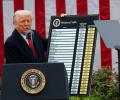
Amid the tumbling stock market in the United States, following the White House clarification of tariffs on China to be at least 145 per cent and an earlier announcement of a 90-day pause on tariffs for over 75 countries, President Donald Trump addressed the challenges associated with his tariff policy, stating that there would be 'transition problems'.
'What the US appears to be doing is to force India to be "the buyer of last resort", on whom their products can be dumped, 1.4 billion people have to eat something, so why not eat American corn?' 'What is exercising the Trump lot is the fact that most of the farms are in solidly Republican Midwestern states: Illinois, Indiana, Kansas, Michigan, Minnesota, Missouri, Nebraska, North Dakota, Ohio, South Dakota, Wisconsin,' points out Rajeev Srinivasan.

Wipro reported Q4FY26 IT services revenue of $2.6 billion, a modest 0.2 per cent Q-o-Q constant currency growth, with adjusted operating profit margin beating estimates at 17.2 per cent. The company announced a significant share buyback of ~15,000 crore, but faces near-term growth challenges, particularly in the BFSI segment, and has issued a soft Q1FY27 revenue guidance.

IT major HCLTech reported a 4.20 per cent year-on-year rise in consolidated net profit to Rs 4,488 crore for the January-March quarter of FY26, but projected a modest 1-4 per cent revenue growth for FY27, citing market volatility and reduced discretionary spending.

The proposed trade deal with the 27-nation European Union (EU) is expected to provide zero-duty access to the $95 billion European market for Indian textile and apparel manufacturers. Currently, India's share of the European market is just 6 per cent, or $5.5 billion.

Equity benchmark indices Sensex and Nifty experienced a significant decline, primarily driven by a selloff in IT stocks due to concerns about AI disruption and renewed worries over global trade.

Indian insurance companies are bracing for reduced profitability in Q4FY26, primarily due to the rationalisation of GST on retail life and health policies, leading to a loss of input tax credit, coupled with volatility in equity markets impacting investment income.

The government has suspended its directive requiring airlines to offer at least 60% of seats on flights without additional charges, following industry concerns about the impact on fares and pricing structures.

India will take all necessary steps to safeguard and promote national interest, Commerce and Industry Minister Piyush Goyal said on Thursday, a day after US President Donald Trump announced 25 per cent tariffs plus penalty on domestic exports to America from August 1.

Lavrov's comments came two days after Russia accused the US of attempting to prevent India and other countries from buying Russian oil, saying Washington was using a wide range of 'coercive' measures, including tariffs, sanctions and direct prohibitions.
"I am telling you, these countries are calling us up, kissing my a***," Trump said during a speech at the National Republican Congressional Committee dinner on Tuesday.

Goods from sectors, including agriculture, precious stones, chemicals, pharma, medical devices, electricals, and machinery may get impacted if the US will go ahead with imposing reciprocal tariffs on Indian products, according to experts. They said that these sectors could face additional customs duties from the Trump administration because of the high tariff differential or gap, which is the difference between the import duties imposed by the US and India on a product.
