
After delivering the judgment awarding death sentence to Ajmal Kasab, the lone terrorist arrested during the terror siege on Mumbai, Judge Madan Lalakshman Tahaliyani officially recorded his appreciation for Rakesh Maria, former head of the crime branch who investigated the case, and his assistant Deven Bharti. The judge didn't also forget to mention the media's positive role
The nation is happy that the most dreaded terrorist caught alive in India was finally sent to the gallows.
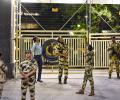
Tahawwur Hussain Rana, a Pakistani-born Canadian national accused of playing a role in the 2008 Mumbai terror attacks, has been extradited from the United States to India. Rana was arrested in the US in 2009 and convicted in 2011 for providing material support to the Lashkar-e-Taiba terror group, which carried out the Mumbai attacks. He had been fighting extradition since 2012, but the US Supreme Court ultimately denied his review petition, paving the way for his transfer to India. Rana will now face trial in India for his alleged role in the attacks, which killed 166 people.
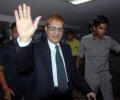
Justice Madanlal Laxmandas Tahaliyani, a retired judge of the Bombay high court, was on Monday sworn in as the new Maharashtra Lokayukta.
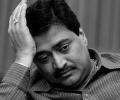
In a blow to former Maharashtra Chief Minister Ashok Chavan, the Bombay high court on Wednesday dismissed his appeal

Khan was produced before the court of the principal sessions court judge M L Tahaliyani on Tuesday.

In the court's opinion, Kasab has no chance to reform. What is your take on the verdict? Tell us
The 26/11 trial turned out to be a learning exercise for Pakistani gunman Ajmal Kasab as well judge M L Tahaliyani, both of whom evinced keen interest in Marathi and Urdu languages respectively.
The death sentence given to Ajmal Amir Kasab may take years to be executed as the lone captured terrorist of Mumbai attacks could be 30th in the list of prisoners who are waiting to be sent to the gallows. Thursday's order by judge M L Tahaliyani is the first step of a long process which will include appeals before higher courts and most importantly, if he exercises his right, a clemency petition before the President.

Following is the chronology of events leading to the execution of Lashkar-e-Tayiba terrorist Ajmal Amir Kasab
The Bombay high court on Friday rejected the plea of hotels and restaurants across the state seeking permission to play orchestra in their establishments on December 31 night until 5 am on the New Year day.
The PIL was dismissed by justices M L Tahaliyani and Girish Godbole after the central government's counsel R V Desai argued that it was a "frivolous" petition and not in the public interest

Describing evidence against him in the 26/11 attacks as "weak", Pakistani gunman Ajmal Kasab asserted before Bombay High Court that police had not been able to prove beyond reasonable doubt he had killed police officers Hemant Karkare and Vijay Salaskar.
The lone captured Pakistani gunman, Ajmal Kasab, today looked flustered and confused while trying to prove his innocence in front of judge M L Tahaliyani.
The Bombay High Court has held that working women take care of their children very well and the argument that they do not get time to attend to kids cannot be a ground for 'disturbing' the custody of the child.
The special 26/11 trial court terminated Pakistani gunman Ajmal Kasab's lawyer Abbas Kazmi, on Monday, observing that he was "not co-operating with it in the interest of justice."
Judge ML Tahaliyani, while listing out the reasons why he was not sentencing 26/11 terrorist Ajmal Kasab to life, invoked the Kandahar hijack of December 24, 1999, when the Indian Airlines flight IC-814 was forcibly taken to Afghanistan to secure the release three hardcore terrorists in Kashmir.

The special court at Arthur Road jail has found Ajmal Kasab, lone surviving terrorist in the 26/11 attacks case, guilty of waging war against India and killing 170 people on 26/11.
Lone surviving 26/11 perpetrator Ajmal Kasab on Monday disputed the prosecution's submission that he and nine others had arrived in Mumbai on board the Kuber boat, claiming the vessel was found abandoned by the police a month before the terror attacks. "The front page of the station diary shows that this abandoned vessel was recovered by the police on October 27,2008, exactly a month before the terror attacks," Kasab's lawyer K P Pawar argued before Judge M L Tahaliyani.
A sessions court in Mumbai has issued warrants against Faheem Ansari and Sabauddin Ahmed asking the Uttar Pradesh police to produce the duo on September 23, as the Bombay high court has admitted state's appeal against their acquittal in the 26/11 terror attack case.
The Bombay high court has issued an arrest warrant against Faheem Ansari and Sabauddin Ahmed after admitting the Maharashtra government's appeal against the lower court verdict acquitting the two in the 26/11 terror attack case. On May 3, 2010, Ansari and Ahmed were acquitted of all charges as Special Anti-terror Court Judge M L Tahaliyani said the evidence produced by the prosecution could not be relied upon.
Lone surviving Pakistani gunman of the 26/11 Mumbai attacks Ajmal Kasab on Monday occasionally gave irrelevant answers to questions asked by the special judge, who cut him short and advised him to reply correctly.
In a reprieve for model Viveka Babajee's 'boyfriend' Gautam Vora, a local court in Mumbai on Tuesday restrained the police from arresting him on the charge of abetment to suicide without giving him a 72-hour prior notice.
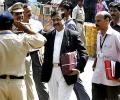
Special Public Prosecutor in the 26/11 trial Ujwal Nikam was visibly upset over a report published in a Mumbai daily.
A special court will hear arguments on Tuesday on the quantum of sentence to be awarded to Pakistani gunman Ajmal Kasab, who has been held guilty for the murder of 170 people in the 26/11 terror strikes in the financial capital of the country.
At a time when the US is finding it extremely difficult to deal with the 9/11 mastermind, Khalid Sheikh Mohammed, within its judicial system, the way India has dealt with Kasab is reflective of the maturity of Indian democracy and its judicial system, notes Harsh V Pant.

Judge M L Tahaliyani has announced May 3 as the date for the verdict after hearing the arguments by both prosecution and the defence.
Pakistani gunman Ajmal Kasab has complained to the special court that jail authorities are giving him food laced with drugs as a result of which he feels 'giddy.'

In a crucial testimony, the Federal Bureau of Investigation on Wednesday told a special court trying the Mumbai terror attack case that Global Positioning System devices used by terrorists had indicated that they had come from Karachi.
The special trial court in Mumbai on Wednesday rejected the petition of Ajmal Amir Kasab, the lone terrorist arrested alive during the November 26, 2008 Mumbai attacks, to examine Maharashtra Minister Narayan Rane as a defence witness.

Kasab, whose statement is being recorded by the court on evidences adduced by the prosecution, told Special Judge M L Tahaliyani that while one of the terrorists of the Taj hotel siege was a Kashmiri, another was from Gujarat.
Judge M L Tahaliyani said Kasab's statement before the court was "broadly speaking not a confession, but an admission of guilt."
Pakistani gunman Mohammed Ajmal Kasab, lawyers and mediapersons burst into laughter when prosecutor Ujjwal Nikam told the special court conducting 26/11 terror trial that he was the lone surviving gunman's "enemy number one."
The trial court hearing the 26/11 terror attack cases issued non-bailable warrants on Tuesday against 22 absconding accused, including Jamaat-ud-Dawa chief Hafeez Saeed and head of operations of Lashkar-e-Toiba Zaki-ur-Rehman Laqvi.
The special court hearing 26/11 terror attacks case on Tuesday asked the police department to file an affidavit explaining how footages of a compact disc filmed on the interrogation of accused Ajmal Kasab was leaked to the media.

Cut to the task, Pawar immediately got back to work after the special court ended its proceedings on Monday at around 3.45 pm. Pawar ensconced himself inside the court to study the documents in details keeping a bevy of eager media persons waiting for more than two hours.
Pakistani gunman Ajmal Kasab's lawyer Abbas Kazmi tendered an unconditional apology, on Friday, to the trial court hearing the Mumbai attack case for his remark that he did not care about affidavits of witnesses filed by the prosecution.
Judge M L Tahaliyani on Thursday awarded the death sentence to Ajmal Kasab, the lone terrorist arrested during the terror siege on the city in November 2008, for the carnage that had claimed 166 lives.
Madan Laxmandas Tahiliyani, the judge who sent Ajmal Kasab to gallows, is versatile in both criminal and civil laws, an experience that came in handy during many a tricky moment during the Mumbai terror attack trial.
