
Backed by technology banks are expanding the branch network - and adding more to the workforce.

'The Indian economy is expected to grow in terms of per capita income and GDP, and with that, the luxury segment becomes more relevant.'

The slowdown is showing on the balance-sheet. During the quarter ended March 2008, India Inc reported the lowest net profit growth in the last nine quarters, after the state-owned oil marketing and power companies declared poor results.

The only saving grace in indirect tax collection during the month was 29.6 per cent rise in service tax realisation.

The slowdown in demand from the US and Europe has not impacted the diamond trade in Surat, Asia's largest diamond polishing hub, thanks to the diversified export market. This was not the case till recently.

Axis Bank, Tata Steel, Kotak Mahindra Bank, ICICI Bank, Tata Motors, and Bajaj Finance were among the other major laggards. Tata Consultancy Services, Reliance Industries, UltraTech Cement, Infosys, HCL Technologies, and Tech Mahindra were among the gainers.

Check out the companies which surpassed economic slowdown and the demonetisation-induced slowdown

As the government plans to take sector-specific steps to tackle the slump, Finance minister Nirmala Sitharaman will soon hold talks with representatives from various sectors to get and take steps so that the confidence of those sectors can be restored.

Consumer goods firms and auto companies are witnessing an upturn in rural demand, which had been lagging for most of FY24. Expectations of a bumper rabi crop harvest have helped turn the tide. The Reserve Bank of India's (RBI's) Monetary Policy Committee kept the repo rate unchanged last week, noting that as rural demand catches up, consumption is expected to support economic growth in 2024-25.
Gartner is of the opinion that Indian IT industry will not suffer a slowdown, even in face of US recession.
The country's largest car maker Maruri Suzuki India on Friday said it has cut down production on most of its models this month due to slowdown in the market.

The April PMI showed that the foundation for China's economic recovery is not solid enough.
Risks emerging from slowdown in the global economy will not overwhelm the Indian economy and pose "no great danger" for the country, Prime Minister Manmohan Singh said on Friday. He said risks from the global slowdown are "acceptable ...and as of now I think there is no great danger that these will overwhelm us or derail our economy".

Reflecting subdued global economic growth, India's outward foreign direct investment (FDI) fell by 33.3 per cent sequentially to $1.21 billion in August, compared to over $1.82 billion in July.

Certain changes in the past two or three years could have a long-term structural impact on the IT services market.

The recent surge in crude oil prices could shave off the gains made by India Inc in profit margins in the past few quarters. Worse, it comes at a time when consumer demand in the country is slipping and major global economies are witnessing a slowdown. A back-of-the-envelope calculation suggests that the margin expansion accounted for three-fourths of the rise in the listed firms' operating profit between the April-June quarter (Q1) of FY23 and Q1FY24, and only a quarter of profits gains came from revenue growth.
India's outward Foreign Direct Investment (FDI) nosedived to $11.12 billion in January-June (H1 2023) from $23.57 billion in the same period last year, indicative of the slowdown in the global economy, according to the Reserve Bank of India (RBI) data. The outward FDI expressed as the total financial commitment, has three components, namely equity, loan and guarantees. The sharp contraction in the commitments (outward FDI) was prominent in the April-June 2023 period.

Lou also spoke about China's tensions with neighbouring countries without directly mentioning the eastern Ladakh border standoff with India since May 2020 which resulted in the Galwan Valley clash in June of that year.

Debashis Chatterjee speaks about the overall demand environment and company's strategy

'Valuations of midcaps and smallcaps have reached very high levels, and hence to that extent leave little margin of safety.'

NRIs still send largest remittances than counterparts elsewhere.

'It makes sense to have gold in one's portfolio keeping the political and economic risks of 2024 in mind.'
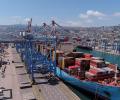
India's private and state government-owned ports (non-major ports) continued to grow faster than those owned by the Centre (major ports) through the first three quarters of 2023-24 (FY24), cargo handling data shows. At 604 million metric tonnes (mmt), cargo at major ports grew by 5 per cent between April and December, while non-major ports' cargo traffic growth was 11 per cent at 531 mmt. During December 2023, central government-owned ports in India handled cargo volumes of 69.9 mmt, a tepid year-on-year (Y-o-Y) growth of 0.7 per cent.

For start-ups, the model can save 30-40 per cent of the total costs.

He also said an impressive industrial growth of 16.8 per cent in December suggests the economy will grow by over 7.5 per cent in 2009-10 and over 8 per cent in the next fiscal.

Tata Motors surpassed Maruti Suzuki (India) (MSIL) to become the most-valuable automobile company, in terms of market capitalisation (mcap), after a gap of seven years. With this, the company's stock hit a new high on the BSE on Tuesday (January 30). The combined mcap of Tata Motors (Rs 285.51 crore) and Tata Motors DVR (Rs 29,119 crore) stood at Rs 3.146 trillion.
Finance Minister Pranab Mukherjee today said the global slowdown will impact India's growth prospects, but expressed hope that inflation will start moderating from December.
Interrupting a two-month streak of decline, outward foreign direct investment (FDI) rose sequentially to $1.85 billion in July over $1.07 billion in June, an increase of 73 per cent. However, it was lower than the $2.18 billion in July last year, according to the Reserve Bank of India data. Outbound FDI, expressed as financial commitment, has three components - equity, loans, and guarantees.

India's crude oil imports from Russia fell for a second straight month in January to its lowest in 12 months but the nation's insatiable appetite for Russian crude remains for the long term, according to data from energy cargo tracker and industry officials. Russia supplied 1.2 million barrels per day of crude oil to India in January, down from 1.32 million barrels in December and 1.62 million barrels in November 2023, according to data from energy cargo tracker Vortexa. Russia however continues to remain India's top oil supplier, accounting for a little less than a quarter of 4.91 million barrels a day of oil that the world's third largest energy consumer imported in January.

Growing at a robust rate due to economic reforms in key sectors like digitisation and infrastructure, India has emerged as a star performer and is projected to contribute more than 16 per cent of the global growth, the International Monetary Fund said on Monday. "What we have been observing for quite some time now is that India has been growing at a very robust rate. "It's one of the star performers when it comes to real growth when you look at peer countries.

The world economy's growth engine is slowing, but not collapsing.

The cash-starved Indian textile industry is of the view that the Technology Upgradation Fund Scheme, or Tufs, flagship scheme of the textiles ministry, has lost its shine, as economic slowdown has put modernisation and expansion plans of companies on hold. The industry says there are more basic problems that the government needs to address.
Scores of leading SEZ promoters, including Infosys Technologies, CMC Ltd, Hindalco Industries, NIIT Technologies, HCL Technologies, Orient Craft Infrastructure, L&T Phoenix Infoparks and K Raheja Corp, have sought more time from the Board of Approval, which is meeting in New Delhi on June 2.

Government announcements for the building of new roads, railways, and other capital expenditure (capex) projects may have hit an all-time low, according to numbers for the December quarter.

Outflows fell 16.4 per cent in April-Sept 2009 compared to the year-ago period.

Industrial output growth rate remained flat in April.
The loans securitised between January 2004 and December 2006 have shown progressively lower collection efficiency and hence, higher delinquency levels. In fact, among all the years, the pools securitised in 2006 have shown the weakest performance, rating agency ICRA said.

In domestic market, gold prices had peaked to Rs 39,011 per 10 grams in September and are now ruling at Rs 38,800 per 10 gram.

Venture capitalists and seed fund providers receive around 500-1,200 business plans every year. The trend continued even among the student fraternity. Venture firms such as Morpheus Venture Partners and Centre for Innovation, Incubation and Entrepreneurship that work closely with students and incubator centres have seen a spurt in activity.
The Bharatiya Janata Party on Friday alleged Prime Minister Manmohan Singh is "directly and openly" trying to put all the blame for the economic slowdown on former Finance Minister Pranab Mukherjee and charged that he was equally responsible for the state of affairs.
 © 2026 Rediff.com - Advertise with us - Disclaimer - Privacy Policy - Sitemap - Feedback - About us - Terms of use - Grievances