
Nearly all FMCG companies like Marico, HUL, ITC and the rest have been indicating that the operating environment has been challenging, with drop in consumption, especially in rural areas, severe crunch in market liquidity conditions, and disruptions and floods in several parts of the country. To overcome this, they are boosting their direct reach in the countryside.

The Q1FY24 earnings season has started on a dismal note for corporate India. The early-bird companies' revenue growth has been at a 10-quarter low, while the combined earnings of non-BFSI (banking, financial services, and insurance) companies seem to have hit the ceiling. The numbers suggest corporate India is entirely dependent on BFSI companies and the IT services sector to drive growth in revenue and profit while other sectors are showing signs of stagnation.

'The deal pipeline across products is robust for 2024.'

A weaker-than-expected sales performance, concerns about higher competitive intensity in the current year, and earning cuts by some brokerages have weighed on the stock of the country's largest paint maker, Asian Paints. While the Q3 volume show was slightly below expectations, the company's operational and bottom line beat estimates, benefiting from the falling raw material costs. The stock ended the day with a decline of over 2 per cent at Rs 3,175 apiece.

The number of millionaire households in India jumped nearly 21 per cent.
Over 36 per cent of the 1,630 executives surveyed in India in March this year expected an upturn in the global economy by the end of 2009, as against 34 per cent of North American business executives and 32 per cent of Chinese. Asia-Pacific and Europe recorded 28 per cent and 24 per cent on the hope meter. However, about 62 per cent of Indians surveyed expected the world economy to rebound only by 2010 or later.

Avenue Supermarts, the operator of DMart retail chain, reported good results for the July-September quarter (Q2FY24) with strong earnings before interest before interest, taxes and depreciation (Ebitda) and profit before tax (PBT) growth, but lower PAT due to higher tax incidence. The operating margin improved, and like-to-like store sales growth was strong. Average bill value also increased though this may be a seasonal effect to some extent. Analysts are assuming this means the slowdown in retail may have bottomed out.
A global slowdown, which is forcing companies to curtail production, cut salaries and jobs, is helping retailers who have launched private labels.

Info Edge (India) reported a good fourth quarter for the 2022-23 financial year (Q4FY23) given depressed conditions in the Key IT segment. The billing growth of 13.7 per cent year-on-year (YoY) in recruitment was well ahead of market expectations. There was solid growth in realisations (up 5.5 per cent) as well as unique customers (up 7.7 per cent).

India will equal China's 4.9 per cent share of world GDP in 2005 by the middle of next decade.

Amid current geopolitical challenges and a slowdown in global growth, veteran emerging market investor Mark Mobius called India a safe haven for investors, backed by a stable government. The renowned investor, who is excited about the opportunities available in India, said the country is now the second largest in the portfolio of Mobius Capital Partners after Taiwan. Calling India a "land of opportunities and innovation", he said that his optimism about India is driven by the stable government and young demographic, with an average age of 27 years.

The exclusive club that dominates the global semiconductor fab scenario is about to get a new member. Taiwan, South Korea, and China control nearly 70 per cent of the global capacity. SEMI, the global industry body for semiconductor and electronics design and manufacturing, projects all fabs collectively will churn out 30 million wafers a month this year.
Debit card transactions showed an increase of 88.6 per cent, against a rise of 34.5 per cent for credit cards for the March. In value terms, daily transactions through debit cards increased by 73.4 per cent vis-a-vis an increase of 24.8 per cent in credit card transactions. Sector experts attribute this to the ongoing economic slowdown and the cautious attitude towards spending money. Add to this the diminished focus of banks in issuing credit cards.
According to GHIAL chief executive officer P S Nair, the company is also introducing austerity measures to reduce cost of operations by 15-20 per cent besides exploring other sources of revenue. During the first six months of the current financial year, domestic traffic from the new airport has declined by 7.7 per cent to 2.49 million from 2.7 million in the corresponding period last year (from Begumpet airport).
Data for 2011 are expected to reveal the number of outbound travellers from India rose 10%, with the West vying for a major slice of the market pie.

The sectors that received most of the investment during this period included manufacturing, financial services, business services, computer services, electricity, and other energy sectors.

The growth of eight key infrastructure sectors slowed down to a 4-month low of 8.1 per cent in September 2023 against 8.3 per cent a year ago, according to the official data released on Tuesday. The growth rate in the output of refinery products, fertiliser, cement and electricity during the month under review has decelerated, while it was negative in the case of crude oil. The previous low was in May, when the growth rate of these sectors stood at 5.2 per cent.
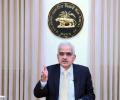
The challenge for the RBI in 2024 is likely to be less about containing elevated inflation and more about curbing excessive financial market exuberance and a 'problem of plenty', notes Sajjid Chinoy, Chief India Economist JP Morgan.
IMF has predicted a slowdown of world economic growth and approves of Fed Reserve's move of cutting its interest rate.

Prices may go up because of higher energy costs, caused by the rise in shipping charges, with commercial vessels taking a longer route to avoid the troubled Red Sea region, the finance ministry said on Monday. Iran-backed Houthi rebels of Yemen are repeatedly attacking ships in the Red Sea. While the global economy is grappling with challenges such as sticky inflation, sluggish growth, and mounting fiscal pressure, India's external sector could face "potential risks" due to the ongoing geopolitical tensions, according to the finance ministry's report on the review of the Indian economy.

India's appetite for imported crude oil may wane in fiscal year (FY) 2023 from record levels in pre-pandemic 2019-20 fiscal as higher oil prices, a spillover from the conflict in Ukraine, and increasing use of biofuels affect domestic demand for petroleum products. Brent crude surged to a nine-year high, shy of a July 2008 record $147.50 a barrel, before declining to around $100 a barrel - but the volatility in commodity rates will slow global economic growth and use of fuels. Demand for all oil products may grow at only 2-3 per cent in FY23, slower than the current fiscal and nearly half the 5.5 per cent growth estimated by the petroleum ministry, according to industry officials.

Most analysts have downgraded the stock of SBI Cards and Payments (SBI Card) as the credit card issuer posted weak results during the December quarter (Q3) of financial year 2023-24 (FY24). The sub-par show, analysts said, was for the eighth straight quarter. With this, they have slashed their earnings estimates by as much as 20 per cent over FY24-26 amid near-term pressure points in the company's growth outlook.

'We are engaging in substantial open market sales of both wheat and rice to control food inflation; special measures of market intervention in vegetables, pulses and oil seeds were also taken to cushion the impact.'
Slowdown in the global economy and bearish market conditions are impacting inflow of funds from foreign institutional investors even as the current account deficit during the first quarter of 2008-09 soared to $10.7 billion, says a report by the Reserve Bank of India.
Slowing economic activities in China would result in excess capacities that could hit the overall demand-supply balance.

The country's largest commercial bank's SME advances grew nearly 23 per cent to Rs 119,676 crore last financial year.
The US slowdown coupled with rupee appreciation, talent crunch and rising salaries, and the 2010 sunset clause on tax holiday for IT firms, is putting knowledge process outsourcing firms in a bind.

The global outsourcing market seems to be going through a sluggish phase, showing signs of slowdown, as number of deals signed during the July-September quarter this year dropped to 472 from 503 deals in Q3 2010.
It's a blessing in disguise, of sorts. Indian companies, which had to face a huge attrition problem over the last few years, can finally breathe easy. HR analysts said the economic slowdown is expected to reduce the attrition rates across industries, at least for the next two quarters.

'In the next 15-20 years, India will have at least 50 new (AI-driven) billion-dollar companies that are going to solve problems for the largest companies around the world.'
Money is the new God and spending it is the closest that one gets to nirvana. These five malls together accommodate close to 1,800 showrooms and smaller kiosks that sell almost everything a consumer could want. The number of visitors at Select City Walk averages around 2,000 on weekdays, going up to 6,000 on weekends.

Tata Consultancy Services' (TCS') contribution to the overall market capitalisation (mcap) of listed Tata group companies has slipped below 50 per cent for the first time in over a decade. This has happened amid a rally in other Tata stocks, led by smaller companies, even as TCS, the group's largest company by mcap, has lagged. In recent quarters, Tata's listed firms have emerged as leading performers on the bourses, with the group's combined mcap crossing Rs 30 trillion early last week - a first for a private sector conglomerate.

Infosys has a long way to go as far as IT business is concerned, said Kris Gopalakrishnan, CEO Infosys Technologies Ltd.

Households may be feeling the pinch of higher inflation but corporate India is enjoying record high margins and profits. The combined quarterly net profit of listed companies scaled a new high in the April-June 2023 quarter owing to a sharp rise in operating and net profit. The expansion in margins more than compensated for the slowdown in revenue growth, which slipped into single digits in Q1FY24 after a gap of nine quarters.
Domestic pharmaceutical market registered a value growth of 14.4 per cent in January and 9.9 per cent in the 12 months ended January 2009. The yearly turnover was Rs 34,487.17 crore. The growth of the domestic drug sector, which was just 6.8 per cent in November 2008, improved to 13.2 per cent in December and to 14.4 per cent this January.
Crude oil is not the only commodity seeing a price correction on fears of an economic slowdown. The same sentiment is driving prices of a range of important industrial metals like copper, zinc, aluminum and the precious metal gold. As a result, prices are now below what they were three months ago.

China's top respiratory disease expert Zhong Nanshan warned of a small COVID-19 spike in the winter and reminded the elderly and vulnerable populations to get vaccinated as soon as possible, state-run Global Times reported.

UltraTech Cement's third quarter of financial year 2023-24 (Q3FY24) performance saw a combination of 6 per cent year-on-year (Y-o-Y) volume growth and 8 per cent revenue growth coupled with better realisations per tonne. The earnings before interest, taxes, depreciation, and amortisation (Ebitda) stood at Rs 3,250 crore and Ebitda per tonne was Rs 1,191. Profit after tax (PAT) was reported at Rs 1,780 crore. Other income dipped and interest costs rose.
 © 2026 Rediff.com - Advertise with us - Disclaimer - Privacy Policy - Sitemap - Feedback - About us - Terms of use - Grievances