
The attack came less than three months after a suicide bomber killed 12 people in a blast outside a district and sessions court building in Islamabad.
India has strongly denied Pakistan's accusations of its involvement in the suicide bombing at a mosque in Islamabad, calling the allegations baseless and a deflection from Pakistan's internal issues.

Suicide bombers carried out attacks targeting Shia Muslims in the Pakistani cities of Lahore and Karachi on Tuesday, killing 15 people and injuring nearly 80 others in the latest series of terrorist strikes against religious minorities in the country.
Two terrorist strikes targeted Shia religious gatherings in southern port city of Karachi and Muzaffarabad, the capital of Pakistan-occupied Kashmir on Sunday, injuring nearly 25 people.

The blast occurred near an Imambargah in the congested Kucha Risaldar area of the walled part of Peshawar.
Seven people were killed and 18 injured when a Shia procession was targeted with a roadside bomb in Pakistan's restive northwest on Saturday, the latest in a string of attacks against the minority community during the month of Muharram. The bomb, which was hidden in a mound of garbage, went off as a procession from an Imambargah on the outskirts of Dera Ismail Khan was on its way to the main procession in the city, witnesses and police officials said.
The suicide attacker entered an Imambargah or prayer hall at Chakwal, located about 90 km from Islamabad, where about 2,000 worshippers had gathered for a religious function, and blew himself up.
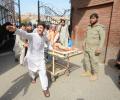
The blast occurred at an Imambargah located near the Qissa Khwani Bazaar area of Peshawar when the worshippers were offering Friday prayers.
A suicide bomber blew himself up outside a Shia mosque in Pakistan's restive northwest region on Friday, killing 22 people and injuring over 50, officials said. The attacker detonated his explosives in a narrow alley near the Imambargah at Pat Bazar in Hangu town of Khyber-Pakhtunkhwa province.
Four persons were killed and several others injured when a powerful bomb went off near Shia prayer hall in the Pakistani garrison city of Rawalpindi on Wednesday night, hours after one person was killed and 15 injured by two blasts outside an Imambargah in Karachi.
Three powerful blasts on Wednesday rocked Pakistan, including two outside an Imambargah in Karachi, killing at least 11 people even as security was tightened across the country to avert attacks on Shia gatherings in the month of Muharram.
At least 12 people, including two children, were killed and about 40 others injured when two blasts ripped through a Shia-dominated area of the southern Pakistani port city of Karachi on Sunday, witnesses and officials said.
Three blasts targeted Shia processions in Lahore on Wednesday, killing at least six persons and injuring nearly 70 others in the latest wave of deadly terrorist attacks across the country.

Over 61 killed in blast in Shia mosque in Pakistan
At least 25 people, including two children, were killed and over 50 injured when a suspected suicide bomber struck a religious gathering in Dera Ghazi Khan town in Pakistan's Punjab province on Thursday.

A powerful car bomb exploded outside a Shiite imambargah at a busy market.
The attacker, a youth aged about 18 years who was clad in black, detonated his explosives at the entrance of the Mirza Kasim Imambargah at Kohati in the congested old quarters of Peshawar, the capital of North West Frontier Province, at 6.55 pm (local time).

Three suicide bombers entered the mosque while only one was able to detonate the bomb.

Pakistani students today formed a human shield for Hindus celebrating Holi at a temple in Karachi to protect and show solidarity with the minority community.
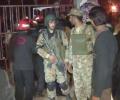
Three people were killed and seven others injured.

"Three children were among those killed. The remote-controlled bomb was attached to a motorcycle," officials said.
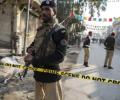
The blast was claimed by both the local affiliate of the Islamic State terror group and by Jamaat-ul-Ahrar, a splinter group of the Tehrik-e-Taliban Pakistan.

A lot of the terrorism that is affecting Pakistan is really a blowback of the Pakistani state's policy of using jihadist groups as instruments of state policy. And unlike some other countries with similar policies, Pakistan doesn't have the benefit of the political and social space for pulling back from the disastrous course, says Sushant Sareen.
 © 2026 Rediff.com - Advertise with us - Disclaimer - Privacy Policy - Sitemap - Feedback - About us - Terms of use - Grievances