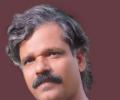
Three eminent writers from Punjab announced that they were returning their Sahitya Akademi awards, while Kannada writer Aravind Malagatti resigned from the body's general council, joining the growing protest by litterateurs over "rising intolerance" and "communal" atmosphere.

A clueless Sahitya Akademi has now called a meeting of its executive council on October 23 to decide the future course of action.

Noted Bengali writer Sunil Gangopadhyay was on Wednesday elected the new president of the Sahitya Akademi, considered India's most prestigious literary post. Gangopadhyay defeated noted Malayalam writer and Jnanpith award winner M T Vasudevan Nair by five votes in the election for the post of president of the Akademi. In an election for the post, necessitated after lack of consensus in the 89-member general council, Gangopadhyay bagged 45 voted while Nair got 40 votes.

Her action comes in the wake of a parade of litterateurs renouncing their coveted prizes.

Eminent poet and writer K Satchidanandan on Saturday resigned from all committees of the Sahitya Akademi, saying the literary body had "failed" in its duty to stand with writers and uphold freedom of expression.

After eminent writers Nayantara Sahgal and Ashok Vajpeyi, Malayalam novelist and Aam Aadmi Party leader Sarah Joseph today said she would return the Sahitya Akademi award in protest against what she called the "growing communalism" and "life threat faced by writers" in the country after Narendra Modi government assumed office.

'Communal tension and violent mobs have been part of our country, whichever government is in power. What has happened since the BJP came into power is that individuals or group activities asserting Hindutva have become louder, more aggressive.' 'Now we are finding ourselves in a country where reasoning and thinking have no place, the power lies with the goons.' 'I find any ban, whether on what we write, what we eat, how we dress etc, absolutely abominable. They have no place in a democracy.' Shashi Deshpande on why she joined the writers' protest against the growing intolerance in India.
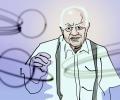
Jayant Narlikar wrote alternative what-if histories, explained difficult scientific theories with funny analogies, and leavened his lectures with jokes and humorous asides.
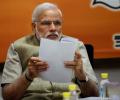
Leading writers Nayantara Sahgal and Shashi Deshpande on Wednesday sought a strong condemnation by Prime Minister Narendra Modi of Dadri lynching incident and opposition to Ghulam Ali's concert.

'Dadri was an extension of the cultural fascism that was happening in the country.' 'All the people in the country suffered under the Emergency, but now we see one community trying to crush the other community. Do they know what is brewing in the minds of the other side? What is happening today can lead to a very dangerous situation in the country.' 'We have lost religious tolerance in today's India.' Writer Sarah Joseph on why she returned her Sahitya Akademi Award.
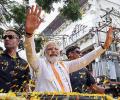
'Religion has divided our country like it never had done.' 'I can't remember a time of such focused hatred.'
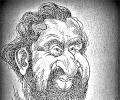
U R Ananthamurthy was one among the most creative triumvirate of Modernist Kannada literature of the late sixties and seventies (the other two being the late P Lankesh and K Poornachandra Tejaswi). He will be missed by all who care to step out and fight for justice and human rights of ordinary people in India despite being surrounded by the consumerist fog, says Shivanand Kanavi.

'The writers fear that the fringe is threatening to become the mainstream and the liberal space -- a must for any creative expression -- is fast shrinking,' says Mohammad Asim Siddiqui.

Will Indian democracy benefit from the potential that Shashi Tharoor stores in his mind, spirit and intellect? Or will it be the saga of another leader who promised much but delivered too little, asks Dr Sudhir Bisht.
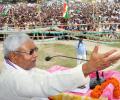
Bihar Chief Minister Nitish Kumar attacks the BJP, saying that its only intention is to capture absolute power.
 © 2026 Rediff.com - Advertise with us - Disclaimer - Privacy Policy - Sitemap - Feedback - About us - Terms of use - Grievances