
During the month, the GST revenue from domestic transactions witnessed a growth of 16 per cent as compared to the year-ago period.

GST collections for January touched an all-time high of about Rs 1.20 lakh crore, the finance ministry said on Sunday. The ministry said in line with the trend of recovery in the GST revenues over past five months, the revenues for the month of January 2021 are 8 per cent higher than that in the same month last year.

GST collections in March slipped below the psychological Rs 1 lakh crore-mark for the first time in four months to Rs 97,597 crore as the Covid-19 lockdown that shut most businesses compounded tax collection woes in an already sluggish economy. Goods and Services Tax (GST) mop-up in March recorded a 8.4 per cent decline over March 2019 collection of Rs 1.06 lakh crore. The collections were lower on account of dip in revenues from domestic transactions as well as imports.

The data primarily pertains to activities in March, which had only a few days under the Covid-19 lockdown. For April , hence, CGST collections could be much lower, fear analysts.
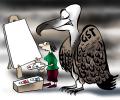
Experts said if the slowdown, and subsequent weakness in GST mobilisation, continued, it would curtail the Centre's resources to a considerable extent in the current financial year.
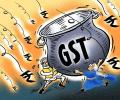
The GST collection in April touched the highest ever level of about Rs 1.68 lakh crore, up 20 per cent from the year-ago period, on improved compliance and recovery in business activity, the Finance Ministry said on Sunday. During the month, 1.06 crore GST returns from GSTR-3B were filed, of which 97 lakh pertained to March 2022. The gross GST revenue collected in April is Rs 1,67,540 crore, of which CGST is Rs 33,159 crore, SGST Rs 41,793 crore, IGST Rs 81,939 crore (including Rs 36,705 crore collected on import of goods) and cess Rs 10,649 crore (including Rs 857 crore collected on import of goods), the ministry said.

Only 69 per cent of the assessees filed returns
This is the third consecutive month when GST mop-up remained below the Rs 1 lakh crore mark, despite the festival season.
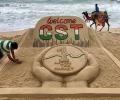
Mop up grows 10% y-o-y at Rs 1.05 trillion, almost equal to levels in February before a nationwide lockdown to contain the coronavirus pandemic
The mop-up could have been much higher, but tax on imports fell 2 per cent y-o-y.

GST is levied on every transaction in the supply of goods and services, barring certain exempted items

With recent rate cuts, November collections could be even less

It shows that states would require a compensation to the tune of at least Rs 1.67 trillion in 2024-25, as none of them would be able to achieve a 14 per cent growth every year.

K M Mani was appointed the chairman of the panel in March this year.

The government will create an EV Venture Capital Fund, for financial support to start-ups in the segment. The overall aim is to make Tamil Nadu the preferred destination for EVs and component makers.
The change in the peak rate will not alter the 4-slab rate structure of 5, 12, 18 and 28 per cent agreed upon last year, but is only a provision being built into the model law to take care of contingencies in future, two officials in the know told PTI.

The states which achieved "extraordinary growth" in total taxes collected include Kerala (44 per cent), Jharkhand (20 per cent), Rajasthan (14 per cent), Uttarakhand (13 per cent) and Maharashtra (11 per cent), an official statement said.

Kerala has seen one of the worst floods in its history during this monsoon. From August 8 to 20, nearly 223 people have lost their lives, 33 are missing and around 1.2 million individuals from 3,02,441 families are in 3,941 relief camps. Initial losses are estimated to be around Rs 200 billion (Rs 20,000 crore). With the rescue measures in its last leg, the Kerala government is looking at raising funds to rebuild the state. In an interaction with Gireesh Babu and T E Narasimhan, Kerala Finance Minister T M Thomas Isaac says he has a three-pronged strategy to raise funds. Edited Excerpts.

States should have enough time. We still do not know the rules. There are a lot of operational difficulties, says Jammu and Kashmir Finance Minister Haseeb Drabu.

The shortfall in GST compensation payable to states in the current fiscal is estimated at Rs 2.69 lakh crore, of which Rs 1.58 lakh crore would have to be borrowed this year. The Centre expects to collect over Rs 1.11 lakh crore through cess on luxury, demerit and sin goods which will be given to the states to compensate them for the shortfall in revenue arising out of GST implementation. The remaining Rs 1.58 lakh crore would have to be borrowed to meet the promised compensation to states under the Goods and Services Tax (GST) regime.
The revenue collection in the same month a year ago stood at Rs 94,442 crore.
Tax experts said historically in July and August indirect tax collections remain subdued and pick up with the onset of the festive season post Ganesh Chaturthi.

Know what terms like anti-profiteering, CGST, SGST, IGST means in the new regime

So far, 38.38 lakh taxpayers accounting for 64.42 per cent of the total businesses, who had registered in July, filed returns.
The collections stood at Rs 98,202 crore in the month, against Rs 1.02 trillion in July. The figures indicate continuation of economic slow down which was reflected in the gross domestic product (GDP) growth which plummeted to a 25-quarter low of 5 per cent in the first quarter of 2019-20, experts said.

Although the June collections were higher than that in July, however, it is important to note that during the previous month, a large number of taxpayers also paid taxes pertaining to February, March and April 2020 on account of the relief provided due to COVID-19.
As much as Rs 6,696 crore has been released to the states as GST compensation for the month of March 2018, as on May 29.

The instruction is that audit of large units be completed within seven working days, of medium units in five working days and of small ones in three.

Experts have flagged issues regarding the levying of new cess/tax, especially those related to complications in administering the cess.

It expects the Indian market to grow to 10 million units annually by 2030 and it intends to control half the market then, like it does now.

Businesses with more than Rs 10 lakh turnover may end up paying the central goods and services tax, with the Centre not agreeing to states' suggestion of keeping the threshold at Rs 1.5 crore.

Besides urging the Centre for extension of loan moratorium, the hotel and travel industries have also demanded deferment of GST and advance tax payments and waiver of fees for all forthcoming licences and permits.
The shortfall in the Centre's GST collections has raised concerns over it meeting the fiscal deficit target of 3.3 per cent of GDP, reports Ishan Bakshi.
'The professional or the freelancer needs to pay taxes from his pocket first and then wait for payments from his clients.'
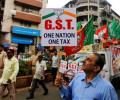
The buoyancy in the tax revenue of GST reflects the upswing in the economy and better compliance
Is the curated and limited data put out by the central government sufficient enough to pass a judgement on the trend in GST collections, particularly that of the Centre?
Rates may be raised from 5 per cent to 8 per cent and 12 per cent to 15 per cent. The Council can explore possibility of merger of slabs to bring down the number of slabs to three. The Central GST collection fell short of the Budget Estimate by nearly 40 per cent during the April-November period of 2019-20
Appearing on Rediff Chat, G Srikanth, partner in GSV Associates, Chartered Accountants, Chennai, and member of the Institute of Cost and Management Accountants, answered readers' queries on the Goods and Services Act.

The GST Council also decided that a committee of officers will be constituted to examine the simplification of forms for annual return and reconciliation statement.
A well-established tax system would have a predictable buoyancy - how fast the collections grow as a proportion to the growth of the economy. But that is not the case with GST. It is still undergoing substantial changes as the government responds to structural as well as administrative glitches.
