
Bangladesh's Home Minister Salahuddin Ahmed will skip the first-ever BIMSTEC home ministers' meeting in New Delhi, with a senior bureaucrat leading the delegation. This absence underscores strained India-Bangladesh ties, particularly following the ouster of the Sheikh Hasina government in August 2024 and Dhaka's request for her extradition from India.

A new report reveals that enterprise AI investment in India has surged by 119 per cent, exceeding the global average. However, only 22 per cent of Indian organisations have established adequate governance frameworks, creating a significant gap between rapid deployment and safe, scalable AI adoption. This lack of governance impacts operational depth and raises concerns about transparency, regulation, and data privacy.

Smriti Singh was alarmed to learn that several girls and women in her village were using ash, wheat stubble and tattered rags during menstruation because they could not afford or access sanitary pads.

'After announcing that she will return to Bangladesh, if she does not, her credibility will suffer.'

Bangladesh summoned India's Deputy High Commissioner to convey "deep disappointment" after Dr. Zahed Ur Rahman, an adviser to the Prime Minister, was stopped and questioned by immigration authorities at Delhi's Indira Gandhi International Airport. The incident led to Rahman's decision to return home despite being cleared to proceed.

Air India has announced a reduction in international flights and temporary suspension of services on six routes, including Delhi-Chicago, due to airspace restrictions and high jet fuel prices.

According to sources, India would be invited to the new proposed forum, while countries like Sri Lanka, Maldives, and Afghanistan are expected to be part of the grouping.

While the West Asia conflict has led to a drop in patient footfalls, hospitals are seeing higher realisations as international patients increasingly travel for complex, high-end procedures.

The broader conflict in West Asia, the largest international market for Indian carriers, has forced a sharp reduction in daily flights relative to the summer schedule.

Air India and Air India Express are introducing a fuel surcharge on domestic and international flights due to rising jet fuel prices, impacting travel costs for passengers.

BNP chairman Tarique Rahman called for maintaining law and order and sought cooperation in building a safe and humane Bangladesh after his party's victory in parliamentary elections.

'Periods of geopolitical uncertainty often see a rise in coordinated cyber threats, disinformation campaigns, and infrastructure targeting.'

Vikram Doraiswami, a seasoned diplomat, has been appointed as India's new ambassador to China, succeeding Pradeep Kumar Rawat. This decision comes as both countries attempt to improve bilateral relations following a period of strain.

A pickup in freight rates, rising fleet utilisation and a long-awaited replacement cycle are breathing fresh life into India's commercial vehicle (CV) market, strengthening the investment case for Tata Motors' CV arm (TMCV). Despite a broadly steady December quarter (Q3) performance, brokerages remain divided on whether the upswing is strong enough to offset margin pressures.
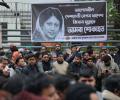
Former Indian envoys reflect on the life and legacy of Bangladesh's former Prime Minister Khaleda Zia, highlighting her role in restoring democracy and the complex relationship between India and Bangladesh during her tenures.

The external affairs minister said the SAARC is in trouble as one of its members has been supporting terrorism.
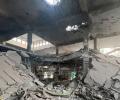
Pakistan has reiterated its desire for normal neighbourly relations with India, while also criticizing India's decision to put the Indus Waters Treaty in abeyance. The Foreign Office spokesperson emphasized Pakistan's commitment to diplomacy and regional cooperation.

There has never been a moment in India's history when it has been so adrift in the world, so confused about what it stands for and against and so humiliated, asserts Aakar Patel.
Reserve Bank on Tuesday launched mobile application 'RBIDATA' which will provide access to more than 11,000 different series of economic data related to the Indian economy. The mobile app offers macroeconomic and financial statistics relating to the Indian economy in a user-friendly and visually engaging format, Reserve Bank of India (RBI) said in a release.
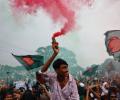
'Militants are taking over the administration. Fundamentalists have been released from jail.'

The 2016 SAARC Summit was originally planned to be held in Islamabad on November 15-19, 2016. But after a terror attack on an Indian Army camp in Uri in Jammu and Kashmir on September 18 that year, India expressed its inability to participate in the summit due to "prevailing circumstances". The summit was called off after Bangladesh, Bhutan and Afghanistan also declined to participate in the Islamabad meet.
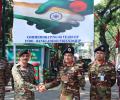
India has lodged a strong protest with Bangladesh over a now-deleted social media post by a key aide of Bangladesh's interim government that claimed certain areas of Indian territory should be part of that country. The post, which included a map showing parts of West Bengal, Tripura, and Assam as belonging to Bangladesh, was made by Mahfuz Alam, a de facto minister in the Muhammad Yunus-led interim government. The post sparked backlash and was subsequently deleted. India's External Affairs Ministry spokesperson Randhir Jaiswal reminded all concerned to be "mindful" of their public comments and emphasized the need for responsibility in public articulation.

The announcements were made after a meeting chaired by Prime Minister Shehbaz Sharif to formulate the country's response to India's move to suspend the Indus Water Treaty and downgrade diplomatic ties after the Pahalgam terror attack.
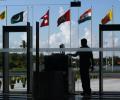
India, along with some other members, objected to the proposal and due to lack of consensus or concurrence, the meet has been cancelled.

In his opening address, Prime Minister Modi said the South Asian region has reported less than 150 coronavirus cases, but "we need to remain vigilant". "Prepare, but don't panic" has been India's guiding mantra in dealing with coronavirus outbreak, he said.
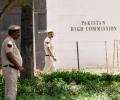
Pakistan is holding a high-level security meeting to formulate a response to India's suspension of the Indus Water Treaty and downgrading of diplomatic ties. The meeting, convened by Prime Minister Shehbaz Sharif, will include the National Security Committee, three services chiefs, and key ministers. The move comes after India blamed Pakistan for a terror attack in Pahalgam, which Pakistan has denied. Diplomatic observers warn that the escalation could further strain relations between the two countries.

The Indian Army has released a booklet on Operation Sindoor, which was launched to avenge the April 22 ghastly Pahalgam attack in which Pakistan-backed terrorists brutally killed 26 civilians, mostly tourists, and left many injured.
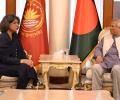
Bangladesh has demanded a public apology and compensation from Pakistan for the 1971 atrocities, raising "historically unresolved issues" during the first foreign secretary-level talks between the two countries in 15 years. Dhaka also asked Islamabad to pay USD 4.3 billion as its share from the combined assets at the time of East Pakistan's split from West Pakistan in 1971 to form an independent Bangladesh.

Pakistan will not engage with India 'until and unless they lift the siege' in Kashmir, it said.
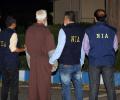
He was sent to judicial custody on May 9 and lodged in Tihar jail after his custodial interrogation by the NIA.
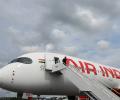
Consider this: despite a traffic of over 130 million passengers flying international-to-international (I2I) routes per annum over India, only one-sixth of the long-haul traffic (26 million) emanates from the country.

The Indian government has revoked 14 categories of visas for Pakistani nationals, including business, conference, visitor, and pilgrim visas, following the terror attack in Pahalgam, Jammu and Kashmir. The decision was made after a Cabinet Committee on Security meeting, and the Home Minister has instructed state governments to ensure that all Pakistani nationals leave India by the set deadlines. The order does not apply to Long Term Visas (LTVs) and diplomatic and official visas issued to Pakistani nationals.

India has suspended the Indus Waters Treaty with Pakistan, citing sustained cross-border terrorism and security concerns. The treaty, brokered by the World Bank in 1960, governs the distribution and use of the Indus river and its tributaries between the two countries. India's decision follows a recent terror attack in Jammu and Kashmir, and has been met with strong condemnation from Pakistan.

Modi said the coming together of SAARC leaders will lead to effective outcomes and benefit citizens in the fight against coronavirus. The PM on Friday had proposed formulation of a joint strategy by the SAARC nations to fight coronavirus, a suggestion that was backed by all the member states.
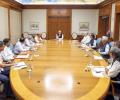
The Cabinet Committee on Security (CCS) met on Wednesday under the chairmanship of Prime Minister Narendra Modi and firmed up the responses to the terror attack.
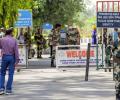
According to the Immigration and Foreigners Act 2025, which came into effect on April 4, overstaying, violating visa conditions, or trespassing in restricted areas could lead to three years in jail and a fine of up to Rs 3 lakh.
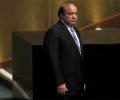
The South Asian Association for Regional Cooperation has "survived" but not "triumphed" as had been envisaged, Pakistan Prime Minister Nawaz Sharif on Thursday said while lamenting the postponement of the eight-member grouping's Islamabad summit.

Several Pakistani nationals visiting India started returning home through the Attari-Wagah land route in Amritsar on Thursday, a day after the Centre set a 48-hour deadline for them to leave the country. The decision came after India announced a raft of measures, including the expulsion of Pakistani military attaches, suspension of the Indus Water Treaty of 1960, and the immediate shutting down of the Attari land-transit post in view of the cross-border links to the horrific terror attack in Kashmir's Pahalgam that killed 26 civilians on Tuesday.
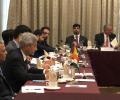
Jaishankar was among the first ministers to arrive for the SAARC ministerial meeting. He was in the meeting for over 45 minutes and then left.
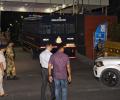
Tahawwur Hussain Rana, the key mastermind of the 2008 Mumbai terror attacks, is being interrogated for eight to ten hours daily by the National Investigation Agency (NIA) to unravel a larger conspiracy behind the strikes. Rana, who was extradited from the US, is being grilled by NIA investigators to probe a larger conspiracy behind the attacks, in which 166 people were killed and over 238 injured. He is being allowed to meet his lawyer and is being provided with basic necessities. The investigators hope to find some important leads on his travels in parts of northern and southern India days before the carnage in Mumbai on November 26, 2008.
