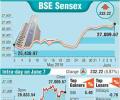
The S&P BSE Sensex ended up 232 points to settle above 27,000 at 27,010 for the first time since October 28, 2015.

The eight Indian companies are part of S&P's list of 300 mid-size companies across 37 countries in the latest S&P Global Challengers List.

Foreign brokerage firm CLSA initiated coverage on the stock with a Sell rating and target price of Rs 1,095, citing hefty premium valuation.

Having exposure to international funds and gold is a must for those who have foreign currency-denominated goals.

Extending losses for 7th session, Nifty fell below the 8,000 mark for the first time since Nov 25

Geopolitical concerns, earnings sees investors rush to safe haven plays post the Union Budget presentation in July.
Global rating agency S&P forecast on Tuesday a slowdown in Indian economy to 8.6 per cent this fiscal due to high interest rates and appreciating rupee but expected no change in key rates and cash reserve ratio in RBI's credit policy on October 30. But the strong domestic demand would ensure that India maintains high growth. The moderation from last year's 9.4 per cent to 8.6 per cent this year therefore reflected a soft landing, S&P said in its mid-year review.
Aviation companies were in focus with all the three airliners SpiceJet, InterGlobe Aviation and Jet Airways adding in the range of 2% to 3% on the BSE
The Nifty PSU Bank pared losses to end flat after falling as much as 1.05%
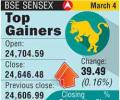
The S&P BSE Sensex ended up by 39 points at 24,646.

'While we note the very strong cyclical recovery in the economy, we believe there is still uncertainty over medium-term prospects.'

'The pressure on relative performance and the feeling of being left out among many investors may also account for the belief among many that this has to be a technology stock bubble.' 'The feeling of a bubble is also reinforced by the extreme performance gap between growth and value investing.' 'While at first glance, one can only stand back awestruck by the wealth creation delivered by technology stocks globally. It does not seem at all like the internet bubble of 1999-2000, says Akash Prakash.
Beat gains made by mid-cap, broader indices.

Fitch Ratings has cut India's economic growth forecast to 8.7 per cent for the current fiscal but raised GDP growth projection for FY23 to 10 per cent, saying the second COVID-19 wave delayed rather than derail the economic recovery. In its APAC Sovereign Credit Overview, Fitch Ratings said India's 'BBB-/Negative' sovereign rating "balances a still-strong medium-term growth outlook and external resilience from solid foreign- reserve buffers, against high public debt, a weak financial sector and some lagging structural factors". The 'Negative' outlook, it said, reflects uncertainty over the debt trajectory following the sharp deterioration in India's public finances due to the pandemic shock.

Omkeshwar Singh, head, Rank MF, a mutual fund investment platform, answers your queries.
Investors must adhere to their risk appetite at all times and should do well for themselves over the long-term.

Seven years after it announced Nexa, there's no mistaking the seriousness with which Maruti wants the segment to grow, says Pavan Lall.

Metal stocks were trading under pressure while IT, auto, realty stocks gained in today's deals

Nikunj Saraf, Vice President Choice Wealth, answers your Mutual Fund queries.
The S&P BSE Sensex shed over 255 points and ended at 25,062.67 while the CNX Nifty traded 76 points lower and ended at 7,493.20.
Women account for less than 5 per cent of the CEOs in S&P 500 companies.

But Trump is about to announce his candidacy for president in 2024. And it is not clear if Florida Governor Ron DeSantis, the present hero of disenchanted Republicans, or Biden, who says he might seek re-election (but will decide in 2023), can checkmate Trump, notes Shreekant Sambrani.

The official said the finance ministry will impress upon rating agencies the resolve of the government to contain fiscal deficit at 4.1 per cent this year and lower it to 3 per cent by 2016-17.
The breadth, indicating the overall health of the market, was slightly positive

Liquidity issues post the crisis at DHFL, progress of monsoon, rupee trajectory at the domestic level and oil prices are some factors that will keep markets choppy, analysts say.
The S&P BSE Sensex gained over 100 points and ended at 26147.33 while the CNX Nifty ended 27 points higher at 7,795.75.

LIC owns 3.69 per cent of the total listed universe based on available disclosures, the lowest since at least June 2009.

BSE Smallcap index outperformed the frontline indices to rise 0.6%, while the BSE Midcap was flat

Monday's drop followed an 8.5 per cent slump in Chinese markets.

India may see a structural shift in supplies of crude oil with Russia emerging as a key source of fuels, a development that reduces New Delhi's dependence on West Asian oil, gives Indian refiners better bargaining power with price-setter Saudi Arabia, and improves overall energy security. The unexpected surge in supplies of Russian crude in the last few months, unthinkable until the war in Ukraine, may also deliver other unforeseen gains such as boosting exports of refined fuels to Europe, which historically has counted on Russian shipments. India has jumped on to the bandwagon of opportunistic buying of Russian crude but if calibrated carefully, Urals crude can be a long-term asset for India refiners.
Global rating agency Standard & Poor's on Thursday warned Asia may see lower growth this year due to adverse impact of oil price pressure and tsunami, but said India will be an 'exception.'
FIIs continue to invest in India, with their net investment since September 2013 standing at about Rs 82,000 crore(Rs 820 billion)
The top three companies in terms of the largest value of physical shares showed over 30 per cent shares are held in physical form. Two of the top three were part of the S&P BSE Sensex and the Nifty50 indices.

Fitch had last upgraded India's sovereign rating from BB+ to BBB- with a stable outlook on August 1, 2006.

A favourable monsoon and government support to the rural economy are among the reasons that agrochemical companies, including makers of pesticides and fertilisers, have done well.

Liquidity pushed benchmark indices 22% higher to become the best performing equity market globally

The regulator is more carefully scrutinising applications by infrastructure investment vehicles that have a limited number of investors. They have been asked to broaden their investor base before application approval, according to two people familiar with the matter. The Securities and Exchange Board of India is concerned about the structure being used for getting around tax requirements, according to one of the sources.
International credit rating agency Standard and Poor's has voiced concern over the fiscal deficit of the central and state governments even as it expressed happiness over the strong economic growth momentum.
