
India's budget for 2015/16 highlighted the government's commitment to keeping the fiscal deficit low.

The value of unclaimed securities and other assets was nearly Rs 20,000 crore in March 2020.

The announcement by Standard & Poor's (S&P) on Wednesday to cut its outlook for India from stable to negative should cause no surprise, even though it comes barely five days after a similar exercise by Moody's, which had retained its outlook on India as stable.
The perceived notion about growing corruption and the policy uncertainties have increased the country-specific credit quality risks for the companies in India, global rating agency S&P has warned.
S&P BSE Midcap shed 0.8% while S&P BSE Smallcap tumbled 0.6%

The 30-share BSE Sensex surged by 477.24 points or 0.83 per cent to close at more than one-week high of 57,897.48. As many as 28 of its constituents closed with gains while two declined. The broad-based Nifty of the National Stock Exchange rose by 147.20 points or 0.86 per cent to settle 17,233.45, tracking gains in Sun Pharma, Asian Paints, and Reliance Industries.

NPA percentage in loans may touch 10% by March 2013, up from 5% in March 2011.

With an m-cap of Rs 31,744 crore, IRCTC stood at 96th position in the overall market capitalisation ranking, the BSE data shows.

There will be pressure on the fiscal situation, especially at a time when the monsoon can also disappoint. More populist expenditure is on cards if the mandate is a hung Parliament or a coalition government.

In the Sensex pack, HDFC, ONGC, Bharti Airtel, Titan, Asian Paints, Mahindra and Mahindra and TCS were the prominent gainers. On the other hand, ICICI Bank, IndusInd Bank, NTPC, UltraTech Cement, Tech Mahindra and SBI were among the major laggards. On the other hand, HCL Tech, Tech Mahindra, HUL, Bharti Airtel and ICICI Bank were trading in the red.
The BSE Midcap and the S&P BSE Smallcap indices outperformed to gain 0.6% and 1.1%, respectively

'Favourable product mix, sales recovery, and cost saving initiatives are expected to support margins going ahead while focus on debt reduction (target of debt free by FY24) will aid balance sheet strength'
The domestic currency had tumbled by 48 paise to close at a record low of Rs 53.71/72 per dollar in the previous session on strong demand for the American currency and strengthening of the dollar against its rivals overseas.
BSE IT index was the biggest sectoral loser, down 1.5% dragged by TCS

IPO-bound mobility platform Ola, said it has successfully raised $500 million via a Term Loan B (TLB) from marquee international institutional investors. This term loan has no impact on the valuation of Bhavish Aggarwal-led Ola. The Bengaluru-based firm recently raised $139 million. This is part of a $1 billion funding round for which the company is in talks with investors, increasing its valuation to about $7.5 billion, according to the sources.

L&T was the top gainer in the Sensex pack, rising over 3 per cent, followed by Bajaj Finance, Reliance Industries, IndusInd Bank, SBI and HDFC Bank. NSE Nifty surged 168.05 points to 14,653.05.
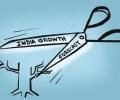
Global forecasting firm Oxford Economics on Monday revised downwards its India GDP growth forecast for 2021 to 10.2 per cent from 11.8 per cent previously, citing the country's escalating health burden, faltering vaccination rate and lack of a convincing government strategy to contain the pandemic. Oxford Economics also said that notwithstanding the likelihood of further mobility restrictions, it expects India's targeted lockdown approach, less stringent restrictions, and resilient consumer and business behaviour to mitigate the economic impact of the second wave.

Rating agency Standard and Poor's could upgrade Greece's rock bottom credit rating "pretty quickly"
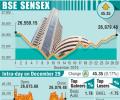

Key share indices ended over 1 per cent higher on Tuesday led by rate sensitive shares as the sluggish April IIP data re-inforced market expectations that the central bank could cut key policy rates and also lower the cash reserve ratio to boost growth.
The market breadth, indicating the overall health of the market, turned negative from positive
Indian-American Deven Sharma, the president of Standard and Poor's, is stepping down by year end, an announcement coming only weeks after the credit rating agency downgraded American credit rating.
There is an Indian at the helm of affairs surrounding the historic downgrade of the United States' creditworthiness, as ratings agency S&P's unprecedented move was taken under the leadership of Deven Sharma.

Analysts caution against volatility and recommend buying stocks of companies that are on strong fundamental footing that have been beaten down badly in the recent carnage.
Standard and Poor's action has left many speechless.
Stock market barometers Sensex and Nifty ended marginally higher on Monday as rise in wholesale inflation capped early gains despite a positive trend in global markets. The 30-share index settled 32.02 points or 0.05 per cent higher at 60,718.71 with half of its constituents ending in green. The broad based Nifty edged up 6.70 points or 0.04 per cent to close at 18,109.45.

The spread of COVID-19 and the accompanying mayhem caused the S&P BSE Sensex to drop over 38.5 per cent from its all-time high of 42,273.9 to a low of 25,981.2 on March 23. Those in the astrology and even numerology segments received more calls than before during the time.

So which sectors are likely to do well in 2022? Should you focus on domestic economy-related sectors or export-oriented ones?
Nifty PSU Bank index gained 1% led by Allahabad Bank, Andhra Bank, Syndicate Bank and IDBI Bank

After a stellar run that saw the frontline indices - the S&P BSE Sensex and the Nifty 50 - clock gains of around 21 per cent and 24 per cent respectively in calendar year 2021 (CY21), the year gone by in real sense belonged to the mid-and small-cap segments. Thus far in CY21, the mid-and small-cap indexes on the BSE have far outpaced the run in the frontline indices and notched up a gain of around 38 per cent and 61 per cent, respectively during this period. Though analysts expect the outperformance to continue in 2022, they caution against the multiple headwinds in the year ahead that may dent the overall market sentiment.

HDFC was the leading gainer among Sensex stocks on Thursday, rising by 1.65 per cent, followed by Sun Pharma, ICICI Bank, Asian Paints, Titan and Infosys. TCS was the biggest loser, shedding 1.33 per cent. Ultratech Cement, Bharti Airtel, Kotak Bank and Tech Mahindra were among the other major laggards.

Moody's Investors Service on Tuesday slashed India's growth forecast for the current financial year to 9.3 per cent saying that the second wave of coronavirus infections hampers economic recovery and increases risk of longer-term scarring. Moody's, which has a 'Baa3' rating on India with a negative outlook, said obstacles to economic growth, high debt and weak financial system contrain sovereign credit profile. The US-based rating agency had in February forecast a 13.7 per cent economic growth for the current fiscal (April 2021-March 2022).

As regards India, FIIs have pumped in over Rs 34,400 crore in the Indian stocks in calendar year 2021.

Experts prefer domestic consumption-driven plays and defensives such as information technology and pharmaceuticals

Investors with high risk appetite must stay invested while risk-averse investors can consider profit booking.
The breadth, indicating the overall health of the market, turned negative. On the BSE, 1,581 shares declined and 1,246 shares fell. A total of 165 shares were unchanged.

Maruti Suzuki fell 0.7% even after its March quarter profit grew by 15.8% to Rs 1,709 crore in Q4
The Adani group has the maximum number of companies in the trillion club at five, followed by the Tata group (four).

The broader NSE index has fallen about 0.9% as investors wait for corporate results

Traditionally, most PSUs have been cash-rich, which added to their value. However, the government has been tapping regularly into their cash resources to boost revenue for the exchequer
