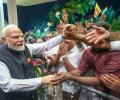
Prime Minister Narendra Modi has conveyed India's expectation to Sri Lankan President Anura Kumara Dissanayake that Colombo will fulfill the aspirations of the Tamil community in the island nation and conduct provincial council elections. The issue was discussed during wide-ranging talks between Modi and Dissanayake. Modi also met with Tamil leaders from Northern and Eastern Sri Lanka, reaffirming India's commitment to supporting the community's well-being. The Tamil community has been advocating for the implementation of the 13th Amendment, which provides for devolution of power. Modi expressed hope that Sri Lanka will fully implement its constitution and conduct provincial council elections.

Ranjith Madduma Bandara, a senior politician from Wickremesinghe's United National Party was sworn in on Thursday morning as the new minister in charge of the police.

With their talks with Sri Lankan government deadlocked, Tamil National Alliance (TNA) leaders on Wednesday left for New Delhi to apprise India of the current situation and seek its intervention in finding a political solution to the three-decade old Tamil question.
Sri Lanka on Friday briefed India about steps being taken towards political reconciliation with ethnic Tamils, amid a growing unease over the slow pace of reforms to enable devolution of power to the war ravaged north.

India has once again pressed for the devolution of powers to the provinces under the 13th amendment (13A) of the Sri Lankan constitution and the system of provincial councils as a meaningful step towards better representation of the island's Tamil minority.
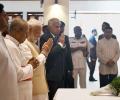
"My heart goes out to the families of the victims and the injured," Modi said.
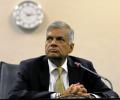
In a Sri Lankan House of 225 members, the cut-off figure comes to 113. With Wickremesinghe side touching 102 and Rajapaksa's team at 101, the three-party Tamil National Alliance with 16 members and the left-leaning Sinhala-Buddhist nationalist Janatha Vimukthi Peramuna with 6 members hold the key. But with the latter declaring that they will not support either formation in a vote count,that leaves the TNA as the deciding factor, says N Sathiya Moorthy.
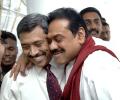
As the island heads for elections, two major factors worry Sri Lankan President Mahinda Rajapaksa. One is the division in the Sinhala vote and the other is the prospect of the Tamils and Muslims voting heavily against him.

Even as the polity find ways and means to address the genuine concerns and fears of the society, the Sri Lankan State apparatus would have to unravel these mystery-questions with convincing answers, and a road-map to the future, says N Sathiya Moorthy.
