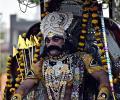
There is definitely much more to the mythical king than his ten heads and his abduction of Sita.

As Prabhakaran was leaving his house, Rajiv Gandhi called his son Rahul and asked him to fetch his (Gandhi's) bulletproof jacket. He put the jacket on Prabhakaran's back and remarked with his usual charming smile: "Take care of yourself."

On the night of July 5, the Tigers launched their first kamikaze operation. Miller took the wheels of the explosive-packed truck, smiled at everyone as he turned the ignition key and drove it slowly towards the Sri Lankan military camp. A few moments later all of Jaffna heard a thunderous explosion that brought the complex crashing down in clouds of dust. Miller had given birth to a deadly tactic that Prabhakaran would employ time and again with devastating consequences to Sri Lanka -- and India. A fascinating excerpt from M R Narayan Swamy's must read new book, The Rout Of Prabhakaran.
According to the book, 'Keenie Meenie: The British Mercenaries Who Got Away With War Crimes', authored by UK-based investigative journalist Phil Miller India's secret use of British mercenaries lasted for four months after the Indo-Lanka accord was signed between former Prime Minister Rajiv Gandhi and then Sri Lankan president Junius Jayewardene in 1987.

Scotland Yard's War Crimes Team, which is part of its Counter-Terrorism Command, has launched an investigation into the role of British mercenaries in fighting the Liberation Tigers of Tamil Eelam (LTTE) rebels in Sri Lanka during the 1980s.

Though dubbed as the "war hero", the role of Rajapaksa in ending the conflict with the Liberation Tigers of Tamil Eelam with the death of its supremo Velupillai Prabhakaran in 2009 is quite divisive as he stands accused of violating human rights, a charge he vehemently denies.
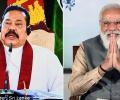
Mahinda Rajapaksa is a democratically elected leader who received a massive mandate of 71% of votes, and he owes nothing to Delhi or Washington for staging his political comeback, observes Ambassador M K Bhadrakumar.
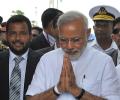
Modi flew to Jaffna by an Indian Air Force chopper after brief visits to the holy town of Anuradhapura where he offered prayers at the sacred Mahabodhi tree and Talaimannar where he flagged off a train service.
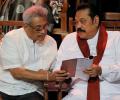
President Rajapaksa and Prime Minister Rajapaksa will transform Sri Lanka's political landscape after Thursday's electoral triumph, predicts N Sathiya Moorthy, veteran Colombo watcher.
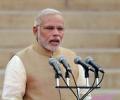
Prime Minister Narendra Modi will visit former LTTE-stronghold Jaffna in Sri Lanka's Tamil-dominated north and address the Parliament in Colombo during his 3-day visit to the country next week.

Though dubbed as the 'war hero', the role of Rajapaksa in ending the conflict with the LTTE with the death of its supremo Velupillai Prabhakaran in 2009 is quite divisive as he stands accused of violating human rights, a charge he vehemently denies.
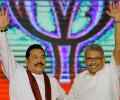
Delhi finds itself between the rock and hard place in the coming Sri Lankan election, points out Ambassador M K Bhadrakumar.

'Gotabaya will expect India to observe the red line.' 'He even dispensed with any gesture welcoming India as an interlocutor on the Tamil issue.' points out Ambassador M K Bhadrakumar.

Maithripala Sirisena was considered so meek and self-effacing that he appeared no threat to anyone. What a mistake his rivals made!
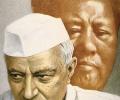
'Hindi-Chini Bhai Bhai? Don't you believe it. I don't trust the Chinese one bit,' Nehru told Gopalaswamy Parthasarathi before he traveled to China as India's ambassador. Asking GP to be ever vigilant, Nehru advised the diplomat to send telegrams on important matters only to him. Many such anecdotes from a long and eventful career as diplomat and bureaucrat crowd the pages of GP: 1912-1995, discovers Uttaran Das Gupta.

The country has a fiendishly complicated electoral system that is a combination of population-based proportional representation and party-based national lists, says Aditi Phadnis

A double-quick analysis of the Lankan election results would show that the relatively narrow victory margin of challenger Maithripala Sirisena was made up by the three minority communities of Tamils, Muslims and Christians, says N Sathiya Moorthy.
