
Some lenders in talks with LIC for pvt placement

In a significant relaxations on Wednesday, the Securities and Exchange Board of India changed pricing rules for qualified institutional placements in view of rising market volatility, and reduced the timeline of rights issues. But the market regulator did not change, as widely expected, the guidelines for participatory notes, derivative instruments, through which many foreign investors trade on the Indian bourses.

'It has remained around 38 per cent over the past four to five quarters.'

With Rs 17,087 crore raised so far this calendar year, the total is already 2.4 times that of the full year of 2023, which stood at Rs 7,266 crore.
It's actually a problem of plenty for investors now. Buoyed by the success of the three companies that sold their QIP issues within a day of opening, as many as 32 companies have joined the queue, hoping to raise a combined Rs 40,000 crore (Rs 400 billion).
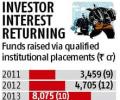
The return of investor confidence in the equity markets is bringing some of the large companies back to the fund-raising table.

The Securities and Exchange Board of India (Sebi) has proposed sweeping changes to the rights issue framework to enhance its attractiveness, aiming to make it the preferred route for additional fundraising by listed companies. Among the changes proposed by the market regulator are reducing the timeline to first 20 days and then to just three days, allowing shareholders to renounce their rights entitlement to investors of their choice, and eliminating the requirement to appoint an investment banker or file a draft letter of offer.

Cash-strapped domestic carrier Spicejet plans to raise Rs 3,200 crore through QIP, warrants and capital infusion by the promoter, the airline said in a presentation on Friday. The funds will be utilised in taking back the grounded fleet in operations, liability settlement, new fleet induction and other general purposes, Spicejet in the presentations. "Spicejet plan to raise Rs 2,500 crore through QIP and Rs 736 crore through Previous Warrants and promoter infusion, the airline said in an investor presentation," it said in a corporate presentation to investors ahead of its proposed capital infusion.

The People's Bank of China has picked up a 0.006 per cent stake in ICICI Bank by investing Rs 15 crore in the private sector lender's Rs 15,000 crore qualified institutional placement (QIP) exercise which concluded last week.

Mop-up misses target as big FIIs skip issue.

In the past two months alone, four companies have garnered a cumulative Rs 22,400 crore via this route.

US and European institutional investors bought a majority of shares in the over Rs 4,800 crore (Rs 48 billion) QIP offering by telecom operator Reliance Communications.

Realtor Godrej Properties Limited (GPL) is present in top real estate markets such as Mumbai Metropolitan Region (MMR), National Capital Region (NCR), Pune, and Bengaluru. In the financial year 2024-25 (FY25), NCR contributed 36 per cent, Bengaluru 17 per cent, and MMR 27 per cent to revenues with the rest 20 per cent coming from Pune, Hyderabad, etc.
The bank, however, plans to raise around Rs 500-600 crore (Rs 5 to 6 billion) to augment its tier-II capital in the domestic market. Union Bank of India, which had planned a rights issue to bolster its capital base, had deferred its plans even before the US financial meltdown started.
Suzlon Energy, one of the top five wind energy manufacturers in the world, plans to raise $500 million (Rs 2,000 crore) through the Qualified Institutional Placement (QIP) route to fund its expansion plans.

Zomato on Monday became the first new-age company to join the prestigious 30-share benchmark Sensex, replacing JSW Steel. This milestone marks a significant achievement not only for Zomato but also for the Indian startup ecosystem, which is increasingly making its presence felt in the $5.2 trillion listed ecosystem.

'We are in a position to start due diligence and private data room access shortly.'

QIP is a capital raising tool, whereby a listed company can issue equity shares, fully and partly convertible debentures, or any securities other than warrants that are convertible to equity shares to a Qualified Institutional Buyer.
QIP is an investment option which is available only to QIBs -- Qualified Institutional Buyers, which are public and financial institutions, foreign venture capital and institutional investors registered with SEBI, scheduled commercial banks, mutual funds and various other categories, defined in Clause 2.2.2 B (v) of the SEBI (Disclosure & Investor Protection "DIP"), Guidelines.

Post-election capital expenditure (capex) has been weak at 2 per cent year-on-year (Y-o-Y) in M9FY25. The FY25 revised estimates (RE) indicate 7 per cent growth in FY25 against FY24, implying 21 per cent Y-o-Y growth in Q4FY25 government capex.

Foreign portfolio investors (FPIs) pumped in Rs 1.7 trillion into domestic stocks in 2023, one of the highest net inflows ever witnessed during a calendar year, of which 25 per cent went into the direct buying of stocks. Data provided by depository NSDL revealed that Rs 44,950 crore of the total FPI flows last year went into primary issuances. A large portion of the FPI investments through the stock exchange route went into block deals, thereby reducing the actual investments made via direct buying of stocks. Last year saw selldowns or block deals worth Rs 2 trillion.

The company has raised the amount to be raised through qualified institutional placement due to the good response to the offer, Tata Motors said in a filing to the Bombay Stock Exchange.
Property developer Indiabulls Real Estate is talking to investors to raise at least $150 million (Rs 750 crore) from sale of shares to select investors as part of its qualified institutional placement (QIP) plan.
The Securities and Exchange Board of India has decided to make it mandatory for qualified institutional investors to make full payments upfront when they apply for shares in initial public offers. At present, QIPs pay only 10 per cent of the amount required for the shares for which they apply upfront.

Online food delivery firm Zomato Ltd on Tuesday reported a consolidated net profit of Rs 176 crore in the second quarter ended on September 30, 2024. The board of the company, which had posted a consolidated net profit of Rs 36 crore in the same quarter last fiscal, also approved the raising of Rs 8,500 crore through qualified institutional placement of equity shares, Zomato Ltd said in a regulatory filing. Zomato's consolidated revenue from operations stood at Rs 4,799 crore.
The Securities and Exchange Board of India, after receiving comments from various parties, said QIPs should be based on the average price of the shares two weeks prior to the issue.
A clutch of global financial institutions led by T Rowe Price, HSBC and an investment arm of the Government of Singapore are the lead investors in the Rs 600 crore (Rs 6 billion) qualified institutional placement (QIP) issue of UB Holdings.

The VBL board approved the purchase of SBC Tanzania for Rs 1,304 crore and SBC Beverages Ghana for Rs 127 crore. These own manufacturing/distribution rights for NARTD (PepsiCo branded) beverages in Tanzania and Ghana. The acquisitions will help VBL gain ground in East and West Africa.

'IPOs have performed exceptionally well, with a notable increase in average ticket size from Rs 800 crore in the last financial year to around Rs 1,300 crore in this financial year.'

The fee pocketed by investment banks for handling equity share sales stood at $244 million during the first half of calendar year 2024. This was the highest first half figure since 2007, according to LSEG Data & Analytics, a provider of financial markets data. Capital mobilised via equity capital market (ECM) activity jumped 2.5 times to $29.5 billion - the highest-ever semi-annual total in terms of proceeds.

Sun Pharma stated the company wanted shareholders' approval to "issue, offer and allot equity shares or non-convertible securities, other than warrants, up to an amount of Rs 12,000 crore ($2 billion), to qualified institutional buyers pursuant to a QIP."

Shares of auto component major, Samvardhana Motherson International, has gained 11.5 per cent on the bourses after the company approved the qualified institutions placement (QIP) issue and announced the calculation methodology for its compulsorily convertible debentures, or CCDs, into equity shares. Analysts cite strong investor response to the issue that has kept the sentiment positive for the stock. Brokerages, however, have a mixed view on the outlook for the auto parts supplier.

Jefferies, IIFL, and JM Financial - none of which were in the top five last year - have now claimed the top spots in the league tables for equity capital markets (ECM) during the first nine months of calendar year 2023 (CY23), a period characterised by small- and mid-sized transactions. This shift marks a significant change, with these firms outperforming the bulge-bracket investment banks. According to data provided by Refinitiv, Jefferies leads the domestic ECM market, having handled share sales worth $2.3 billion, representing 12.4 per cent of the total volume of $18.4 billion for ECM transactions.

Markets regulator Securities and Exchange Board of India (Sebi's) measures to curb speculative activity in the Rs 450-trillion-a-day futures and options (F&O) market is not a case of "throwing the baby out with the bathwater," whole-time member (WTM) Ananth Narayan said on Friday. "As a regulator, we are conscious that we must not throw the baby out with the bathwater. "When it comes to frenzied trading in options nearing expiry, however, it is difficult to see any baby in this bathwater," he said while delivering his address at the 21st FICCI Annual Capital Markets Conference.

The fundraising through rights issues in the first 10 months of 2022 is the lowest since 2016 during a similar period.

Capital markets are becoming more prominent in India's growth story, with an expanding share in capital formation and investment landscape on the back of technology, innovation and digitisation, according to the Economic Survey 2023-24 tabled in Parliament on Monday. Further, Indian markets are resilient to global geo-political and economic shocks, it added. "Despite heightened geo-political risks, rising interest rates and volatile commodity prices, Indian capital markets have been one of the best performing among emerging markets in FY24," the Economic Survey said.

'We have got enough internal accruals, and we are able to do acquisitions on our own.'

'A key reason for the strong interest in IPOs has been an increased focus on profitability and reasonable pricing of deals.'
'The deal pipeline across products is robust for 2024.'

The government on Thursday withdrew its offer to sell its entire 52.98 per cent stake in Bharat Petroleum Corporation Ltd, saying that majority of bidders have expressed their inability to participate in the current privatisation process due to prevailing conditions in the global energy market.
