
India's electric motorcycle market is experiencing significant growth, with a 28 per cent year-on-year increase in volumes, as new product launches and improved total cost of ownership attract a broader base of riders beyond early adopters.
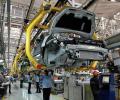
India's passenger vehicle (PV) industry is projected to experience moderated growth in FY27, following a strong rebound in H2FY26, primarily due to the high base effect, absorbed pent-up demand, and the lingering impact of geopolitical tensions in West Asia.
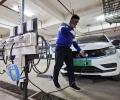
India's electric vehicle (EV) market experienced a significant surge in financial year 2025-26 (FY26), with e4W registrations nearly doubling and e2Ws growing by over 20%, propelled by expanding charging infrastructure, diverse model launches, and accessible financing.

India's electric passenger vehicle market saw an 87.4 per cent year-on-year increase in FY26, reaching 233,246 units, primarily driven by the mid-size SUV segment (20-30 lakh price bracket), while the entry-level segment (sub-10 lakh) experienced a decline.

Mahindra and Mahindra (M&M) recorded the sharpest acceleration among large players, with EV retail jumping to 33,513 units from 7,139 units, an almost 5-fold jump, aided by strong demand for new launches.

Despite India's electric passenger vehicle market experiencing an 83.6% year-on-year surge in FY26, new foreign entrants VinFast and BYD have significantly outpaced Tesla, which struggles with high import duties, a limited retail footprint, and a lack of local manufacturing commitment.

The figures are grim. India accounts for around 19 per cent of global cervical cancer cases and 23 per cent of deaths.

India's electric passenger vehicle (ePV) market has expanded sharply over the past five years, with registrations rising from just 3,252 units in 2020 to about 170,000 in 2025. Throughout this scale-up, southern states have remained the bedrock of adoption, consistently contributing around one-third of national electric vehicle (EV) registrations - emphasising the region's role as the structural backbone of India's EV transition.

'In India's competitive automotive market, staying relevant means continuously raising the bar.'

'India is clearly moving toward more targeted treatment pathways in high-burden cancers.'

India's two-wheeler industry is seen growing 6-9% in 2026, though a proposed ABS mandate for sub-125cc models could push up prices and temper volumes.

Indian automakers are reviving legacy nameplates to leverage brand recall and stand out in a crowded market, as classic badges like Sierra, Safari, Baleno and Scorpio return to attract buyers.

For decades, multinational pharmaceutical companies and Indian drugmakers worked in ways that supported each other: MNCs brought innovation and brands, while Indian companies built scale through generics and cost efficiency. There was an important overlap - generic drugs - but this is shrinking fast. And the consequences are reshaping India's gigantic pharmaceutical market.

India's leading conglomerates are stepping up investments in real estate, recasting what was once a peripheral activity into a core growth driver. Supported by strong balance sheets, established brands and access to long-term capital, major business houses including Aditya Birla, Tata, Godrej, L&T, Raymond, Wadia, Shapoorji Pallonji, Mahindra and Adani are positioning realty as a strategic pillar within their diversified portfolios.

The surge has come alongside a decline in average issue sizes and more muted listing-day returns compared with last year.

Loan against fixed deposit is cheaper and comes with fewer charges.

Starting January, the market is expected to welcome models like the Tata Punch 2025 which is expected to be around 6 lakh, Mahindra BE 07 EV around 29 lakh, Maruti WagonR Electric around 8.5 lakh, Toyota 3-Row SUV around 14 lakh, and Volkswagen Tera to be around 8 lakh.

'Faulty alarms, delays in shutting off oxygen, poor electrical maintenance and staff untrained for emergencies. These are not isolated incidents but reflect a larger pattern of weak oversight.'

Vinfast sold 137 cars versus Tesla's 109 during the festive months of September and October, as BYD maintained a strong lead with over 1,100 cars sold, according to Fada data.
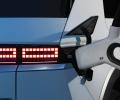
India may see its busiest EV festive season in 2025 with SUVs, luxury cars and scooters set to launch, but rare-earth supply bottlenecks risk delaying rollouts.

Hero MotoCorp and TVS Motor crossed Rs 1,000 crore in R&D spend for the first time, as legacy OEMs accelerate innovation to compete with new-age EV players.

Prices for Indian consumers are expected to come down significantly from the current Rs 17,000-Rs 26,000 monthly.
The Indian pharmaceutical industry is likely to benefit from a major wave of patent expiries in the US, as small-molecule drugs worth $63.7 billion are expected to go off-patent between 2025-29, a 65 per cent rise over the previous five years, according to a report by Antique stock broking limited.

Manufacturers of passenger vehicles (PVs) in the first half of the calendar year (2025) reported a modest 0.5 per cent year-on-year increase in wholesale dispatches, while retail sales grew 2.5 per cent for the same period, reflecting a calibrated approach by automakers amid elevated dealership inventories and cautious consumer sentiment. According to the Society of Indian Automobile Manufacturers (Siam), dispatches rose marginally to 2.16 million units, up from 2.15 million units a year earlier.

India currently performs around 6,00,000 to 7,00,000 laser-assisted in situ keratomileusis (Lasik) and refractive procedures a year, and the uptake is accelerating.

Several multinational medical device makers are focusing on deepening their presence in India by expanding their local manufacturing footprint and research capabilities, a move that can catapult India into a strategic hub for the medical technology (medtech) industry. Among those increasing their reach in the country are Siemens Healthineers and Philips, signalling a broader shift from India being only a sales destination to becoming a global production and innovation base.

Major two-wheeler (2W) manufacturers in India witnessed a single-digit decline in domestic sales in November after dispatches had picked up in October for the festive season when wholesales went up by 14 per cent and retail also grew by 36 per cent.

Armed with swanky showrooms, decked with plush fixtures, and offering indulgences such as high-end perfumes and customisable accessories, BMW, Mercedes, Audi are rolling out the red carpet for the well-heeled.

India's three-wheeler exports, which have been on a downhill trajectory over the past few years, are showing no signs of recovery in FY25, with key markets like Sri Lanka, Bangladesh, Nigeria, and Egypt witnessing subdued demand. In May, the country's exports plummeted 11.3 per cent year-on-year (Y-o-Y).

The growing complexity of E2Ws and the evolving threat landscape make it challenging to guarantee complete immunity from attacks.

From attractive EMIs to assured buyback guarantees, luxury carmakers have lined up a slew of offers to woo customers this festival season to address dwindling sales amid rising inventories.

Mahindra is coming up with the Thar Roxx. MG Motor India announced a third electric vehicle Windsor. Hyundai and Kia are expected to introduce updated versions of the Alcazar and Carnival respectively.

The rise of startups and a thriving entrepreneurial culture in Tier-II and Tier-III cities is contributing to the increasing sales of high-end cars.
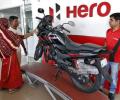
The two-wheeler segment has shown signs of recovery in the first half (H1) of calendar year (CY) 2024, largely driven by improving performance in rural areas. According to the Federation of Automobile Dealers Associations, rural contribution to two-wheeler sales surged by 57-60 per cent in the April-June quarter of 2024-25, indicating a rising demand in these regions. Experts believe that this trend will continue, supported by a favourable monsoon season and government initiatives aimed at rural development.

The government may provide for targeted fiscal incentives and allocation of funds for promotion of green hydrogen in the country in Union Budget 2022-23, which is slated to be unveiled in Parliament on Tuesday. The government launched National Hydrogen Mission in 2021. Earlier this month, Power and New & Renewable Energy Minister R K Singh had indicated that a green hydrogen policy will be unveiled in February which would feature many incentives to boost green hydrogen in the country. "While 2021 saw the launch of National Hydrogen Mission, it is likely that the Budget may provide for targeted fiscal incentives for R&D in green hydrogen segment, creation of domestic supply chain for hydrogen and reduce customs duties on electrolysers to boost green hydrogen production," says Venkatesh Raman Prasad, Partner, J Sagar Associates (JSA).

Retail inflation remained above the RBI's comfort level for the second consecutive month despite slipping slightly to 6.26 per cent in June while the factory output recorded a growth of 29.3 per cent in May, mainly on account of the base effect, the government data showed. The marginal slippage in the Consumer Price Index (CPI)-based inflation was noticed despite little firmness witnessed in the food inflation which inched up to 5.15 per cent in June from 5.01 per cent a month ago. Retail inflation based on Consumer Price Index (CPI) was 6.3 per cent in May 2021 and 6.23 per cent in June 2020.

Nitish Kumar has lost his credibility. He is now only a weak ally of the BJP. And he may no longer have a shot at a national role.

Let Bihar be damned under its contradictions of having gone 'dry' and then having been submerged under flood, which is a recurrent phenomena? After all it is a godforsaken land, having lost its promises of overcoming its problems, says Mohammad Sajjad.
