
The Indian Navy, which regards itself as the 'net security provider' in the Indian Ocean Region, has also stepped up to the plate, with a warship stationed at all times off the Gulf of Aden for counter-piracy tasks. 91 Indian warships have been deployed in the region since 2008, patrolling high risk areas where piracy was rampant.
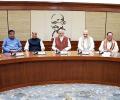
Among the new entrants to the Union cabinet, former Madhya Pradesh chief minister Shivraj Singh Chouhan has been given the agriculture and rural development portfolios, Bharatiya Janata Party president J P Nadda the health portfolio and former Haryana chief minister Manohar Lal Khattar the power portfolio.

The wholesale inflation rose to a 13-month high of 1.26 per cent in April fuelled by rising prices of food articles, especially vegetables, amid expectations of RBI holding interest rates in the policy review next month. The wholesale price index (WPI) based inflation has been rising for two months in a row.

Drivers of commercial vehicles, including trucks and tankers, stopped work in several states on Monday and blocked roads at some places to protest against the provision in the new penal law regarding hit-and-run accident cases involving motorists.
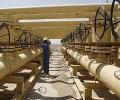
The approval is required to put through gas sales agreements with customers, which in turn are required to finalise Gas Transportation Agreements with transmission companies.
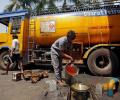
Investors shunned shares of oil marketing companies (OMCs) on Friday as they feared that the government's decision to cut retail prices of petrol and diesel could hurt the companies' profit margins in the near term. On Thursday, the government announced that OMCs will reduce pump prices of petrol and diesel after a record 22 months, making them cheaper by Rs 2 per litre in the national capital. The changes were effective from Friday.

Stocks of Hindustan Petroleum Corporation Limited (HPCL), Bharat Petroleum Corporation Limited (BPCL) and Indian Oil Corporation Limited (IOCL) have more headroom left despite the sharp run in the last few weeks, suggests a recent report from Morgan Stanley. Stocks of these oil refining and marketing companies (OMCs), it believes, are seeing multiples re-rate as investors reassess long-term growth prospects. "IOCL trades at one year forward P/BV of 1.2x, 19 per cent below +1 standard deviation (SD); BPCL trades at one year forward P/BV of 1.5x, near historical averages; HPCL trades at one year forward P/BV of 1.5x, near +1SD," Morgan Stanley said.

India, which imports 12 per cent of its oil from Iran, will not scale down its petroleum imports from Tehran despite US and European sanctions against the Islamic republic, Finance Minister Pranab Mukherjee has said.

India's crude oil imports from Russia fell for a second straight month in January to its lowest in 12 months but the nation's insatiable appetite for Russian crude remains for the long term, according to data from energy cargo tracker and industry officials. Russia supplied 1.2 million barrels per day of crude oil to India in January, down from 1.32 million barrels in December and 1.62 million barrels in November 2023, according to data from energy cargo tracker Vortexa. Russia however continues to remain India's top oil supplier, accounting for a little less than a quarter of 4.91 million barrels a day of oil that the world's third largest energy consumer imported in January.

'The private sector believes that some enablers in labour-intensive sectors like apparel, toys, tourism, and media retail, can unlock a lot of jobs.'

...to fund the revenue gap. Of the gross market borrowing of Rs 14.13 trillion estimated for FY25, Rs 7.5 trillion, or 53 per cent, is planned to be borrowed in the first half.

There is no payment problem for Russian crude, Petroleum and Natural Gas Minister Hardeep Singh Puri said on Wednesday. He said there is no proposal to cut retail fuel prices at the moment. Addressing a press conference, the minister said India enjoys a buyers' position and foreign suppliers are approaching Indian companies with offers to sell oil.

India's exports declined by 2.83 per cent to $33.90 billion in November this year compared to $34.89 billion a year ago, government data released on Friday showed. Imports also declined to $54.48 billion in the month under consideration, as against $56.95 billion recorded in November 2022.

Finance Minister Nirmala Sitharaman on Thursday made a modest increase of 11 per cent in capital expenditure (capex) to Rs 11.11 lakh crore for the next financial year as private investment picks up. The government had hiked capex by 37.5 per cent to Rs 10 lakh crore for the current fiscal. Against this, the government expects to spend Rs 9.5 lakh crore in the financial year ending March 2024.

The wholesale price index (WPI)-based inflation eased in January to 0.27 per cent, mainly due to moderation in prices of food items. WPI inflation was at 0.73 per cent in December 2023. The WPI inflation was in the negative zone from April to October and had turned positive in November at 0.39 per cent.

Corporate margins and profits in India remain vulnerable to changes in crude oil prices in the international market. Historical quarterly data from listed companies (excluding banks, finance and insurance, oil and gas, and power sectors) indicate an adverse correlation between corporate margins and crude oil prices.
Capital expenditure (capex) by 54 large central public sector enterprises (CPSEs) and five departmental arms with an annual capex target of Rs 100 crore and above has reached around 42.5 per cent of their annual target of about Rs 7.33 trillion in this financial year so far, a senior official from the Ministry of Finance told Business Standard. "The Centre is pushing the big public undertakings in the infrastructure and refinery sector to achieve 90 per cent of their target by the end of the third quarter," he said. The capex by this group of CPSEs stands at around Rs 3.1 trillion in the April-August period so far.

State-owned fuel retailers are losing close to Rs 3 per litre on selling diesel while the profit on petrol has trimmed due to recent firming up in international oil prices, industry officials said detailing reasons for continuing to hold retail prices. Indian Oil Corporation (IOC), Bharat Petroleum Corporation Ltd (BPCL) and Hindustan Petroleum Corporation Ltd (HPCL), who control roughly 90 per cent of India's fuel market, 'voluntarily' have not changed petrol, diesel and cooking gas (LPG) prices for almost two years now, resulting in losses when input cost was higher and profits when raw material prices were lower.

According to an Andhra government statement, Naidu 'reposed confidence' in the PM's leadership.

Petrol and diesel prices are unlikely to be increased despite firming raw material costs because of upcoming general elections next year, Moody's Investors Service said. Three state-owned fuel retailers -- Indian Oil Corporation (IOC), Bharat Petroleum Corporation Ltd (BPCL) and Hindustan Petroleum Corporation Ltd (HPCL) -- which control roughly 90 per cent of the market, have kept petrol and diesel prices on freeze for a record 18 months in a row. This is despite the raw material (crude oil) cost surging last year, leading to heavy losses in first half of 2022-23 fiscal year before easing oil prices propelled them to profitability.
Despite discounts on Russian crude oil - which fell to the lowest since the Ukraine war began - and the rising sanctions, import volumes from the country will remain stable for now or at least till July, said refinery officials. "There is an appetite for Russian crude, and shipments are not expected to taper off beyond this point unless something major happens. "Talks are on, and buying will continue," an official at a major refinery said.

Jet fuel or ATF price on Wednesday was cut by almost 6 per cent after four rounds of monthly increases since July, while commercial cooking gas (LPG) rates were raised by a steep Rs 101.5 per 19-kg cylinder in line with international benchmarks. However, the price of domestic LPG - used in household kitchens for cooking purposes - remained unchanged at Rs 903 per 14.2-kg cylinder. Aviation turbine fuel (ATF) price was cut by Rs 6,854.25, or 5.79 per cent, in the national capital to Rs 111,344.92 per kl from Rs 118,199.17, according to a price notification of state-owned fuel retailers.

It bought Rs 410 crore of electoral bonds between financial years 2021-22 and 2023-24, but Reliance said the company is not a subsidiary of any Reliance entity.
Chennai Petroleum Corporation Ltd has posted a net profit of Rs 323.80 million for the quarter ended December 31, 2002 as compared to Rs 349.50 million in the quarter ended December 31, 2001.
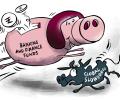
Even as banks and finance companies are reporting record-high earnings, their weighting in the benchmark National Stock Exchange Nifty50 Index has seen a downward trajectory. Investors expect a stronger performance from other sectors in the new year. Currently, banking, financial services and insurance (BFSI) companies collectively hold a weighting of 34.5 per cent, down from 36.7 per cent at the end of December 2022 and a record high of 40.6 per cent at the end of December 2019. This represents the sector's lowest weighting in the index since December 2021 when it stood at 33.7 per cent.
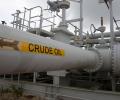
The government on Monday hiked special additional excise duty on crude petroleum to Rs 7,100 per tonne with effect from August 15. In the last fortnightly review, windfall tax on domestically produced crude oil was set at Rs 4,250 per tonne.

'The life of his political career is dependent on success in this constituency.'

Prime Minister Narendra Modi on Friday received Bhutan's highest civilian award, the 'Order of the Druk Gyalpo', making him the first foreign Head of the Government to receive the honour.

Qwik Supply, the third largest donor to political parities using electoral bonds, bought Rs 410 crore bonds between 2021-22 and 2023-24, and gave all but Rs 25 crore to the BJP.

Operating margins have been the primary driver of corporate earnings in India in recent quarters, despite revenue growth suffering from weak consumer demand. Companies across sectors have reported a sharp improvement in earnings before interest, tax, depreciation, and amortisation (Ebitda) margins over the past two years, benefiting from lower commodity and energy prices. Higher margins more than compensated for slower revenue growth, resulting in double-digit growth in net profit for five consecutive quarters.

The limited availability of flexible (flex)-fuel vehicles in the Indian market and the slow rollout of ethanol-blended petrol by oil-marketing companies (OMCs) remain major obstacles to achieving widespread use of biofuels in the transportation sector in India. Recently, two Union ministers have emphasised India's biofuel potential, arguing that it has the capacity and potential to lead a transition towards widespread biofuel adoption. Road Transport Minister Nitin Gadkari signalled that this transition is well underway and urged car manufacturers to quickly adapt and introduce new biofuel-run vehicles, lest the government resort to taxing diesel vehicles.

The meeting was attended by Home Minister Amit Shah, Finance Minister Nirmala Sitharaman and Urban Affairs and Petroleum Minister Hardeep Singh Puri.

Top government officials in New Delhi have started discussions with stakeholders ranging from shipping and container companies to export promotion councils to understand the impact of the Iran-Israel tensions and plan ahead. Inter-ministerial talks are also being lined up amid the crisis situation in West Asia, sources confirmed. While the crude flows are not directly under any threat, elevated oil prices remain a concern, according to officials.

The top-notch faculty at Crotonville, including Noel Tichy, Ram Charan, Vijay Govindarajan, along with GE's top leaders Jack Welch, Gary Reiner, Bill Conaty, Jeffrey Immelt and Susan Peters, together delivered sought-after programmes on leadership to generations of early-stage leaders, mid-tier and senior managers from all over the world, recounts Indrajit Gupta.
India's exports declined by 6.86 per cent to $34.48 billion in August this year as against $37.02 billion in the same month last year, government data showed on Friday. Imports too declined by 5.23 per cent to $58.64 billion as against $61.88 billion recorded in August 2022.

Rekha Jhunjhunwala's net worth has increased by more than 7 per cent, or Rs 2,865 crore, compared to less than 1 per cent rise in the BSE Sensex.

This is the case even though the benchmark index is only 5 per cent below its all-time high. The list of stocks trading at a discount primarily consists companies in the automotive, banking, oil and gas, insurance, healthcare, and metal sectors.

Eight Union ministers, two former chief ministers and one ex-governor are among those who are set to test their electoral fate in the first phase of elections on April 19 when 102 seats across 21 states and Union territories will go to polls.

Union excise duty collection dropped 18 per cent in August year-on-year at a time when the overall central tax kitty rose about 94 per cent before devolution to the states. The mop-up from Union excise duty declined to Rs 23,576 crore in August this year compared to Rs 28,816 crore in the same month a year ago. On the other hand, total tax collection rose to Rs 2.9 trillion in the month as against Rs 1.5 trillion in August 2022-23, shows the data released by the Controller General of Accounts (CGA).

Russian energy giant Rosneft has appointed a former Indian Oil Corporation (IOC) director to its board in signs it may be looking at boosting trade links with India. G K Satish, who retired as director for business development at IOC in 2021, is one of the three new faces appointed to the 11-strong board of directors of Rosneft, according to a statement issued by the Russian firm. Satish, 62, is the first Indian to be appointed to the board of Rosneft.
