
The last round of Corps Commander-level talks had taken place on October 12 but there was no breakthrough on the disengagement of troops from the friction points.

External Affairs Ministry Spokesperson Anurag Srivastava said India is committed to resolve all issues through dialogue, noting the way ahead to address the issue is negotiations.

Senior officers recounted extreme Chinese brutality to the Indian prisoners, with some of them being pushed over cliffs and soldiers' bodies being recovered from the Galwan River.

The annual threat assessment of the US Intelligence Community released by the Office of Director of National Intelligence (ODNI) also said that the 'expanded military posture by both India and China along the disputed border elevates the risk of armed confrontation between two nuclear powers that might involve direct threats to US persons and interests and calls for US intervention'.
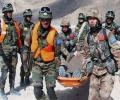
'For the moment in Eastern Ladakh, it is unlikely there will be any more escalation of this conflict,' observes Colonel S Dinny (retd) who served as Commanding Officer of an infantry battalion deployed in the Pangong Tso area.
Gen Wang is the fourth commander to head the Western Theatre Command after the eastern Ladakh standoff began in May last year.
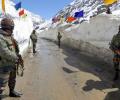
China on Thursday said Chinese and Indian troops have taken "effective measures" to disengage at the Galwan Valley and other areas along the Line of Actual Control in eastern Ladakh and the situation is "stable and improving," days after the two sides agreed on an expeditious withdrawal of soldiers from all the standoff points.
It is learnt that the India's top military brass is constantly monitoring the evolving situation even as the United States said the aggressive behaviour by Chinese troops was a reminder of the threat posed by China.
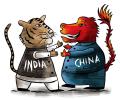
India and China achieved a major milestone this year when their bilateral trade crossed the landmark figure of $100 billion but it did not generate any fanfare in both capitals as the two Asian giants are going through a "particularly bad patch" in their relations due to a set of actions by Beijing in violation of agreements that led to the military standoff in eastern Ladakh. Starting with a modest $1.83 billion in 2001, the bilateral trade crossed $100 billion-mark in the first 11 months this year, a significant milestone for which the two countries carried out campaigns to boost trade and build it as a major stakeholder to improve the relations between two nations, whose ties otherwise remained frosty over the festering boundary dispute and strategic rivalry. According to last month's data from China's General Administration of Customs (GAC), the India-China bilateral trade totalled $114.263 billion, up 46.4 per cent year-on-year from January to November 2021.

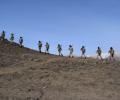
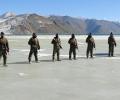
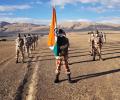
Rediff reader CK Varma shared these photographs.
The 60-metre bridge is around four kilometres east of the confluence of Shyok and Galwan rivers, and links the narrow mountainous region to the Shyok-Daulat Beg Oldi road.

'We should not allow ourselves to be surprised in any manner in future on the border.'
"I am not aware of the information you provided," Chinese foreign ministry spokesman Zhao Lijian said in Beijing when asked about the reports of the Indian casualties at the contested borders. "Our border troops had a high-level meeting and reached important consensus on easing the border situation but astonishingly, on June 15, the Indian troops seriously violated our consensus and twice crossed the border line for illegal activities and provoked and attacked Chinese personnel which led to serious physical conflict between the two sides and China has lodged strong protest and representation with the Indian side," Zhao said.
"Against such background, the words and deeds of relevant important military and government officials and military deployments should be conducive to deescalating and cooling down the situation, and to enhancing mutual trust, rather than the opposite", the spokesman said.
'The Indian Army is fully prepared for a long and permanent deployment if the PLA does not retreat.'

India and China are likely to hold another round of diplomatic talks this week on eastern Ladakh with a focus on moving forward in disengagement of troops in the remaining friction points, people familiar with the development said on Tuesday.

'The General appreciated the importance of history in understanding modern conflict.' Tibetologist Claude Arpi recalls his meetings with General Bipin Rawat.
India and China on Friday agreed to hold the next round of military talks at an early date to achieve the objective of complete disengagement in remaining friction points in eastern Ladakh amid fresh sparring between the two sides on the prolonged Line of Actual Control (LAC) standoff.
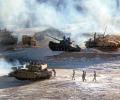
'We must be careful because China has not given its design in Eastern Ladakh.'
Who knows, the moment of truth in Ladakh may also augur for a giant leap toward boundary settlement with China in the fulness of time. The news that the special representatives of the two countries are planning to meet gives a positive signal, suggests Ambassador M K Bhadrakumar.

Wrapping up his two-day visit to Ladakh, Gen Naravane said the Indian Army has undertaken precautionary deployment in some areas and that the force is well prepared to safeguard the territorial integrity of the country.

The two sides are also expected to finalise a roadmap for restoration of peace and tranquility in the high-altitude region that witnessed an eight-week bitter standoff between the troops of the two countries.
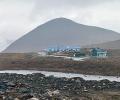
China's national legislature -- the National People's Congress (NPC) -- on October 23 adopted the new law on the protection and exploitation of the land border areas which drew sharp reaction from India as it was passed amid the protracted military standoff between the two sides in eastern Ladakh region.

In the first highest level face-to-face contact between the two sides after border tension erupted in eastern Ladakh in early May, Singh and Wei met for two hours and 20 minutes in Moscow on Friday evening on the sidelines of a meeting of the defence ministers of the Shanghai Cooperation Organisation.
There was no visible forward movement in disengagement of troops in the remaining friction points as the Chinese side did not show flexibility in their approach on it at the 11th round of military talks.

The meeting will take place in Chushul sector on the Indian side of Line of Actual Control.

External Affairs Minister S Jaishankar said on Friday that India and China are going through a 'particularly bad patch' in their ties because Beijing has taken a set of actions in violation of agreements for which it still doesn't have a 'credible explanation' and it is for the Chinese leadership to answer where they want to take the bilateral relationship.

In a statement, the Indian Army said the face-off was resolved by local commanders as per established protocols. The incident at Naku La became public on Monday hours after senior commanders of both the armies concluded a nearly 16-hour-long meeting in an attempt to defuse tension in eastern Ladakh.
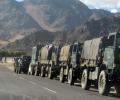
According to estimates, both India and China have deployed more than 50,000 troops in the Eastern Ladakh sector opposite each other despite the limited disengagement in the Pangong lake sector by both sides earlier this year.
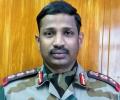
Colonel Santosh Babu who hailed from Suryapet district in Telangana, was serving in the 16 Bihar regiment as Commanding Officer.
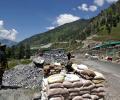
India's top military and strategic brass on Tuesday reviewed the overall situation in eastern Ladakh amid indications that the latest round of talks between senior military commanders of Indian and Chinese armies on the next phase of disengagement of troops may not have produced encouraging results, people familiar with the developments said.
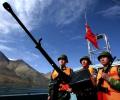
Both the Indian and Chinese armies have brought in more troops in sensitive locations like Demchok, Daulat Beg Oldie and areas around Galwan river as well as Pangong Tso lake in Ladakh, the sources said. The area around Galwan has been a point of friction between the two sides for over six decades.
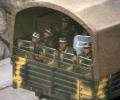
The intrusions into India were likely carried out by the PLA's better trained and equipped 'mobile operational units'.
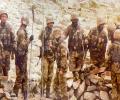
The Chinese numbers had surged significantly during the summer season as they brought in a large number of troops for summer training. They have now gone back to their rear locations.
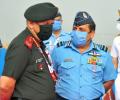
Gen Rawat's comments about the supporting role of the Air Force came at a conference when asked about the growing perception that the Indian Air Force was not keen on setting up the proposed theatre commands integrating the capabilities of the three forces.
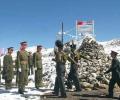
In separate statements, the Chinese foreign and the defence ministries, however, repeated Beijing's stand that India was responsible for the June 15 violent face-off in eastern Ladakh. Defence Ministry Spokesman Col Wu Qian said the two defence ministers are negotiating on the phone.
The two armies had mutually decided not to resort to use firearms during face-offs in sync with provisions of two agreements on border management.

Senior government sources told ANI that one such camp is coming up few kilometres inside the Chinese territory opposite the Naku La area in north Sikkim area, which is barely a few minutes distance from the area where Indian and Chinese troops had clashed last year when the confrontation started and also in January this year.

'Wang Yi said the border issue is important and we should stay committed to peacefully addressing it through consultation and coordination.'

Gen Naravane said that the Indian Army did not hide casualties during Galwan clash in eastern Ladakh as the Chinse have done.
