
If the markets regulator has not yet sent an advisory note to Coal India on its chief executive's frequent announcements in the media, it is probably because it is a public sector enterprise.
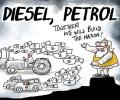
The government on Friday slapped an export tax on petrol, diesel and jet fuel (ATF) while also joining nations like the UK in imposing a windfall tax on crude oil produced locally. A Rs 6 per litre tax on export of petrol and ATF and Rs 13 per litre tax on export of diesel is effective from July 1, finance ministry notifications showed. Additionally, a Rs 23,250 per tonne tax was levied on crude oil produced domestically.
Public sector banks have asked the Centre to intervene as talks with bank unions for allowing half of their employees a second chance to opt for pension instead of provident fund have reached a deadlock.

Was told that account will be closed if it did not stop providing insurance cover to ships ferrying oil from Iran.
An Asscocham survey reveals that middle-rank employees in public sector units, foreign embassies and academic institutions are satisfied with their jobs driven by limited accountability.

This was stated by Minister of State for Health Ashwini Kumar Choubey in the House in response to a question on the number of healthcare staff, including doctors, nurses and ASHA workers who have been affected died due to COVID-19.
Public sector banks, in a frenzy to cash in on the retail credit boom during the three years beginning 2003-04
In 2003 when the West Bengal government initiated public sector units restructuring programme, it was believed that off loading government's stake in PSUs would deliver effective social welfare programme in the state.
Reckless lending during the three years of the retail credit boom beginning 2003-04 is hurting public sector banks hard.

Mihir Tanna, Associate Director, S K Patodia & Associates, answers your tax queries.

The current power crisis is mainly on account of sharp decline in electricity generation from different fuel sources and not due to non-availability of domestic coal, a top official said on Sunday. The above statement assumes significance in the wake of reports of many states, including Maharashtra, facing power outages due to shortage of coal. In an interview to PTI, Coal Secretary A K Jain attributed the low coal stocks at power plants to several factors such as heightened power demand due to the boom in the economy post COVID-19, early arrival of summer, rise in the price of gas and imported coal and sharp fall in electricity generation by coastal thermal power plants.

The move is expected to encourage brokers to sell issues, which have not received a very encouraging response so far.

Besides, some PSUs that have remote locations are unable to communicate the public offer message to their employees and face various difficulties like opening demat accounts.
Nikunj Saraf, Vice President Choice Wealth, answers your queries.

Under Indradhanush roadmap announced in 2015, the government will infuse Rs 70,000 crore in state banks over four years while they will have to raise a further Rs 1.1 lakh crore from the markets to meet their capital requirement in line with global risk norms, known as Basel-III.

A review of three years' audit reports of CAG showed that the state PSUs' losses of Rs 6,072.96 crore (Rs 60.72 billion) were 'controllable' with better management.
Employees of profit making central public sector units may retire at 60 years against 58 currently, depending on the decision of the administrative ministry.

FDI rules announced last year changed the criteria of calculating these investments and included American depository receipts, global depository receipts and convertible shares also in that category.
Public sector undertakings Bharat Earth Movers (BEML), Rural Electrification Corporation (REC), Power Grid Corporation of India and National Hydroelectric Power Corporation (NHPC), are slated to hit the market with their IPOs.

Mid- and small-cap indices have outperformed the frontline benchmarks - the S&P BSE Sensex (up around 10 per cent) and the Nifty50 (13 per cent) - in the first half of calendar year 2021 (H1-CY21) by rallying 26 per cent and 39 per cent, respectively. The trend, analysts believe, is likely to continue in H2-CY21 as well. The outperformance in H1-CY21 comes on the back of improved earnings and strong inflows from the foreign portfolio investors (FPIs) in Indian equities. However, good monsoon so far, gradual opening up of the economy and the pick-up in the pace of vaccination provides support to the market.

Affordable pricing, a variety of themes, and the ease of transacting are among key reasons that have made smallcases a hit among young investors.

At present, the rules do not allow the government to shed stake in the four public sector general insurance companies - New India Assurance, United India Insurance, National Insurance and Oriental Insurance.
Officers of Central Public Sector Units will go an indefinite nationwide strike from December 22, demanding higher salaries and autonomy for the public sector.
Concerned over the flight of talent from public sector undertakings to private sector, officers of profit making public sector units have threatened to go on an indefinite strike from December 22 seeking higher salaries.

Initial public offerings (IPOs) by start-ups are bringing cheer to investors and investment bankers alike. After food delivery company Zomato, Nykaa has issued the fattest pay cheque to the managers of its share sale -- Rs 148 crore, or 2.8 per cent of its issue proceeds of Rs 5,300 crore. In absolute terms, this is the second-highest amount paid to investment bankers for handling an IPO, while in percentage terms, it is the highest for large IPOs (>$300 million) in the last one year, shows an analysis of the data provided by Prime Database, a primary market tracker.

Infosys was the top gainer in the Sensex pack, jumping over 4 per cent, followed by Tech Mahindra, Tata Steel, ICICI Bank, ITC, Maruti, SBI and Axis Bank. On the other hand, HCL Tech, M&M, Dr Reddy's, Asian Paints, Bajaj Auto and Bharti Airtel were among the laggards.
The wait of seven public sector companies for inclusion in the elite Navratna club seems to be an endless affair, with the meeting of a top body that will vet their case repeatedly getting postponed because of absence of compelling proposals.
Financial performance, tax issues to be discussed on June 13 meeting.

'It really doesn't matter that investors getting allotments sell their IPO stock holdings on listing day because a new set of investors are entering.' 'This explains the continued rise in stock prices even after the first day of listing.'
The Comptroller and Auditor General of India on Friday criticised the previous National Democratic Alliance government for undervaluation of a number of public sector units, including Balco and VSNL, where equity was divested.\n\n

Omkeshwar Singh, Head, Rank MF, a mutual fund investment platform, answers your queries.

State-owned companies have been set stiff targets to increase accountability as they get ready for divestment. Nikunj Ohri explains why meeting them will be challenging.

Report points out corporate vulnerability indicators remain elevated.

Billionaire Mukesh Ambani's Reliance Industries Ltd on Friday reported a 46 per cent jump in net profit for the three months ended June on the back of bumper earnings from oil and telecom businesses. The oil-to-retail-to-telecom conglomerate's consolidated net profit rose to Rs 17,955 crore during April-June period -- the first quarter of 2022-23 fiscal year -- from Rs 12,273 crore in the year-ago period, it said a stock exchange filing.

The current employee strength of all state-run banks is about 672,000.
ONGC retained the top position on the coveted list of 10 most profit-making PSUs, while AirIndia was the biggest loss-making state firm during 2010-11.

