
Although we all have tastebuds that are dying to sample all the yummy food around us, we must remember that anything in excess is bad.

The Nikkei Markit India Manufacturing Purchasing Managers' Index increased to 50.7 in February

Capital goods shares continued to trade firm in late noon despite weak market trend on the back of encouraging core sector growth in February.

Supported by greater demand from both domestic and external markets, total new business rose at the fastest pace since March

Indian economy grew 7.9% in March quarter and recorded a five-year high growth rate of 7.6% for the 2015-16 fiscal

'The large scale and widespread shrinking of the labour force in November, the peaking of unemployment in October and the fall in lead indicators in October and November point towards a worsening of the slowdown of the Indian economy in the third quarter of 2019-20,' says Mahesh Vyas.

Investors went looking for bargain in banking, oil and gas and auto stocks.

There is a strong case for 25 basis points cut in interest rates.

RBI's fifth bi-monthly monetary policy meet due tomorrow also kept the investors on their toes.

Indian companies have signed contracts worth Rs 3,000 crore in Iraq. The government has been facilitating these contracts with the help of the Permanent Mission of India in New York.

Heavy dollar selling by banks and exporters alongside debt-related inflows largely supported the rupee

The higher rate cut by RBI is positive for rate-sensitive sectors in the medium to long term.

China had been trying hard to enter the Indian market, without opening its own to Indian products. There is an economic crisis in India-China relations that the Chennai Connect barely scratched the surface, points out Srikanth Kondapalli.

Although growth picked up slightly across the world's main emerging markets on an average, rates of expansion remain subdued

Stock markets crashed over 1,000 points or nearly 4 per cent on Monday, making it the biggest fall since 2008.

On the sectoral front, rate-sensitive sectors such as Bankex and Auto gained by 1% and 0.7% respectively while BSE Consumer Durables gained 1.4%.

The survey showed firms' confidence regarding future business grew at the slowest pace in a year last month.

The NSE 50-share Nifty also closed higher by 61.60 points, or 0.59 per cent, at 10,504.80 after shuttling between 10,513 and 10,441.45.
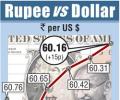
The currency got support from dollar flows into local equities and greenback sales from state-run lenders.

Growth concerns on China, which has already seen the yuan getting devalued twice in August, have rattled global financial markets, including that of India.

Data for the four largest emerging economies showed contrasting activity trends in November. China registered growth for the seventh month running, while India posted the fastest growth since June.

In the offshore non-deliverable forwards, the one-month contract was at 62.26/36, while the three-month was at 62.83/93.
Custodian banks are selling dollars for their foreign fund clients.

On the employment front, services employment was unchanged in April.
.jpg)
Although the survey pointed to the softness in demand leveling off, a complete recovery is still some way off.

A reading below 50 means contraction in the sector.

Launched in September 2013, the Conference Board Leading Economic Index for India, conceptualised back to April 1990, has successfully signalled turning points in the economic cycles of India.

India's manufacturing expanded at a faster pace than China

Investors were focussed on the RBI's monetary policy review on Tuesday which will give an insight into its inflation and rates outlook.
Adani Ports, HUL and L&T gained the most, while ICICI Bank, ONGC, GAIL and Tata Steel lost the most

ONGC, Sesa Sterlite, Tata Steel, RIL and HDFC emerged as the biggest losers

Growth in the eight core sectors jumped to 8.5% in April, due to a sharp pick-up in refinery products and a commensurate rise in electricity generation.

International education consultant NNS Chandra shares advice on how to pick the right international education.

Investors watch out for cues from the on-going winter session of the Parliament.

Coal India topped the losers' list in the Sensex pack on Tuesday, falling 2.36 per cent, followed by Bharti Airtel at 2.16 per cent.

Production at factories, mines and utilities likely rose an annual 2.4 per cent in August, up from July's 0.5 per cent rise, according to the survey of 26 economists.

Expenditure cuts necessitated by slowing revenue growth, weak industrial activity worrisome portents

The RBI left interest rates unchanged, saying there was no substantial development on inflation or fiscal fronts to warrant a fresh reduction.

In dull trade, the rupee on Monday ended a mere two paise lower at 60.20 against the US dollar on weak local equities and imported-driven demand for the American currency.
