The Delhi government is set to introduce a comprehensive drone policy aimed at creating over 1,000 jobs and regulating drone operations. The policy will focus on establishing research clusters, flight testing facilities, and providing subsidies, while also addressing drone usage for government purposes like traffic management and surveillance, considering the city's extensive 'no drone zones'.
Prime Minister Narendra Modi-led National Democratic Alliance government has changed the telecom policy after receiving electoral bonds worth Rs 150 crore from a company, All India Majlis-e-Ittehadul Muslimeen chief Asaduddin Owaisi claimed on Thursday.

The main thrust of the policy is on the multiplier effect and transformational impact of such services on the overall economy.

The Telecom Policy 1999 which revolutionised the telecom sector will be revamped soon with the Department of Telecom likely to retain licensing powers.

The Department of Telecommunications (DoT) will finalise its internal view on the Telecom Regulatory Authority of India (Trai's) recommendations, which was given in May last year, on mergers and acquisitions, spectrum allocation, spectrum sharing and other licencing aspects by the end of this month, a senior official from the department said.

'1991 was an exceptional period in Indian history.' 'A big 400-volt shock was administered to the system, which was required. Today, we are in a much, much better position.'

Trai Chairman Anil Kumar Lahoti highlighted the transformative role of satellite communications in expanding seamless connectivity across India, especially in remote areas. He noted that India's space economy is projected to grow significantly, driven by satcom technology that will bridge the digital divide, provide resilient infrastructure during disasters, and support strategic sectors.
Trai Chairman Anil Kumar Lahoti highlighted the transformative role of satellite communications in expanding seamless connectivity across India, especially in remote areas. He noted that India's space economy is projected to grow significantly, driven by satcom technology that will bridge the digital divide, provide resilient infrastructure during disasters, and support strategic sectors.
The policy is also pushing for a one-country-one-licence regime, which means removal of roaming charges.

With the import bill of telecom equipment rising, the government on Wednesday said preferential treatment would be given to its indigenous production in the New Telecom Policy, which is under formulation.

The Delhi government is developing a drone policy focused on creating research clusters, establishing testing facilities, enabling drone use in traffic management, and providing subsidies to support the drone ecosystem.

The department is planning a complete overhaul of the archaic Indian Telegraph Act.

Indian stock markets this week will be primarily influenced by a series of corporate Q1 earnings, the evolving geopolitical situation in West Asia, and fluctuations in crude oil prices, according to market analysts.
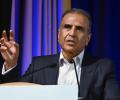
Bharti Airtel is strategically shifting its focus towards data centres, cloud services, and financial services as key drivers for its next phase of growth, leveraging significant past investments in digital infrastructure, as outlined by Chairman Sunil Mittal in the company's Annual Report for 2025-26.

The policy was earlier expected to be unveiled by December this year, but delays in receiving recommendations have pushed the date to next year.

Kanwal Rekhi is a peaceful techie who ardently believes in competitive market economics and democracy, despite the trauma his family suffered during Partition and his narrow escape from violent mobs in 1984.

Reports that the government is considering seeking a review of that judgment are worrying.

Telecom users will be able to avail free roaming and keep their phone numbers even if they switch service providers anywhere in the country, as per the draft New Telecom Policy unveiled by the government said on Monday.
Citing statistics of teledensity which has gone up from seven per cent in March 2004 to 66 per cent in December, 2010, Singh said the policy has paid 'rich dividends'.
The Joint Parliamentary Committee on the 2G spectrum scam on Wednesday began examining the telecom policy pursued during the National Democratic Alliance rule as it sought to know the quantum of losses incurred during that period and decided to summon the then Attorney General Soli Sorabjee in this connection.
The Department of Telecommunications is planning to give more powers to the telecom regulator, Telecom Regulatory Authority of India, in the new telecom policy, including the power to impose financial penalties on the erring telecom service providers.
The Iran conflict led to a sharp correction in Reliance Industries Ltd's (RIL's) share price, which has been partially reversed by a rebound.

The government has approved mergers between telecom companies with a combined market share of 35 per cent and rejected spectrum-sharing among 3G operators while restricting it for 2G operators.

The Karnataka government is reviewing its data centre policy to prioritise sustainability due to concerns about the significant water and energy consumption of data centres. The government is exploring coastal locations like Mangaluru for future data centre development and focusing on smaller-scale data centres.

Investors are keenly awaiting clarity on Reliance Jio Infocomm's IPO, the company's AI and data centre strategies, and next-generation leadership structure at Reliance Industries Ltd's (RIL's) 49th annual general meeting (AGM).
"Draft of the policy was circulated in 2011 for consultation with various stakeholders. Views/comments from these stakeholders have been received and the same are under consideration. NTP is likely to be in place by June 2012," the Survey said.
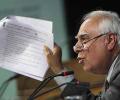
Delinking spectrum from the licences in the aftermath of the 2G scam, Sibal said, "In future, the spectrum will not be bundled with licence. The licence to be issued to telecom operators will be in the nature of 'Unified Licence' and the licence holder will be free to offer any of the multifarious telecom services."

A section of industry may need to begin compliance immediately, even as most states are yet to notify their rules.

The Joint Parliamentary Committee to probe the 2G spectrum issue will look into the allocation and pricing of telecom licences and spectrum from 1998 to 2009.
Amidst the controversy over the allocation of spectrum and grant of telecom licences, the government on Monday said all licences are proposed to be renewed after 10 years instead of the 20-year period earlier.

Among the Sensex firms, Bharat Electronics Ltd, Mahindra & Mahindra, Adani Ports, HCL Technologies, Eternal, Infosys, Bharti Airtel, Sun Pharmaceuticals, Larsen & Toubro, Hindustan Unilever and UltraTech Cement were the gainers. Bajaj Finance, Tata Motors Passenger Vehicles, Kotak Mahindra Bank, PowerGrid and Tata Steel were among the laggards.

As the March 31 deadline arrives, a wave of Maoist surrenders suggests insurgency's end, but political and social concerns remain.

FPIs net sold equities worth Rs 1.7 trillion in 2025 -- the highest annual net sale on record.

The same technologies that enable State forces to monitor and strike insurgent camps are now being mirrored by non-State actors with increasing sophistication.
Telecom Minister Kapil Sibal has accused the Bharatiya Janata Party-led National Democratic Alliance (NDA) government over the 2G spectrum allocation
