
The banking sector is set to move at a fast pace from hereon.

The bank's gross non-performing assets rose to 10.69 per cent of total advances at the end of June, against 9.97 per cent a year ago.

The National Company Law Tribunal (NCLT) has approved the resolution plan of Twin Star Technologies -- a promoter entity of the Vedanta Resources group -- for the Videocon group. But it has pointed out that the successful resolution applicant is "paying almost nothing" as the amount offered is only 4.15 per cent of total outstanding claim. It noted the hair cut for all the creditors is 95.85 per cent and suggested to both committee of creditors (CoC) and the successful applicant an increase in the payout.

Norms governing investments by provident funds bar these from depositing funds in a commercial bank in case the NPAs of that bank exceed two per cent of net advances.

Industrial Developemnt Bank of India, the principal lender to the Dabhol Power Company, has finally declared the 2,184 mw power project as a non-performing asset.

The stimulus measures include extension of the 90-day moratorium on recognition of impaired loans to 180 days, in addition to several relaxations in bank lending limits, including allowing banks to fund interest on working capital loans.

Fraud-hit Punjab and Maharashtra Cooperative (PMC) Bank on Tuesday invited expression of interest (EoI) from potential investors for investment or equity participation in the bank for its reconstruction. Subsequent to commencement of the normal day-to-day operations, it will be open for the investors to convert the bank into a small finance bank by making an application to the RBI, the lender said.

The Finance Ministry has asked top rung exectives of United bank of India to furnish bad loan recovery report on daily basis.
Software firm dismisses charge, says Finacle has proven ability.

India's banking sector, dominated by more than two-dozen state-run lenders, has been hobbled by its highest bad-loan ratio.

Overall, in the last five straight sessions, the index has lost nearly 1,129 points.
The major beneficiaries of loan recasting will be sub-Rs 500 crore corporate exposures and retail exposures, which were earlier expected to see the highest increase in NPAs in percentage terms.

Standalone total income increased to Rs 74,457.86 crore in the first quarter of 2020-21, from Rs 70,653.23 crore in the same period a year ago.

'If credit is not available, people will postpone buying. That's what has happened.'
All restructured loans to become NPA from April 1, 2015; Promoters' personal guarantee a must; Infra projects to get breather

The airline was considering selling two properties worth Rs 120 crore for partial loan repayment.

Every employee on an average contributed Rs 650,000 to the bank's profit in the last fiscal.

The one-time restructuring of loans will help every firm and prevent cost-cutting measures such as lay-offs.
Cases of students defaulting on loan payments prompted Indian Bankers Association to review the educational loan scheme. We explore what this means for students.

'We do not know when we will get to the business-as-usual mode.' 'Many borrowers may not be able to pay up.' 'The incidence of cheque bouncing has doubled or even trebled, some lenders say,' says Tamal Bandyopadhyay.

While the overall loan disbursements stood strong at 15 per cent YoY in Q2, pockets such as vehicle finance, loans to NBFCs, and business banking showed some weakness. A continued fall in these numbers may make it tough for AU SFB to defend its valuations under the current circumstances.
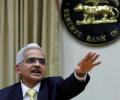
'The banking sector appears to be on course to recovery,' declares the RBI governor.

The bank, which has suffered reverses following a massive spike in dud assets and also the dismissal of its chief executive Chanda Kochhar over governance issues, however, hinted that the worse is behind.

With the above relaxation, more than 70 per cent of the depositors of the bank will be able to withdraw their entire account balance, the central bank said as most of its account holders have an average balance of just about Rs 10,000.
Explaining the modus operandi of the case, the FIR said HDIL promoters allegedly colluded with the bank management, to draw loans from the bank's Bhandup branch. Despite non-payment, the bank officials did not classify the loans as NPA and intentionally hid the information about the same from RBI.

Bankruptcy proceedings are going at a slower pace than what the bankers had envisaged and many cases have gone beyond the 270-day timeline set under the IBC mainly because of litigation.

Bank had registered a standalone net profit of Rs 1,263 crore in the same period a year ago

The bank may post a loss of Rs 1,000 crore during October-December 2019-20 quarter, an analyst commented.

'The snakes and ladders game will continue till the consolidation process is complete simply because we don't know how bad the scene is, with some of the banks being merged,' says Tamal Bandyopadhyay.

The new circular provides for a framework for early recognition, reporting and time-bound resolution of bad loans.

Regulator wants to change NPA classification and hike capital requirement.

Axis Bank was the top laggard in the Sensex pack, plunging more than 5 per cent, followed by HDFC, Bajaj Finance, ICICI Bank, Tata Steel, Bajaj Auto, HDFC Bank and IndusInd Bank. On the other hand, M&M, Infosys, Asian Paints, UltraTech Cement and Tech Mahindra were among the gainers.
Reserve Bank has almost finalised the structure of Central Fraud Registry.

Rating agency Care Ratings said the gross non-performing assets ratio of domestic banks will increase to 4.5 per cent by March 2014 and impact the profitability by up to 30 per cent.
Dream hillstation project Lavasa, near Pune, is now a millstone around lenders' neck.
The Reserve Bank on Monday eased norms for structuring of existing long-term project loans to infrastructure and core industries, to revive stalled plans and help banks tide over mounting bad loans.

The combined market capitalisation of the 21 listed PSU banks declined by about Rs 76,000 crore to Rs 425,800 crore during the month.

With a view to protect prudent commercial decision of bankers, the government has taken a slew of decisions, including doing away with personal responsibilities of MD and CEO of PSBs for compliance in dealing with large value frauds committed by bank officials.

Y H Malegam, 80, will head the panel that will look into non-performing bank assets and their relation to the Rs 114-bn PNB scam.
