
The meeting came amid a face-off between the central bank and the finance ministry over issues ranging from appropriate size of reserves that RBI must maintain to ease of lending norms to step up growth in an election year.

Companies expect recovery in second half of fiscal as BS VI approaches, claim banks and NBFCs showing greater interest in financing.

The Indian financial system's asset quality improved despite the pandemic, but it could be due to special dispensations by the regulator, and banks would likely see increased stress on their books once the schemes expire. According to the annual trend and progress report of the Reserve Bank of India (RBI) released on Tuesday, the data available for this financial year so far indicate that banks' bad debts have moderated while provision coverage ratios (PCRs), capital buffers as well as profitability indicators have improved relative to pre-pandemic levels.

You should also get the maximum tax benefit from your home loan. See if you can make your spouse a co-applicant and avail the tax benefits. You will simply double the tax benefits if there are two co-applicants.

A vast majority of borrowers are in the essential services' supply chain with tiny and micro businesses, and this has sprung back.

Troubled Vodafone Idea Ltd (VIL) has filed a review petition in the Supreme Court after the apex court recently dismissed its plea for rectification of the alleged errors in the calculation of adjusted gross revenues-related dues. In the petition, filed earlier this week, VIL has said it is "a travesty of justice" that the company is restrained from questioning the arithmetical errors/ omission which are going to cost it about Rs 25,000 crore (Rs 5,932 crore of principal plus interest, penalty and interest on penalty). VIL has said its contentions have been rejected by the order under review and added that this denial could result in the company going under and its about 27.3 crore subscribers being left "high and dry".

PV registrations in this year's festive period stood at 287,717 units as against 333,456 units in the corresponding period last year, down 14 per cent. Two-wheeler registrations also fell by 13 per cent to 15,83,276 units as against 18,11,703 units in the year-ago period.

Currently, there is no standard method for arriving at the value of gold accepted as collateral and valuation is arbitrary and opaque.

'Banks, fund managers, NBFCs, rating agencies, those buying into debt funds -- all of them will have to watch their step as India's financial system enters a new phase,' warns T N Ninan.

Finance Minister Nirmala Sitharaman on Friday said the government is proposing additional tax deduction of Rs 1.5 lakh on interest paid on home loans taken up to March 2020 for purchase of house up to Rs 45 lakh.

Reserve bank is working with the govt to bring suitable amendments in the statutory provisions
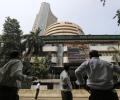
Top gainers in the Sensex pack included Sun Pharma, TechM, Axis Bank, L&T, Reliance Industries and ICICI Bank, which rose up to 2.66 per cent.

'Q1 is going to bear the brunt of the second wave, exposing full-year GDP forecasts to downward revisions, unless phase-3 of vaccination is executed quickly.'

Sitharaman said the government wants to sell stake in public sector companies at a time when it fetches the right price.

'At this moment, investors should look for relative value within sectors and clear visibility (third-wave-or-not) on earnings delivery.'

Observing that the economic recovery was not yet fully entrenched, the RBI Governor said recovery is likely to be gradual.

Axis Bank emerged as the biggest gainer in the Sensex pack, surging 6.62 per cent, followed by SBI at 5.88 per cent.
The Reserve Bank of India (RBI) is considering options to make cheaper finance available to the non-banking finance companies (NBFCs), including a separate line of credit for bank finance backed by government securities or AAA-rated commercial paper (CP).

The government plans to bring down its stake to 26 per cent in these two banks, which are yet to be identified. This may not come in the way of getting investors for these banks, provided the government is willing to step back rather than run them the way it had been doing for over five decades since these banks were nationalised, points out Tamal Bandyopadhyay.

'The effect will be seen two-three quarters down the line.'

The focus of the meeting will be on enabling businesses and households to avail of the revival framework on the basis of viability, necessary steps like finalising bank policies and identifying borrowers, and discussing issues that require addressing for smooth and speedy implementation.

Sitharaman said economic slowdown seems to have bottomed out and the coming festive season will help the economy start looking up.

The government is set to ask PSBs to expeditiously introduce repo-rate linked products "to step up affordable credit".
'Companies with a strong business case and healthy balance-sheet should sail through and emerge more robust in the future.'

Corporate indebtedness is now twice what it was before the global financial crisis; banks' bad loans ratio is 3.5 times higher.

Subbarao said, short-term as well as medium-term prospects or Indian economy continue to be grim. Fiscal deficit is going to be much higher, the debt burden much larger and the financial sector will be in a worse shape.

'Slower-than-anticipated recovery can be a bigger risk this time than a liquidity-driven event -- at least for India.'

The sentiment in the real estate industry turned optimistic during October-December 2020 and the outlook for the next six months is positive on the back of revival in demand for both residential and office properties, according to a survey by Knight Frank India-FICCI-Naredco. The 27th edition of 'Real Estate Sentiment Index Q4 2020 survey' of developers, banks, financial institutions and private equity players operating in the sector was released on Monday in a video-conference. As per the report, the 'Current Sentiments Score', for the first time in 2020, entered the optimistic zone at 54 points in Q4 (October-December) 2020, a significant jump of 14 points over the previous quarter.

For a borrower, who has serviced his loan without missing any repayment, the banks will be willing to take over the loan, give a top-up, and would offer lower interest rates, says Tinesh Bhasin.

When looking for alternatives, consider several parameters -- your investment horizon and liquidity requirement, post-tax returns, and risk.

'It really doesn't matter that investors getting allotments sell their IPO stock holdings on listing day because a new set of investors are entering.' 'This explains the continued rise in stock prices even after the first day of listing.'

However, in the first quarter when the country was under a lockdown, net financial savings rose to 21 per cent of gross domestic product (GDP), according to the data released in the RBI's monthly bulletin.

Among the stocks that have seen the largest cut by MFs, the DVR shares (shares with differential voting rights) of Tata Motors have seen a cut of 243 basis points (bps) in MFs' stake.

The Reserve Bank of India (RBI) raised the minimum capital requirement for so-called shadow banks and tightened rules on deposits and bad loans to avoid any potential risk to the economy from these rapidly growing finance firms by regulating them like traditional banks.

The scheme is the biggest fiscal component of the Rs 20-lakh crore Aatmanirbhar Bharat Abhiyan package announced by Finance Minister Nirmala Sitharaman last month.

With the wedding season already in full swing, a few things to keep in minutes financially when tying the knot, advises Bindisha Sarang.

Krishnamurthy Subramanian listed land, labour, law, and liquidity as the key areas of big reforms.

The MSME sector, which is employment-intensive, accounts for 45 per cent of the country's manufacturing, 40 per cent of exports and nearly 8 per cent of gross domestic product.

Prices in Bengaluru, the National Capital Region, Hyderabad and Ahmedabad, however, witnessed an uptick during the period.

The report said resilience of the banks has increased with a sharp improvement in the provision coverage ratio to 60.6 per cent in March 2019 from 52.4 per cent in September 2018 and 48.3 per cent in March 2018.
