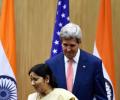
There was no breakthrough in US Secretary of State John F Kerry's India visit, but no breakdown either, says C Uday Bhaskar.
Attending the Nuclear Security Summit for the first time, Modi is expected to lay out his vision of securing nuclear weapons.
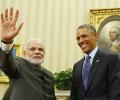
With their landmark 2005 civil nuclear deal still in limbo, India and the United States have established an inter-agency contact group to sort out outstanding liability and technical issues to fast-track its full implementation.

'... For the India-US relationship to continue its positive trajectory, it will require India to adapt to a different approach.' Nisha Desai Biswal -- who as the Obama administration's point person for South Asia was in the inner circle of all the Obama-Modi Summits -- tells Rediff.com's Monali Sarkar why she is hopeful that India and the US are on an irreversible forward course.
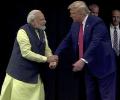
'... to Imran Khan, that there's not going to be any mediation of any meaningful sort given his (Modi's) special relationship with Trump.'

'Obama probably thinks, "He is quite a guy!" Americans on Capitol Hill think, "He has guts. He is a big player".' An Indian official explains the importance of the Modi visit to Sheela Bhatt/Rediff.com

'Cooperation at sea involves not just ships going out together and carrying out exercises over a couple of days, but understanding the whys and the wherefores,' points out Vice Admiral Premvir Das (retd).
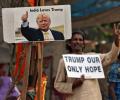
Congruence on terrorism, current disquiet on immigration, short-term visa would top the wish list.

Ahead of Prime Minister Narendra Modi's 3-day visit to the US, hundreds of Indian-Americans from across the country have joined hands to give him a rousing welcome in front of the United Nations headquarters and the White House.

For a rising country like China with its sights set on global and regional power, any coming together of the US and India is the worst case scenario. Hence, China is concerned with the emerging equations between New Delhi and Washington, says Srikanth Kondapalli.
At no other time has a single meeting of the leaders of two democracies been so critical and hazardous.

US President Barack Obama said there is natural convergence between India and the United States.
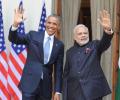
Modi and Obama surely put India-US ties in fast-forward mode. But 5 things deserve careful attention.

'This is the first time that the Americans have agreed to refer to "cross-border terrorist attacks" in a joint statement.' 'No wonder Pakistan has called the joint statement "singularly unhelpful" and has blasted it, and its all-weather friend China has applauded Pakistan's frontline role in combating terrorism,' points out former foreign secretary Ambassador Kanwal Sibal.
'A three generation US-Pakistan relationship is not likely to be snapped any time soon. All this presents an irritant to an India that wishes to concentrate on economic development,' says Colonel Anil A Athale (retd).

'The question remains: Was the Obama visit truly a success? Only the future will tell us if the "breakthrough" in the nuclear liability issue will concretise into electricity.' 'As importantly, it will be interesting to watch how India's relations with China will evolve in the months to come.'
'By his very presence in Delhi on Republic Day, Obama is revisiting the most defining relationship of the 20th century after a period of stagnation,' says Ambassador T P Sreenivasan.

'In the past the US has been reluctant to name Pakistan directly in an US-India joint statement.'

'If the dimensions of the strategic partnership worked out by India and the US seem like a grand alliance targeted at you-know-who, China had better realise that it has fathered it,' says B S Raghavan, a long time observer of China.

'It is in the interest of both sides that the visit of the US President is seen as being successful. Both sides have invested considerable political capital in it. This rapid exchange of visits and the decisions taken have to be justified, beyond the symbolism, which is no doubt important in itself. This opportunity to impart a fresh momentum to ties should not be missed,' says former foreign secretary Kanwal Sibal.
