
'Our automakers export 50 per cent of what they manufacture and once the policy comes into play, which is in the next 2-3 years, we would become a Rs 10 trillion industry.'

Of the total cash outgo Rs 40,000 crore is towards enhanced expenditure under Mahatma Gandhi National Rural Employment Guarantee Program and Rs 33,771.48 crore have been sought for direct benefit transfer under Pradhan Mantri Jan Dhan Yojana and National Social Assistance Programme.
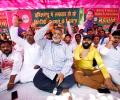
Unless controlled and contained, given the untested belief that the north Indian labour support and follow the Hindutva kind of political ideology, there is a potential in terms of ideological clashes with their Dravidian brethren in the local neighbourhoods, and it all escalating into violence, especially during election time, predicts N Sathiya Moorthy.

The Budget, to be presented on February 1, is likely to be less worried about fiscal deficit and will be focused more on nursing the fragile growth, according to a Wall Street brokerage report. Bank of America Securities India expects the budget to peg "fiscal deficit at a high 5 per cent of GDP for FY22 and 7.2 per cent for FY21, as it is likely to step up capex, recap public sector banks, push asset sales to break government monopolies, offer sops for real estate, tax cuts for lower income groups and creation of a bad bank". Its house economists expect these spends to be funded by debt and partly by imposing a cess on high income groups and also by some non-fiscal measures like tapping the central bank's revaluation reserves and bank recapitalisation and infra bonds.

Despite being given the post of a Union minister, Rane has been behaving like a "roadside gangster", Shiv Sena's mouthpiece Saamana said in an editorial.

"Unfortunately, while homage was paid to the photos of Bapu, and he found mention in speeches for many years, Khadi, handicrafts, use of swabhasha and swadeshi were forgotten. After becoming the prime minister, Narendra Modi gave a new lease of life to all these ideas of Bapu," Shah said.
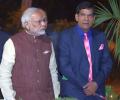
Known for delivering time-bound results, Sharma earned Modi's confidence as his secretary during his tenure as the Gujarat chief minister by successfully handling the Vibrant Gujarat campaign to get investments to the state.

Finance Nirmala Sitharaman on Friday asked various ministries to try to spend more than their capital expenditure targets as well as explore public private partnerships for viable projects. During a meeting with senior government officials to discuss the infrastructure roadmap, she also urged the ministries and their CPSEs to ensure clearance of Micro, Small and Medium Enterprises (MSME) dues at the earliest. This was the fifth review meeting by the finance minister with ministries and departments on the infrastructure roadmap.

As the FM said, this is a Budget that lays the foundation for the next 25 years, observes Kumar Mangalam Birla.

Gadkari said that the MSME sector contributes significantly in pushing the country's economic growth and creating employment.

The background work of creating a suitable digital architecture of a website also remains unfinished as it has been a challenge to shortlist technology partners.

With the spectrum auction now delayed till at least next May, the expected 5G orders for telecom equipment have not been sealed, the companies point out. Surajeet Das Gupta reports.

The presence of the private sector at a prestigious military training institution is an important acknowledgement of its growing capabilities in designing and manufacturing cutting edge aerospace and defence equipment, reports Ajai Shukla.

The Bharatiya Janata Party's Uttar Pradesh vice president Arvind Kumar Sharma will be reaching out to residents of western UP with public meetings in Noida, Greater Noida and Bulandshahr from Friday.

'Where will industry have funds when they open up?'

E-commerce firms and sellers including Amazon and eBay have made recommendations to the government for a differentiated policy framework for e-commerce in the revised Foreign Trade Policy (FTP) which is expected to come into effect from April 1, 2021. This is because the existing policies on exports have catered largely to traditional, offline and business-to-business exports. Suggestions have been made to the government that through the FTP, it is important to create a conducive policy framework for e-commerce exports that lowers the entry barrier for small businesses to start exporting, according to the industry sources.

'Nobody is talking about the inequality that is going to come.'

The bosses of SBI, Union Bank and Central Bank have been driving down to their offices everyday to take stock of the biggest loan drive ever undertaken for MSMEs, discovers Tamal Bandyopadhyay.
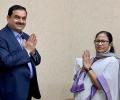
The words 'industry', 'industrial development', 'jobs', and 'employment' have been ringing with higher frequency since Mamata Banerjee stepped into her third term with landslide victory after a high-octane election last year. "Our government's next target is industrial development," the chief minister (CM) had been heard stating at different public meetings in the past few months - perhaps setting the tone for the sixth edition of the Bengal Global Business Summit (BGBS) slated for later this month. Investor summits by any state are about intent, big numbers, and tall claims. Yet in competitive federalism, its importance as a marketing tool is undeniable.
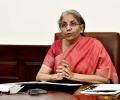
India Inc on Thursday pitched for continuation of reforms while ensuring tax and policy stability in the forthcoming Budget to prop up the economy hit hard by the COVID-19 pandemic. In the virtual pre-Budget consultation held with Finance Minister Nirmala Sitharaman, industry chambers said that government measures will help firmly entrench the nascent signs of recovery being currently seen in private investment. Capital expenditure by the government through enhanced infrastructure spending should in the meantime continue to support growth, CII president TV Narendran said.

Private lender Tamilnad Mercantile Bank's (TMB) is planning an Initial Public Offering ( IPO) of about Rs 1,000 crore by November-December 2021. The IPO will involve combination of fresh capital plus sale of existing shares. The shareholders of the unlisted South-based private bank have already given nod for IPO.

The National SC/ST Hub, under the micro, small and medium enterprises ministry, with an initial outlay of Rs 490 crore, will work towards strengthening market access/linkage, monitoring, capacity building, leveraging financial support schemes and sharing industry-best practices.

Officials said several witnesses were heard on the impact of the pandemic. They added that this was the longest meeting of the panel without a break so far.

The Reserve Bank on Tuesday asked all lending institutions, including non-banking financial companies, to implement the waiver of interest on interest for loans up to Rs 2 crore for the six months moratorium period beginning March 1, 2020.
Rs 5,000 crore additional liquidity facility to be provided by the National Housing Bank to boost liquidity in housing sector, the RBI said.

According to Fitch, the scheme could open a window for banks to build capital buffers while putting off full recognition of COVID-19 pandemic's impact on loan portfolios, but is reminiscent of a strategy adopted over 2010-2016 that delayed and exacerbated problems for banks.

Three TMC leaders Amit Mitra, Bratya Basu and Rathin Ghosh were sworn-in virtually. Mitra is unwell and both Basu and Ghosh are recuperating from COVID-19.

The country's economy will start witnessing a growth of 6.5 to 7 per cent from fiscal 2023 onwards, helped by various reforms undertaken by the government so far and also as COVID-19 vaccination drive progresses, Chief Economic Advisor Krishnamurthy Subramanian said. He said the second wave of COVID-19 is unlikely to have a very significant on the economy. The country's economy contracted by 7.3 per cent in fiscal 2020-21. "Together with the reforms and focus on vaccination, I expect growth to start hitting close 6.5 to 7 per cent from FY23 onwards and accelerate from there on," Subramanian said at a virtual event organised by Dun & Bradstreet.

What is your USP?
Why should your customers come to only you and nobody else? What particular problem are you solving? Solve these puzzles before launching a stat up suggests Rajiv Talreja.

The IMA feels that there is a dire need for a drastic change in health administration which can be realised by raising a new cadre of administrators, it said in a statement.

Finance Minister Nirmala Sitharaman on Tuesday unveiled a Rs 39.45 lakh crore Budget with a view to fire up the key engines of the economy to sustain a world-beating recovery from the pandemic. This was Sitharaman's fourth Budget. While the taxpayers were left in the lurch, once again, was she able to cheer Corporate India?

"The agitation of farmers continues and the government has shown shocking insensitivity and arrogance going through the charade of consultations," she said.

A plea was filed in the Supreme Court on Wednesday challenging the Delhi high court's May 31 verdict which dismissed a petition seeking to suspend all construction activity of the Central Vista Avenue redevelopment during the COVID-19 pandemic while describing it as a 'vital' and 'essential' project of national importance.

Net job creation in the economy fell by 16.9 lakh in FY21 over the previous fiscal, shows an SBI Research analysis of EPFO payroll data. However, the FY21 numbers are better than the FY20 net job creation, which had declined by 28.9 lakh, further cementing the view that the economy is not creating new employment opportunities. The latest EPFO data shows that net new EPF subscribers stood at 94.5 lakh in FY21, and NPS added 5.82 lakh, taking the cumulative net addition to 100.4 lakh, which is marginally down from 102.3 lakh in FY20.

India will not allow Chinese companies to participate in highway projects, including those through joint ventures, Union Minister Nitin Gadkari said on Wednesday amid the border standoff with China. Gadakri also said the government will ensure that Chinese investors are not entertained in various sectors like the micro, small and medium enterprises (MSMEs).

Govt to bring 'Bankruptcy Code' for ease of doing biz
The Reserve Bank on Monday superseded the boards of Srei Infrastructure Finance as well as Srei Equipment Finance, citing concerns over governance and payment defaults, and decided to refer the two NBFCs for resolution under the insolvency law. This is only the second time in as many years that the Reserve Bank of India (RBI) is referring entities for the resolution process under the Insolvency and Bankruptcy Code (IBC) after taking first ever such step in the case of DHFL back in 2019. Superseding the boards of the crisis-hit Srei Infrastructure Finance Limited (SIFL) and Srei Equipment Finance Limited (SEFL), the RBI has appointed Rajneesh Sharma, former Chief General Manager of Bank of Baroda as the administrator to manage the affairs of the two companies.

In an affidavit filed by Union finance ministry on behalf of the Union of India, it said that the relief to all borrowers in respect of compounding of interest during the period of moratorium would be admissible to the categories specified irrespective of whether the borrowers had availed the moratorium or not.

'There was hardly any recruitment after the second wave.' 'Now, there is a huge demand for manpower.'

'The economy is expected to bounce back and things are expected to recover faster than what we previously thought.'
