
Tamil Nadu government on Friday moved the Supreme Court seeking two-day police custody of ultra-Left folk singer Kovan, who was granted relief by the Madras High Court in a sedition case.
Granting him bail, Principal Sessions Judge N Audinathan observed during the hearing that the case was not one of defamation.
Kovan, a folk singer in Tamil Nadu, was arrested on October 30 for criticising the state government in a song distributed on the Internet. Kovan was charged with sedition among other alleged crimes.
'The song says that liquor should not be sold by the government. The government should stop people from drinking.' 'I am working for a social cause. I am not doing anything wrong. We have moved a petition in the high court to quash the FIR against me.' 'It is a people's movement. There is no Naxalite involvement here.' Singer Kovan, who was arrested on sedition charges for protesting against the Tamil Nadu governments liquor policy, speaks out.
Besides the sedition charge, police said they had registered cases against him under IPC sections including 153(A) (promoting enmity between different groups) and 502 (sale of printed or engraved substance containing defamatory matter).

One would not think that a Facebook status or a tweet could land you in jail, at least not in India -- the world's largest democracy. However, the reality is a lot more brutal in India, which has a shameful history of locking up its citizens for dissenting viewpoints. According to Mint, at least 50 people have been arrested through 2017 and 2018 for posts on social media. Syed Firdaus Ashraf/Rediff.com presents some of the most prominent cases.

The state police had last month arrested a 54-year-old singer on charge of sedition for allegedly uploading 'defamatory' electronic content against Jayalalithaa
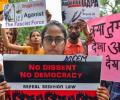
Why should an elected government, any party's government, need a law to protect itself from its people? asks Shekhar Gupta.

'The new generation voter is hyper-nationalistic, but it isn't essentially illiberal.' 'They will find the rants of Adityanath as laughable as Irfan Habib's. They will also find the BJP's polarising approach to vote-gathering unacceptable if it fails to deliver jobs and growth,' says Shekhar Gupta.

India "routinely" uses vaguely-worded laws like sedition and criminal defamation as "political tools" to "stifle" dissent, a leading rights group said.
