
Japan Plus to facilitate and fast-track investment proposals.

World No. 40 Anirban Lahiri will be a part of the International Team, which will take on United States in the biennial Presidents Cup in Korea.

The Indo-Japanese nuclear deal may not come easy considering India's Civil Nuclear Liability Act provisions which had earlier put off suppliers like General Electric, says Debalina Ghoshal.

An average of 30-40 per cent automation is standard across all big automobile plants in the country
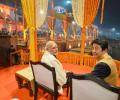
'Modi and Abe are working seriously for India-Japan bonhomie to grow stronger.' 'It is a win-win situation for both countries and the future look promising,' says Rajaram Panda, the Indian Council for Cultural Relations India Chair Visiting Professor at Reitaku University, Japan.

The referendum will have long-term implications for Indian companies, which earn a substantial portion of revenue from the region.

Under MRA, Japan is to recognise Indian medical degrees and treat the country's doctors and other medical personnel on par with its own.

Sebastian Vettel justified his favourite tag for the Singapore Grand Prix when he stormed clear of his rivals in Friday's second free practice, lapping more than half a second quicker than Red Bull team mate Mark Webber.


New Delhi's growing defence partnership with Tokyo could take wing with the US-2 (Utility Seaplane Mark 2), a one-of-a-kind amphibious aircraft that has Indian naval planners goggle-eyed.

'Building on the potential for closer ties is the changing narrative in each country about the other. The Chinese narrative on India has become significantly more positive over the past few years,' says Walter Andersen and Zhong Zhenming.

Experts tell Carnegie Endowment for International Peace that a Modi government may be Asia oriented, but the US will remain a deep influence. Aziz Haniffa reports

Prime Minister Narendra Modi enjoys a close relationship with Shinzo Abe. For Abe, "a strong India is in the best interest of Japan, and a strong Japan is in the best interest of India."

Arvind Panagariya speaks about climate change, globalisation and India's economy.
.jpg)
To no one's surprise, the first question directed at Indian Ambassador to the United States Dr S Jaishankar -- at the end of his first public address since he assumed his duties in December -- was about the controversial Devyani Khobragade episode.

Continued uncertainty or confrontation in the Asia-Pacific is clearly in no one's interest as it will affect major powers' attempts to restructure their economies and revive growth. Conflict would roll back the gains to each of our countries of 40 years of stability and peace, says Shivshankar Menon.

An array of Olympians and stars of sports niche and new arrive in the South Korean city of Incheon for the 17th Asian Games this month, bringing together some 10,000 athletes for a 16-day multi-sport spectacular second only in scale to the Summer Olympics.
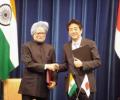
India's commitment to an open and plural security architecture attests to the fact that Asia's transition is a dynamic of both power & identity, says Zorawar Daulet Singh

PM Modi seems to be gradually ending India's strategic ambiguity

'After many rudderless years, India and Japan have prime ministers with a sense of purpose and direction,' says Brahma Chellaney.

Japan has the capital and needs to pull out of China, which has been its major destination. India, on the other hand, desperately needs capital especially for infrastructure, argues Rajeev Srinivasan.
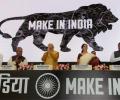
'India is going to maintain its ties to China, India is going to develop a strong relationship with the United States. It means that India is going to have the flexibility to pick and choose its friends.' 'That's traditional Indian foreign policy, and it's smart.' Former US ambassador to India Frank Wisner, one of America's sharpest minds on South Asia, tells Aziz Haniffa/Rediff.com what Washington can expect from Narendra Modi's visit.
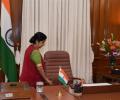
Sushma Swaraj, like Clinton, has a strong political base in her own party and is likely to have her imprint on foreign policy, says Ambassador T P Sreenivasan.

Trade between India and Indonesia stands at $20 billion.
