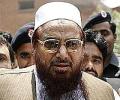
Notwithstanding the recent Indo-Pak foreign secretary-level meeting for which India took initiative, Jamaat-ud-Dawah chief Hafiz Mohd Saeed has said Pakistan will have to 'fight a war at all costs' if New Delhi is not prepared to hold talks.

Jamaat-ud-Dawah, the frontal organisation of the Lashkar-e-Tayiba, which is blamed for the Mumbai attacks, has written to the United Nations claiming that it was not associated with the Al-Qaeda and Taliban and that the Security Council's sanctions on it were 'unjustified'.
Pakistani authorities have extended by two months the detention of Jamaat-ud-Dawah chief Hafiz Mohammed Saeed and seven other activists of the front organisation of Lashkar-e-Tayiba, blamed for the Mumbai terrorist attacks.A spokesman for the Punjab government told reporters that the province's home department had on Saturday extended the detention of Saeed and the seven other JuD leaders by 60 days.Saeed and other Jamaat leaders were placed under house arrest for a month.
India has informed Pakistan that it has not engaged in any sort of troop build-up along the frontier and sought firm action against terrorist camps and groups operating from the Pakistani soil. New Delhi has also told Islamabad that it has no plans for a military action, but wanted a combination of 'executive action and judicial processes' against terrorist elements like the LeT and its front organisation Jamaat-ud-Dawah, which have been linked to the Mumbai attacks.

India on Tuesday raised the Mumbai terror attack at the United Nations and demanded that the world body ban Pakistan-based Jamaat-ud-Dawa, the front organization of Lashkar-e-Toiba(LeT) blamed for the carnage, and other such organisations and impose effective sanctions against them.
Pakistan on Thursday said it was "disturbed" by reports that India could be preparing for additional nuclear tests and hoped a unilateral moratorium on testing would remain in place in the region.
The counsel for Hafiz Mohammad Saeed, chief of the banned Jamaat-ud-Dawah, today told a court hearing a petition challenging his detention that the group was not linked to the Taliban and that the UN Security Council had not asked Pakistan to detain its leaders.
The sanctions committee of the Council had circulated a note to its members that the United States, backed by Britain and France, had tried to add JuD chief Hafiz Mohammed Saeed to the list of individuals and organisations connected to terrorism last May, but was blocked by China, according to a note circulated in the UNSC on Wednesday.

Inciting the public to raise funds for jihad (holy war) is not allowed to individuals or any organisation in Pakistan and is considered as treason, the Lahore high court has ruled even as it dismissed appeals of two terrorists convicted for raising funds for a proscribed terror outfit.

'After a ten year search, the so-called 'mastermind' of the Mumbai Terror attacks has been arrested in Pakistan. Great pressure has been exerted over the last two years to find him!' said Trump who is scheduled to meet Khan at his Oval Office on Monday, July 22.

Faisal said Pakistan respected all religions and would continue the Kartarpur project to help Sikh pilgrims.

Seeking to wriggle out of the FATF's grey list, Pakistan has imposed tough financial sanctions on 88 banned terror groups and their leaders, including Hafiz Saeed, Masood Azhar and Dawood Ibrahim, by ordering the seizure of all of their properties and freezing of bank accounts, a media report said.

Gopal Singh Chawla, under the instructions from the Pakistani authorities, recently stopped Indian officials from entering Gurudwara Panja Sahib on April 14 (Baisakhi day).

The Jammu and Kashmir Liberation Front chief, who was shifted to Tihar jail under police protection, was taken into preventive custody in February by the Jammu and Kashmir police and shifted to Jammu's Kot Balwal jail.
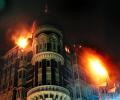
For the seventh time in a row, a Pakistani anti-terrorism court trying the seven accused in the 2008 Mumbai attacks case adjourned the hearing on Wednesday till September 3 as the judge has gone on a summer vacation.
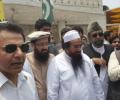
Hafiz Saeed on Tuesday led a 'Kashmir Caravan' from Lahore to Islamabad

The minister ruled out the possibility of any legal action against the groups saying 'how can you prosecute a group with whom the state itself has been involved with?'.

Saeed said Pakistan government has added insult to the wounds of Kashmiris by welcoming Singh.

Just days after his organisation was declared a terror outfit by the US, Jamaat-ud-Dawah chief Hafiz Saeed, who orchestrated the 2008 Mumbai terror attacks, addressed a seminar at the Lahore High Court spewing venom on India and America.
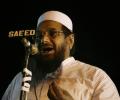
Saeed claimed, "Kashmiris had announced before the partition that it wanted to remain with Pakistan. But after partition India forcibly sent army to Jammu and Kashmir."
The team of 30 doctors of 'Muslim Medical Mission' of the Jamaat-ud-Dawah applied for a visa through online and courier.
After his release, Saeed said he would gather people across Pakistan for the "cause of Kashmir" and try to help Kashmiris get their "destination of freedom".
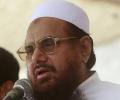
He also slammed Prime Minister Nawaz Sharif for holding a meeting with his Indian counterpart Narendra Modi in Paris, saying it has hurt the sentiments of 'Kashmiri Muslims'.

Pakistan on Friday freed Saeed, the Lashkar-e-Tayiba founder, who immediately launched his anti-India rhetoric and vowed to mobilise people for the "cause of Kashmir".
Saeed's arrest is also being seen as a pressure on Pakistan in connection with its commitment to the Financial Act Task Force whose next deadline is in October.
The party, political observers said, seems as an effort to set up a front which is acceptable to moderate Pakistanis.

Pakistan should not buy electricity from India, Jamaat-ud-Dawah chief Hafiz Saeed has told the government, days after Prime Minister Nawaz Sharif directed his power minister to visit India to address the severe energy crisis facing the country.
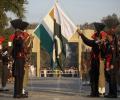
India has been seeking global action against Pakistan for allowing terror safe havens in its territories, and has been pressing for punishing Pakistan-based terrorists involved in a series of attacks in India, including the 2008 Mumbai attack.
A Pakistani court has asked the Punjab government to explain under what authority it has detained Jamaat-ud-Dawah chief Hafiz Saeed "without a trial".
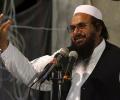
JuD official Ahmad Nadeem later said that the statement 'erroneously' mentioned China's name regarding terrorism in Pakistan.
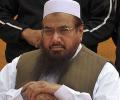
The SECP notification further warned that non-compliance with the said ruling could result in a hefty monetary fine.
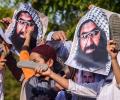
Pakistan will remain on the 'grey list' of the Financial Action Task Force (FATF) until it further demonstrates that action is being taken against Jamaat-ud-Dawah chief Hafiz Saeed and Jaish-e-Mohammed founder Masood Azhar who are listed as global terrorists by the United Nations, the global anti-money laundering and terror financing watchdog said on Thursday.

Addressing a large gathering at the Gaddafi Stadium, the Lashkar-e-Tayiba founder called for unity among Muslim community "to fail the design of infidels".

The banned Jamaat-ud-Dawah head has hired Lahore-based law firm -- Mirza and Mirza Law Associates -- to file the petition.

The JuD has been declared as a foreign terrorist organisation by the United States in June 2014.
Jamaat-ud-Dawah chief Hafiz Mohammad Saeed has rejected claims by Union Home Minister Rajnath Singh that he had supported the event in the Jawaharlal Nehru University in memory of Parliament attack convict Afzal Guru.
In another round of provocative remarks, Jamaat-ud-Dawah chief and Mumbai attack mastermind Hafiz Saeed has warned India of more terror attacks.

For the eighth time in a row, a Pakistani anti-terrorism court trying the seven accused in the 2008 Mumbai attacks case adjourned the hearing after a government witness and prosecution lawyers did not show up on Wednesday.
Unfazed by sanctions imposed by the government, Mumbai 2008 attacks mastermind Hafeez Saeed-led militant outfit Jamaat-ud-Dawah has launched an ambulance service in Karachi in southern port city of Pakistan.
The judge of the anti-terrorism court conducting the trial of seven Pakistani suspects charged with involvement in the 2008 Mumbai attacks was changed for the seventh time on Wednesday, with the current incumbent transferred to another court.
 © 2026 Rediff.com - Investor Information - Advertise with us - Disclaimer - Privacy Policy - Sitemap - Feedback - About us - Terms of use - Grievances