
Iram Sharmila has been on fast for six year deamading the repeal of the Armed Forces Special Powers Act.

Human rights activist Irom Chanu Sharmila, who has been charged with the offence of attempt to commit suicide by fasting, was on Monday released from judicial custody.

The 'Iron Lady of Manipur' Irom Chanu Sharmila, who has been on a hunger strike since 2000 demanding repeal of Armed Forces Special Power Act, will be completing 12 years of fast on Monday.

Activist Irom Chanu Sharmila, who has been on fast for the past 12 years demanding withdrawal of the Armed Forces Special Powers Act, 1958, from Manipur, has been remanded to judicial custody for 15 days.

Manipur's 'Iron Lady' Irom Chanu Sharmila has rejected an offer from the Aam Aadmi Party to join politics and contest this year's Lok Sabha elections.
Many people will be fasting in Imphal, Manipur from September 13 while hundreds from different countries in the world have signed the petition to fast for varying number of days (one to five) to support the 'Iron lady' from Manipur -- Irom Sharmila.
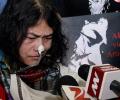
A day after being released from jail, rights activist Irom Chanu Sharmila was on Friday arrested once again by police under the same charge of attempt to commit suicide by means of her indefinite fast.

A local court on Tuesday ordered the release of rights activist Irom Chanu Sharmila, under detention for attempting to commit suicide by fasting for nearly 14 years demanding withdrawal of a tough law that gives sweeping powers to armed forces from Manipur.
Social activist Irom Chanu Sharmila was on Friday forcibly taken away by the police from a small makeshift shelter outside the government-run hospital in Imphal where she was continuing her fast after being released from jail on Wednesday.
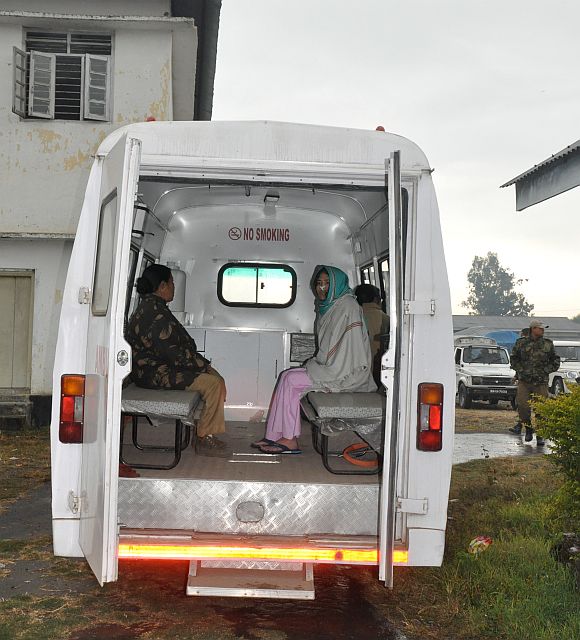
On the occasion of her breaking the world's longest hunger strike, Rediff.com reproduces this 2011 feature on the activist and her life.
A court in Imphal has ordered the release of social activist Irom Sharmila Chanu, who has been on a fast for more than 12 years to demand the repeal of the controversial Armed Forces Special Powers Act from Manipur.First Class Judicial Magistrate, Imphal East, on Tuesday ordered the release of Irom Sharmila, who was arrested on charges of attempt to commit suicide.

Activist Irom Sharmila Chanu, who has been on fast for more than 12 years demanding repeal of the 'draconian' Armed Forces Special Powers Act from Manipur, was re-arrested by state police, officials said on Thursday.
A Delhi court on Monday framed charges against Irom Sharmila Chanu, who has been on fast for about 12 years demanding repeal of controversial Armed Forces Special Powers Act, for allegedly attempting to commit suicide during her 'fast until death' in the national capital in 2006.
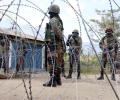
The Armed Forces (Special Powers) Act (AFSPA) has been extended for six months in parts of Manipur, Nagaland, and Arunachal Pradesh due to the prevailing law and order situation.

She said she no longer believes that her fast will lead to the repeal of the 'draconian' AFSPA but she will continue the fight.
The AFSPA, often criticised as a draconian law, gives armed forces operating in disturbed areas sweeping powers to search, arrest and open fire if they deem it necessary.

The Centre has reimposed the Armed Forces (Special Powers) Act in Manipur's six police station areas, including the violence-hit Jiribam.

The name of her party "People's Resurgence and Justice Alliance" was announced at the Johnstone Higher Secondary School in Imphal.
Irom Sharmila Chanu was re-arrested on March 8, a day after she was released from the security ward of JN Hospital in Imphal for continuing her fast unto death in protest against the Armed Forces Special Powers Act. Irom Sharmila was arrested at the Meira Shang near Aka Tren playground where she was protesting. The 'Iron Lady' was taken into custody under IPC Section 309 for attempting to commit suicide.
Activist Irom Sharmila Chanu, who was on Monday charged with attempting suicide for her fast unto death here in 2006 while demanding repeal of the controversial Armed Forces Special Powers Act, said she is following Mahatma Gandhi's principle of non-violence and should not be "discriminated" against.

The Armed Forces (Special Powers) Act, 1958, was completely withdrawn in Meghalaya in 2018, Tripura in 2015 and Mizoram in the 1980s.
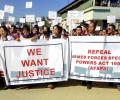
A home ministry spokesperson, however, said the decision does not imply that the AFSPA has been completely withdrawn from the three insurgency-hit states but will continue to be in force in some areas of the three states.
Officials said the EC has directed them to provide security to Sharmila as 'she travels alone almost all the time'.

The present happenings in Manipur are the wages of continued neglect, and not so benign at that, of a vital region and its people. Had we lavished on the North East even a fraction of the care and resources we do on Kashmir, things would not have come to this pass, asserts Shreekant Sambrani.

Sandeep Pandey salutes women who have contributed to social transformation in India after 1980.
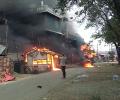
Security presence which has been bolstered by flying in more army troops and rapid action force and central police forces was clearly visible at all major areas and roads.

A much larger number of candidates could garner less than 500 votes each.

Iconic rights activist Irom Sharmila on the highs and lows of her long fast, why she gave it up and her plans.
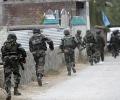
Tripura should be taken as a case study on how misuse of the AFSPA can be avoided even while transforming public opinion and controlling insurgency, says Sanjib Deb.
