
Non-resident Indians (NRIs) in the Gulf region are increasingly purchasing term life insurance policies from India, driven by geopolitical uncertainties in West Asia and the significant cost advantages offered by Indian products, with the GCC region now contributing over half of the total NRI demand.

The Delhi government's Health Department has received an audit report highlighting alleged financial and administrative irregularities within the Delhi Medical Council (DMC) between 2019 and 2025.

New business premium of life insurance companies grew 18 per cent year-on-year (Y-o-Y) to Rs 35,417 crore in February, driven by robust growth at the state-owned Life Insurance Corporation of India (LIC) due to a favourable base.

As heart disease increasingly impacts young Indians, understanding the complexities of health insurance, including higher premiums, waiting periods, and the benefits of specialised cardiac policies, becomes vital for financial protection.

The life insurance industry recorded nearly 40 per cent year-on-year (Y-o-Y) growth in new business premiums (NBP), aided by the rationalisation of goods and services tax (GST) on individual life insurance premiums, which has made policies more affordable for consumers.
The committee formed under the Life Insurance Council to review the commission structure in the life insurance sector has recommended capping distributor commissions or deferring them to ease acquisition costs. The recommendations will be sent to the insurance regulator -- Insurance Regulatory and Development Authority of India (Irdai).

Both the life and non-life insurance segment posted over 20 per cent premium growth in November for the first time in this financial year (FY26), supported by the reduction in goods and services tax (GST) on premiums from 18 per cent to zero and a favourable base effect.

The United States and Iran have reached an agreement in principle to immediately and permanently halt all military operations, lift sanctions, and work towards a comprehensive final agreement within 60 days, including a significant reconstruction package for Iran.
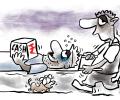
Recent years have been turbulent for the insurance industry due to direct and indirect tax reforms, regulatory overhaul and other external pressures. The events cumulatively slowed growth rate to single digits from the high teens seen earlier.

Even as non-life insurers reported muted premium growth in October, standalone health insurers saw a robust 38 per cent year-on-year (Y-o-Y) surge. This growth was driven by pent-up demand in the retail health insurance segment.

The Indian government is set to accelerate reforms, including measures to enhance foreign direct investment, speed up divestment, and boost asset monetisation, to maintain economic growth despite rising fuel and fertiliser import costs driven by the West Asia crisis.

Finance Minister Nirmala Sitharaman on Tuesday said that raising the FDI limit to 100 per cent in the insurance sector will help attract more capital, improve competition and increase insurance penetration by making policies more affordable.

A recently finalised peace deal between the US and Iran, set to be signed on June 19, is expected to significantly benefit India's economy by boosting exports to West Asia, stabilising the rupee, and easing inflationary pressures, according to exporters and experts.

Nagaland Governor Ajay Kumar Bhalla announced the state government's plans to form an interim council for the Frontier Nagaland Territorial Authority (FNTA) and highlighted key achievements and future priorities across various sectors during the Budget Session.

A report indicates that mid-tier banking, financial services, and insurance (BFSI) entities in India are highly exposed to cyberattacks due to aggressive digitisation coupled with insufficient cybersecurity investments.
New business premiums of life insurance companies dropped 5.2 per cent year-on-year (YoY) in August to Rs 30,959 crore, owing to a double-digit decline reported by state-owned Life Insurance Corporation (LIC), data from the Life Insurance Council showed. LIC recorded a 17 per cent YoY fall in new business premiums to Rs 16,023 crore during the month, while private life insurers reported a 12 per cent YoY increase to Rs 14,936 crore.

Male central government employees are entitled to 15 days under service rules and provisions in the private sector depends on the company's policy.

'It has always been viewed as a hedge against inflation.'

'Investment by insurers in the Bima Sugam India Federation is illegal as it is a private limited company.'

The GST Council, in its meeting on Saturday, is likely to decide on reducing tax rates on life and health insurance premiums, while hiking it on high-end wrist watches, shoes and apparels, besides considering a separate 35 per cent tax slab for sin goods. The 55th meeting of the GST Council, chaired by Union Finance Minister Nirmala Sitharaman and comprising state counterparts, is likely to discuss rate rejig in about 148 items, besides, it will also deliberate on bringing Aviation Turbine Fuel (ATF), a major component for airline industry's operation cost, in the Goods and Services Tax (GST) fold.
The Centre has proposed exempting life and health insurance policies for individuals from GST, Bihar Deputy Chief Minister and convenor of insurance GoM Samrat Choudhary said on Wednesday. Currently, health and life insurance premium attracts 18 per cent GST.

'It is imprudent on the part of Indian insurance companies to invest out of the shareholders' fund in a private limited company.'

'LIC will reduce but not fully exit its stake in IDBI Bank, which remains an important bancassurance partner,' says LIC of India' MD and CEO R Doraiswamy.
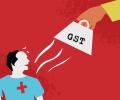
Reduction of GST on health insurance premium from 18% to 0% looks like a straight 18% reduction in what consumers pay. The truth, however, is...
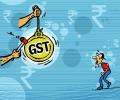
India needs Goods and Services Tax (GST) Council-like common platforms between states and the Centre in areas such as land clearances, power, and water to fast-track infrastructure projects to achieve double-digit growth going ahead, said Praveer Sinha, chief executive officer and managing director of The Tata Power Company.

While investors would focus on the results and guidance for the third quarter of financial year 2025-26 (Q3FY26) in the normal course of business, the US-Israeli attack on Iran and the latter's retaliation at Gulf allies of the US has forced them to weigh the consequences of the event.

Iran is fighting a different war: Older, slower, and in some ways more dangerous. Iran doesn't need to shoot down an F/A-18. It only needs to make the Strait of Hormuz feel dangerous long enough for insurance markets, shipping companies, and oil futures traders to do the rest. Prem Panicker continues his must-read daily blog on the war in the Middle East.

Residents across the Gulf region, including the UAE, Bahrain, and Qatar, experienced fear and disruption following attacks, leading to flight suspensions and heightened security measures.

Israeli Prime Minister Benjamin Netanyahu has threatened to continue targeting Iranian leaders, claiming recent successes in eliminating key figures. He asserted that Israel, with US support, aims to undermine the Iranian regime and empower the Iranian people.

Will rising tensions between US-Israel and Iran threaten crude oil supply through the Strait of Hormuz, putting India's fuel prices, imports, and economic stability at risk?

With the Iran war escalating sharply and crisis deepening in the global energy market, India on Monday unveiled a coordinated plan to support exporters and shippers caught in the fallout.
New India Assurance and Niva Bupa have invested in the Bima Sugam India Federation.

Health insurance premium growth has slowed after touching record highs during the Covid-19 pandemic due to tapering demand from retail consumers amid affordability issues. According to General Insurance Council data, health insurance premiums grew by 10.44 per cent year-on-year (Y-o-Y) in the Apr-Jan period of FY25 in comparison with 20.79 per cent in the year-ago period. It was around 23.57 per cent in FY23, and 25.89 per cent in FY22.
The new business premium (NBP) of life insurance companies dropped 21.7 per cent year-on-year (Y-o-Y) to Rs 30,218.71 crore in December 2024 on the back of a steep fall in business. According to data published by the Life Insurance Council, LIC's premium dropped 41.15 per cent Y-o-Y to Rs 13,523.87 crore while private insurers reported 7 per cent growth in NBP to Rs 16,694.85 crore as the industry absorbs the impact of the revised surrender value norms.

'We hope we will be able to at least end crashes that involve collisions with stationary vehicles as there will be an automatic warning.'
Life insurers shifted their focus to selling high-value policies in October as the transition to new surrender value norms, effective October 1, limited their ability to roll out all products in their portfolio. This led to a 40 per cent year-on-year (Y-o-Y) drop in the number of policies sold in October. Additionally, distributors engaged in a fire sale of policies in September due to uncertainty about the impact of the new norms on their commission structures.

In the Indo-Pacific's new era -- where perception shapes reality faster than treaties -- the real entrapment is not of China or the United States. It is the test Japan has set for itself -- and whether partners like India, acting as balancers rather than accelerants, can help ensure that the story ends in stability, points out Varun Arya.

Life insurance companies reported a 13.16 per cent year-on-year (Y-o-Y) growth in new business premium (NBP), totting up Rs 30,347 crore in October, even as the number of policies sold saw a sharp decline. The growth was largely driven by strong performance from private sector life insurers.

The GST Council on Saturday postponed a decision on cutting tax rate on life and health insurance premiums, officials said. The 55th meeting of the GST Council, chaired by Union Finance Minister Nirmala Sitharaman and comprising state counterparts, decided that some more technicalities needed to be ironed out and tasked the GoM for further deliberations.
Some of the key names include: Maruti, M&M, Ashok Leyland, Britannia, Ultratech, JK Cement, Havells, Voltas, Amber, Metro, Trent, LemonTree, Indian Hotels, Niva Bupa, HDFC Life, IGL, Acme Solar, Suzlon, Swiggy, Delhivery, ICICI Bank, HDFC Bank, Bajaj Finance, Shriram Finance," according to a report by Motilal Oswal Financial Services.
