
Apple CEO Tim Cook's strategic pivot, from initial rejections to local partnerships and leveraging government policies like PLI, transformed India into a major iPhone manufacturing and export hub, now accounting for one in every four iPhones assembled globally.

Prime Minister Narendra Modi urged industry and start-ups to focus on quality and make excellence a benchmark in manufacturing. He also lauded the start-up ecosystem and greeted the nation on National Voters Day and Republic Day.

The three-day India Mobile Congress (IMC) will showcase the widening convergence of telecom with new domains, such as semiconductors and deep tech, P Ramakrishna, the forum's chief executive officer, said on Tuesday. With more than 250 global and domestic exhibitors, the seventh edition is expected to draw more than 100,000 visitors this year, he said. There will also be over 5,000 CXO-level delegates and more than 350 speakers.

Reiterating Sitharaman's statement that this is a youth power budget, Modi emphasised that the provisions made in the budget will prepare leaders, innovators and creators across different sectors.

Japan is expected to increase its investment target in India from the earlier 5 trillion yen ($34 billion) to almost 10 trillion yen.

US President Donald Trump's announcement of 25 per cent tariff on all goods coming from India starting August 1, plus an unspecified penalty, is expected to impact Apple's plans to expand iPhone manufacturing in India as well as export of other electronics to the US. The move comes at a time when Indian electronics production is reeling under pressure due to restrictions imposed by China on supply of several critical components, capital goods and even skilled technology professionals.

Their favourite alternatives: Malaysia, Vietnam and the Philippines. Note, India is missing from that list. And this is despite an attractive financial incentive scheme for OSAT players. The reason, said a senior executive of a US chip company who had a meeting in Taiwan just a few weeks ago, is that "they want more predictability in government policy because they plan to put in big money."
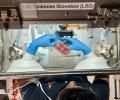
The $1.2 billion in-space manufacturing market is expected to grow and be worth more than $20 billion by 2033.

The 17 rare earth elements that are at the centre of the current crisis are critical components of everyday products -- from cars to jet engines to electronics like smartphones and flat-screen TVs.
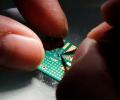
Foundries in Taiwan account for more than 75 per cent of the chips that mobile devices made in India need, according to estimates by the Indian Cellular and Electronics Association (ICEA), which represents global and domestic manufacturers. The number is slightly lower, 60 per cent, if one considers all chips -- those of consumer electronics, PCs, laptops, autos, etc. This ties in with the fact that foundries in Taiwan, led by TSMC, account for over 70 per cent of the world's microchip supply, according to estimates by Gartner.
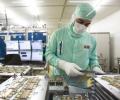
Mumbai-based Indian Semiconductor Manufacturing Company (ISMC) and Singapore-headquartered IGSS Ventures have one strategy in common: They have told the government in their application for semiconductor fabrication plants that they will export the bulk of the chips they make in India in the initial five or 10 years. The third applicant, Vedanta-Foxconn, which is also building a fab plant, has said it will concentrate on the needs of consumer electronics and mobile device markets, and earmark 80 per cent of output for domestic consumption, but has not specified its customers. Finding a viable domestic market could well be the biggest challenge for India's renewed tryst with semiconductors. Fab plants do not sell directly to end users but to intermediary chip design companies - such as Qualcomm or MediaTek.

Different industry and trade bodies have extended their support to BangaloreIT.in, the premier annual IT event organised by the Karnataka government and STPI. The three-day event will be inaugurated on the 29th of October in the premises of Bangalore International Exhibition Centre (BIEC).

Andhra Pradesh Chief Minister N Chandrababu Naidu, who was instrumental in developing Hyderabad as a key information technology services destination in the country, is now embarking upon a mission to establish the state as an electronics manufacturing hub.

India is all set to make its presence felt in the $47 billion global outsourced semiconductor testing and packaging market, an arena where Malaysia and Vietnam have been way ahead so far. The Cabinet last Thursday cleared two projects, the Tata's assembly testing and packaging plant (ATMP) and the Murugappa-owned CG Power with Renesas from Japan as its tech partner. These, together with Micron's assembly and testing plant which is already being constructed in Sanad in Gujarat, will collectively invest Rs 47,300 crore to set up the factories.
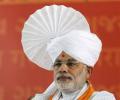
This will be the first time BJP's prime ministerial candidate holds a discussion with IT, telecom czars.

Indian plants -- who plan to begin production with 28 nano metre chips -- will take two to four years to get off the ground. By that time, in the fast changing world of chip making, the global market would have shifted to 22 nm.

India and the US on Friday said they have started talks to put in place a strategic framework for human space flight by year-end as they plan to send an Indian astronaut to the International Space Station in 2024.

Despite the robust growth in this country, Apple's India share in its overall global sales remained modest -- constituting 1.5 per cent of its overall turnover of $389 billion in FY23.

A disagreement between mobile operators and device manufacturers over e-SIMs has reached the government with the Cellular Operators Association of India (COAI) asking the DoT to order handset manufacturers to introduce eSIMs, in addition to the physical SIM slot, in all smartphones costing over Rs 10,000. The reason is the unprecedented global shortage of semiconductors which has severely impacted the supply of SIM cards across the globe and pushed up the price by four to five times. The shortage is not likely to improve before 2024.
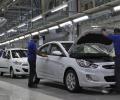
The country's leading automakers Maruti Suzuki and Hyundai Motor reported a decline in dispatches to dealers in March as shortage of electronic components impacted production. On the other hand, Tata Motors, Skoda and Kia India posted their highest ever monthly wholesales last month. Toyota Kirloskar Motor said its dispatches in March were the highest in the last five years while Mahindra & Mahindra also reported a robust increase in its passenger vehicle dispatches in March.

Foxconn is the world's largest contract manufacturer for electronic goods and makes iPhones for Apple and smartphones for its Chinese rival Xiaomi.

The Eknath Shinde-led Maharashtra government has come under fire following the Centre's announcement that Tata-Airbus C-295 transport aircraft project would be set up in Gujarat, with the opposition seeking to know why the project that was supposed to come up in Maharashtra went to the neighbouring state.

While chips have become ubiquitous, Moore's Law has remained a self-fulfilling prophecy even half a century later. Not bad for an industry where the time scale is not measured in decades and centuries, but in annual quarters, says Shivanand Kanavi.

Analysts say it is a case of over-promise and under-delivery.

The key proposals from the IT industry that were not addressed included removal of dual levies on software products
 © 2026 Rediff.com - Advertise with us - Disclaimer - Privacy Policy - Sitemap - Feedback - About us - Terms of use - Grievances