
There has been a "sharp decline" in collection efficiencies in retail asset pools across asset classes in May due to the second wave of the pandemic, with microlenders witnessing a dip of up to 20 per cent, a report said on Monday. "ICRA has observed a sharp decline in the collections of its rated securitisation transactions in April 2021 (i.e. May 2021 payouts), following the rise of COVID-19 cases and imposition of lockdowns/movement restrictions which has impacted the operations and collection activities of the NBFCs and HFCs," the report from domestic rating agency ICRA said. A major part of the country was undergoing localised lockdowns till May-end in the second wave, which saw new cases top 4.14 lakh and resulted in over 4,500 deaths daily at its peak.

The production growth of eight infrastructure sectors slowed down to 4.3 per cent in March due to a decline in the output of coal and crude oil, though for the full 2021-22 fiscal, the core sector recorded a 10.4 per cent expansion, according to official data released on Friday. The eight infrastructure sectors - coal, crude oil, natural gas, refinery products, fertiliser, steel, cement and electricity - had expanded by 6 per cent in February. During April-March 2021-22, the eight sectors grew by 10.4 per cent compared to a contraction of 6.4 per cent in 2020-21. The output of coal and crude oil contracted by 0.1 per cent and 3.4 per cent in March.

India's merchandise exports in June rose by 16.78 per cent year-on-year to $37.94 billion while the trade deficit ballooned to a record $25.63 billion on account of a steep increase in gold and crude oil imports, according to the government's preliminary data released on Monday. The export growth in June moderated from 20.55 per cent in May and 48.34 per cent in June 2021. During the month under review, exports of engineering, pharmaceutical and plastic products recorded negative growth.

Subdued prices of food items like vegetables pulled down retail inflation for the third month in a row to 5.3 per cent in August, within the RBI's comfort zone. While the Consumer Price Index (CPI)-based retail inflation declined to 5.3 per cent in August from 6.69 per cent in the same month a year ago, food inflation dipped at a much faster pace to 3.11 per cent from 9.05 per cent in August 2020. The food inflation was also lower than 3.96 per cent in preceding month of July.

In a double delight, retail inflation eased to a one-year low of 5.72 per cent - staying below the upper tolerance limit for two months in a row, while factory output rose sharply to 7.2 per cent on the back of healthy growth in manufacturing. The retail inflation numbers based on Consumer Price Index (CPI) will provide some room for the Reserve Bank to further moderate the quantum of hike in key interest rate or even press a pause button. The RBI has been on a rate hiking spree since May 2022 in its bid to tame inflation, having raised the repo rate by a cumulative 225 basis points (bps).

According to ICRA, even in a high-growth scenario, wherein the second half of FY20 sees the incremental bank credit rise to Rs 6.5-7 trn, there will still be a 40-45% year-on-year decline.

Yes Securities, the broking and investment arm of Yes Bank, on Wednesday said the Supreme Court directive on loan moratorium due to pandemic has brought the much needed clarity and there will not be any financial impact on the banks as the compound interest waiver is to be reimbursed by the government. On its verdict on a batch of pleas seeking moratorium extension beyond August 31, 2020, the apex court on Tuesday said it is a policy decision, refusing to interfere with the Centre's and RBI's decision to not extend the loan moratorium beyond the limit. However, it observed that the benefit of moratorium should go to all set of borrowers irrespective of the loan amount and asked to refund any amount collected as penal interest and compound interest during March-August 2020.

As COVID-19 infections spike in the country resulting in restrictions in various states and impacting the fragile recovery, many economists are expecting RBI to delay the policy normalisation move, which is expected in the February review. The country has reported a single-day rise of 58,097 new Covid-19 cases as of Wednesday morning--the highest in around 199 days -- of which 2,135 are Omicron cases and later in the day, the first confirmed Omicron-related death has also been reported. Maharashtra recorded the maximum number of 653 Omicron cases followed by Delhi at 464, Kerala 185, Rajasthan 174, Gujarat 154 and Tamil Nadu 121 cases, taking the total tally of cases to 3,50,18,358.

Exports in June rose by 23.52 per cent to $40.13 billion while the trade deficit ballooned to a record level of $26.18 billion mainly due to jump in gold and crude oil imports, the government data said on Thursday. The country's export growth in May was 20.55 per cent. Imports expanded by 57.55 per cent to $66.31 billion in June compared to the year-ago month, the data showed.

Reliance Power (RPower) has defaulted on payment of interest worth Rs 1.17 crore to DBS Bank India and Rs 44 lakh to IDBI Bank. It failed to pay up interest on October 30, 2021. The firm, part of the Anil Ambani-promoted Reliance group, in filing with BSE, said it has term loans and working capital arrangements with three lenders - YES Bank, IDBI Bank and DBS. Its stock closed 1.41 per cent lower at Rs 12.6 per share on the BSE on December 1. About exposure of YES Bank, there is a 'standstill' applicable till December 26, 2021.

'An eerie similarity with 2019 inflation trajectory could now mean that the RBI and market inflation estimates could go awry.'

Around 241 companies were sent for liquidation under the IBC by various NCLT benches and in only 58 cases have the resolution plans been accepted

Retail inflation fell to a five-month low of 4.35 per cent in September from 7.27 per cent in the year-ago period as prices of vegetables and other items declined, according to government data released on Tuesday. The moderation in Consumer Price Index-based inflation is in line with the assessment of Reserve Bank Governor Shaktikanta Das who recently projected substantial softening of retail inflation. The CPI inflation was at 5.3 per cent in August and at 7.27 per cent in September 2020.
Retail inflation softened to 6.71 per cent in July due to moderation in food prices but remained above the Reserve Bank's comfort level of 6 per cent for the seventh consecutive month. With retail inflation continuing to remain high despite a fall in prices of vegetables and edible oils, among other commodities in July, the Reserve Bank of India (RBI) might go for another rate hike in September. The Consumer Price Index (CPI) based retail inflation was at 7.01 per cent in June and 5.59 per cent in July 2021. It was above 7 per cent from April to June this fiscal.

While weather forecasters remain divided on how the monsoons will play out in India over the next few months, analysts believe the news at the current juncture - at best - can trigger a knee-jerk reaction in the markets. They believe it is too early to say whether the sub-par monsoon on account of El Nino can seriously dent the market sentiment in the short-to-medium term. "These are just initial forecasts and we will have another round / status update from the weather forecasters a month down the line.
India always faces a Hobson's choice as far as feeding coal-fired generators goes - even if the government is reluctant to admit it. The country cannot do without shipping in the world's most polluting fuel from overseas. And it will continue to do so unless it decides to reduce demand by forcing citizens, farmers and businesses to live without electricity for part of the day, or use diesel generators to fire facilities.

While margins contracted by 30 basis points on y-o-y basis, they fell a sharper 120 basis points on a sequential basis to 16.8 per cent. Profitability was impacted adversely due to subdued demand, tepid realisations in commodity sectors, and negative operating leverage.

Officials from State-run refiners contend that savings from purchase of Russian oil are used to offset a part of the losses in revenues from selling transport fuels and LPG at State-set rates.

Of $90 billion remittances that India is expected to receive in 2022, only $27.4 billion has come in the first half of the year.

Tyre companies are stepping up on exports to offset declining volumes from domestic OEMs.

'It has been an ongoing process, talking to the relevant ministries about eliminating leakages and curbing non-core expenditure in various schemes.'

The impact of fiscal measures announced by the government to contain inflation will be seen in the next few months because of the base effect, reports Indivjal Dhasmana.

Mutual fund houses hold Rs 3,400 crore of Yes Bank's 'riskier' bonds. Reliance MF, Franklin Templeton MF and UTI MF account for bulk of these exposures.

One of the factors behind the rise in securitisation deals was State Bank of India's (SBI) decision to buy portfolio worth Rs 45,000 crore from NBFCs

The wholesale price-based inflation rose for the second consecutive month in February to 4.17 per cent, as food, fuel and power prices spiked. The WPI inflation was 2.03 per cent in January and 2.26 per cent in February last year. After witnessing months of softening of prices, the food articles in February saw 1.36 per cent inflation. In January it was (-) 2.80 per cent.

The production of eight infrastructure sectors rose by 7.5 per cent in October on healthy performance by the segments of coal, natural gas, refinery products and cement, official data released on Tuesday showed. The output of eight core sectors of coal, crude oil, natural gas, refinery products, fertilisers, steel, cement and electricity had contracted by 0.5 per cent in October 2020, according to the data released by the commerce and industry ministry. Core sectors' growth stood at 4.5 per cent in September this year.
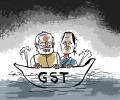
In the current financial year, the Centre released nearly Rs 1 lakh crore compensation to the states till September.

Automobile manufacturers, new and old, as well as ancillary suppliers are set to spend a combined Rs 70,630 crore over the next five years on either entering the electric vehicle segment or stepping up their presence in it. Data culled from announcements made by firms shows India, the world's fifth largest automobile market, is poised to receive one of the biggest capex pushes ever to fuel the transition from internal combustion engines to electric motors and batteries as part of a green drive. The EV push, egged on by the government's emphasis on electric mobility to meet its net zero targets, is expected to yield at least 25 electric vehicles - new ones as well as electrified versions of existing vehicles running on internal combustion engines.

The wholesale price-based inflation spiked to 12.54 per cent in October, mainly due to rise in prices of manufactured products and crude petroleum. WPI inflation has remained in double digit for the seventh consecutive month beginning April. Inflation in September this year was at 10.66 per cent, while in October 2020 it was at 1.31 per cent.

Retail investors have put at least Rs 2,296 crore in listed companies facing proceedings under the Insolvency and Bankruptcy Code (IBC). A median such-company had 16,163 retail investors as shareholders many of whom apparently have bought a stake on the hope of making money if the firm revives. They own a fifth of the total stake in the companies under consideration. The analysis looked at 75 listed firms for whom shareholding data was available for March 2022.

The Centre and states are likely to budget for higher market borrowings to the tune of Rs 2.3 lakh crore next fiscal even though the Union budget may peg a lower-than-expected fiscal deficit for the Centre at 5.8 per cent of GDP, says a report. Icra Ratings anticipates higher redemptions will lead to gross market borrowings of the Centre to rise to Rs 14.8 lakh crore and of the states to jump by Rs 1.6 lakh crore to Rs 9.6 lakh crore, taking the combined borrowings (of the Centre and the states) to Rs 24.4 lakh crore in FY2024, up by 2.3 lakh crore from FY23 combined. In FY23, the Centre's gross borrowings are budgeted at Rs 14.1 lakh crore and of the states at Rs 8 lakh crore, or a combined borrowing of Rs 22.1 lakh crore, according to the agency.
About 50 per cent of the accounts that availed of the EMI moratorium amid the pandemic, which made things worse in an already slowing economy, are expected to be restructured, and of these accounts that would undergo restructuring, one-third, or Rs 6-9 trillion, could turn into NPAs.

Analysts at rating agency ICRA say the debt level of the telecom companies is very high and the ecosystem for the premium band is not in place.

Russia is among the top buyers of Indian tea, accounting for about 18 per cent of the industry's total exports.

The output of eight core infrastructure sectors grew marginally by 0.1 per cent in January, mainly due to growth in the production of fertiliser, steel and electricity. The core sectors had expanded by 2.2 per cent in January 2020, according to the provisional data released by the commerce and industry ministry on Friday. Coal, crude oil, natural gas, refinery products, and cement recorded negative growth in January.

This may come as a surprise to many. Retail price inflation in petrol was the lowest at 10.21 per cent in March since November 2020. In diesel, it scraped the bottom of the barrel at 5.19 per cent in the last month of 2021-22 since February 2020. Even liquefied petroleum gas (LPG) was at a nine-month low of 9.97 per cent in the month.

In twin blows to Indian economic revival, higher food prices drove retail inflation to a five-month high of 7.4 per cent while factory output fell for the first time in 18 months. The second consecutive month of rise in consumer price index (CPI)-based inflation will add to the pressure on the Reserve Bank of India (RBI) to again raise interest rates to tame high prices. Inflation has been above the targeted zone for the ninth month in a row and as per statute, the RBI will now have to explain to the government in writing why it failed to keep prices below 6 per cent.

For the first time in 21 years, the Reserve Bank of India (RBI) will revise norms for investment portfolios of commercial banks to reflect changes in global standards on valuation and measurement, and progress in the domestic market. This could pave the way for banks to transition to the new accounting standards (Ind-AS). The outstanding investment portfolio of commercial banks was at Rs 45.84 trillion as of November 19 this year.

A looming global shortage of diesel in Europe presents India with more than one opportunity to profit from strong margins. A shortage of the fuel, a key contributor to inflation, has been exacerbated by the conflict in Ukraine, and western sanctions on Russian fuel supplies. The slowdown in natural gas supply means the West needs diesel to heat their homes this winter.

States may face a GST compensation shortfall of Rs 3 lakh crore in the next financial year, a situation that will force them to borrow more from the markets, says a report. The states may face a shortfall of Rs 2.7-3 lakh crore as Goods and Services Tax (GST) compensation from the Centre next fiscal. Out of that amount, the shortfall from cess collections will be at Rs 1.6-2 lakh crore, according to an Icra report released on Monday. In FY21, the states were facing a shortfall of Rs 1.1 lakh crore in GST compensation from the Centre but over 90 per cent of that amount has been cleared now.
