
From the 30-share blue-chip pack, Adani Ports, UltraTech Cement, Larsen & Toubro, Sun Pharma, HDFC Bank, ICICI Bank, NTPC and State Bank of India were the major laggards. Tata Consultancy Services, Reliance Industries, ITC, Asian Paints, HCL Tech and Maruti were among the gainers.
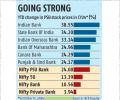
Stock Market News today, PSU banks: The year 2024 was a roller-coaster ride for Indian stock markets, marked by volatility driven by the Lok Sabha elections, Union Budget 2024, a slowdown in corporate earnings, and sticky inflation. Geopolitical tensions - particularly between Israel and Iran in West Asia - along with various stimulus announcements by China and yen carry trade rocked the equity markets throughout the year.

Sebi on Thursday imposed a penalty of Rs 1 crore on HDFC Bank for invoking securities pledged by stock broker BRH Wealth Kreators in violation of the regulator's interim directions. In addition, the bank has been directed to transfer Rs 158.68 crore along with 7 per cent interest per annum into an escrow account till the issue of settlement of clients' securities is reconciled, Sebi said in an order. The instant proceedings have essentially arisen on account of non-conformity by HDFC Bank with the directions contained in the interim order issued by Sebi against BRH Wealth Kreators and other entities on October 7, 2019.

Asset management companies launched 239 new fund offerings (NFOs) mobilising Rs 1.18 lakh crore in 2024, with sectoral or thematic equity funds emerging as the top choice of investors, according to a report by Germinate Investor Services Research. This was higher than 212 NFOs collecting Rs 63,854 crore in 2023 and 228 NFOs garnering Rs 62,187 crore in 2022.

The last time this happened was in 1996.

The new business premium (NBP) of life insurance companies dropped 21.7 per cent year-on-year (Y-o-Y) to Rs 30,218.71 crore in December 2024 on the back of a steep fall in business. According to data published by the Life Insurance Council, LIC's premium dropped 41.15 per cent Y-o-Y to Rs 13,523.87 crore while private insurers reported 7 per cent growth in NBP to Rs 16,694.85 crore as the industry absorbs the impact of the revised surrender value norms.
HDFC was the top gainer in the Sensex pack, surging over 5 per cent, followed by M&M, L&T, Tata Steel, Bajaj Finance, HDFC Bank and Sun Pharma. On the other hand, IndusInd Bank, Hero MotoCorp, Bharti Airtel and Asian Paints finished in the red.

The combined market valuation of eight of the top-10 most valued firms surged Rs 1,21,270.83 crore last week, with Reliance Industries becoming the biggest gainer, in line with an outstanding rally in benchmark equity indices. Last week, the BSE benchmark jumped 1,027.54 points or 1.21 per cent. The BSE Sensex hit its record high of 85,978.25 on Friday.
Tech Mahindra was the top gainer in the Sensex pack, rising around 4 per cent, followed by HDFC, Infosys, Bajaj Finserv, Asian Paints and Bajaj Finance. Nifty rose 229.15 points to 18,102.75.

India needs another shot of difficult reform, of the kind only possible at gunpoint. Mr Trump holds that gun to our heads now. A drastic reduction in tariff protection, other elements of sarkari wet-nursing will force entrepreneurial India to become competitive again, argues Shekhar Gupta.
The mobile banking app of the largest private sector lender HDFC Bank, which has been under the regulatory lens for network outages, was down for an hour on Tuesday due to unspecified issues. The city headquartered bank said the issues were faced for an hour late in the morning on Tuesday and the same was resolved in an hour. It urged customers to use the net banking alternative to transact in the interim.

Equity benchmark indices Sensex and Nifty settled lower for the sixth straight session on Monday due to heavy selling in bellwether stocks including HDFC Bank and Reliance Industries amid mixed trends in the global markets and outflow of foreign funds. Falling for the sixth consecutive session, the BSE Sensex tumbled 638.45 points or 0.78 per cent to settle at 81,050. During the day, it plummeted 962.39 points or 1.17 per cent to 80,726.06. The NSE Nifty slumped 218.85 points or 0.87 per cent to end at 24,795.75.

Gold prices rallied by Rs 630 to a lifetime high of Rs 82,700 per 10 grams in the national capital on Wednesday following persistent buying by jewellers and retailers amid strong global trends, according to the All India Sarafa Association. Rallying for the sixth straight session, gold of 99.5 per cent purity appreciated by Rs 630 to hit a lifetime high of Rs 82,330 per 10 grams.

All sectoral indices ended lower. BSE Telecommunication tanked 2.18 per cent, metal (1.77 per cent), auto (1.70 per cent), energy (1.64 per cent), oil & gas (1.59 per cent), commodities (1.39 per cent) and financial services (1.37 per cent) were the major laggards.

Maruti, Axis Bank, HDFC, ICICI Bank and Bajaj Finance also finished with gains. NSE Nifty rallied 203.65 points to 11,095.25.

Fuelled by the $57.8-billion merger of HDFC twins (HDFC Ltd and HDFC Bank), M&A (merger and acquisition) transactions in India touched a record high of $124.2 billion in the first half of 2022-23. Bankers said with several transactions, including the government's stake sale in IDBI Bank and Hindustan Zinc in the pipeline, the ongoing financial year will end up as the best year for M&A activity in the country. Apart from the HDFC transaction, the $6.5-billion acquisition of Holcim stake by the Adani family and L&T's $3.2-billion acquisition of Mindtree added to the record transactions in the first half of FY23.
Ask rediffGURU and PF expert Milind Vadjikar your insurance, stocks, mutual fund and personal finance-related questions.

From the 30-share Sensex pack, Mahindra & Mahindra, Infosys, HCL Technologies, Adani Ports, Bajaj Finance, Tech Mahindra, Titan, Tata Consultancy Services, Reliance Industries and Power Grid were among the laggards. On the other hand, State Bank of India was the only gainer.
Benchmark Sensex bounced back from early lows and closed higher by nearly 376 points on Monday, snapping its four-day losing run following a rally in blue-chips ICICI Bank, HUL and HDFC Bank. The 30-share BSE Sensex rebounded 375.61 points or 0.46 per cent to settle at 81,559.54. The index opened lower and hit a low of 80,895.05 points in early trade.

The need to maintain people's confidence in digital banking resulted in the action against HDFC Bank for service outages, RBI Governor Shaktikanta Das said on Friday and exhorted lenders to invest more on the technology front.

Gold prices hit a fresh record high of Rs 84,900 per 10 grams in the national capital on Friday, driven by robust domestic demand and strong global cues, according to the All India Sarafa Association. The precious metal of 99.9 per cent purity continued its ascent for the third straight session, jumping by Rs 1,100 to hit a new peak of Rs 84,900 per 10 grams.
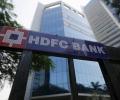
The country's largest private sector lender HDFC Bank on Saturday reported a 23 per cent jump in standalone net profit to Rs 10,055.20 crore for the March quarter, led by growth in loan demand across categories and lower provisioning as bad loans were trimmed. The bank's net profit during the corresponding period of the previous fiscal stood at Rs 8,186.51 crore. "After providing Rs 2,989.5 crore for taxation, the bank earned a net profit of Rs 10,055.20 crore, an increase of 22.8 per cent over the quarter ended March 31, 2021," HDFC Bank said in a regulatory filing.
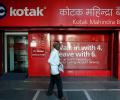
Kotak Mahindra Bank's net interest margin is likely to swell after the Reserve Bank of India (RBI) lifted its restrictions on the private lender that barred it from issuing fresh credit cards and onboarding new customers through digital mode, brokerages said on Thursday. The bank's net interest margin (NIM) has seen a decline of over 35 basis points (bps) since the restrictions were imposed by the regulator in April 2024.

From the 30-share Sensex pack, Adani Ports surged 6 per cent. NTPC, HDFC Bank, Bajaj Finance, Maruti and Axis Bank were among the other gainers. In contrast, Titan, State Bank of India, Asian Paints, Tata Consultancy Services, HCL Tech, Sun Pharma, IndusInd Bank and ICICI Bank were among the laggards.

Quarterly earnings from corporates, global trends, and trading activity of foreign investors will guide market sentiment this week, analysts said, adding that benchmark indices may face volatile trends. "The upcoming release of Q2 results will be closely watched, providing insights into corporate performance. "Meanwhile, the escalating tensions between Israel and Iran introduce a significant geopolitical risk, potentially leading to increased oil prices and market volatility.

'We do not believe in fire sale. We don't do it.'

'He's at best a holding-CEO. Not one who will re-imagine the bank,' a senior banker and former colleague tells Raghu Mohan about HDFC Bank CEO & MD Sashidhar Jagdishan.
New India Assurance and Niva Bupa have invested in the Bima Sugam India Federation.
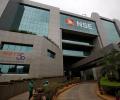
Leading stock exchanges NSE and BSE on Monday said all their operations are functioning in a normal manner after HDFC Securities flagged that confirmations were not received for orders placed in the NSE cash segment due to a "technical glitch". After mentioning about the technical glitch in a tweet at 10.01 am, HDFC Securities, at around 11.53 am, issued a statement saying the issue "got resolved at 9.50 am" and that investigation is going on to find out the root cause. The episode, which happened less than one hour after markets opened for trading, comes within days of a technical glitch forcing NSE (National Stock Exchange) to halt trading for nearly four hours on Thursday. In a statement, a NSE spokesperson said that all the operations on its platforms were "functioning smooth and normal".

Mortgage lender HDFC on Wednesday said it has approved the highest ever retail home loans of over Rs 2 lakh crore in 2021-22. The demand for these loans was from across the country, HDFC said in a statement. HDFC managing director Renu Sud Karnad said, "In over four and half decades, I have not seen a better time for the housing sector than now due to lower interest rates, stable property prices, government's thrust on affordable housing, improved affordability, favourable demographics, increasing urbanisation and rising aspirations." The residential real estate segment will continue to see strong traction going forward, as the demand for housing is not just pent up demand but is a structural one, she said.

Benchmark equity indices Sensex and Nifty pared early gains to settle lower on Wednesday due to late selling in index major Reliance Industries, ITC and HDFC Bank even as the RBI took the first step towards a rate cut in its monetary policy review. Erasing its early gains, the 30-share BSE Sensex fell 167.71 points or 0.21 per cent to close at 81,467.1. During the day, it surged 684.4 points or 0.83 per cent to hit an intra-day high of 82,319.21.

A merchant using the bank's merchant App, QR code, PoS or Payment gateways, across all segments, including electronics, apparel, grocery, stand to win assured cashback and prizes on volume build-up, EMI or digital transactions.

rediffGURU Vivek Lala answers your income tax and personal finance queries.

Metropolitan Stock Exchange of India (MSE) plans to raise Rs 120 crore from investors in an attempt to stay afloat. The beleaguered exchange's board has approved issuance of 1.19 billion equity shares of face value Rs 1 at a premium of Rs 1 through private placements, according to a disclosure on its website.

'Margins will be an outcome of that. They will likely remain somewhat range-bound.'

From the 30-share Sensex pack, UltraTech Cement, JSW Steel, Adani Ports, Tech Mahindra, Titan, Maruti, Mahindra & Mahindra, Tata Steel and Reliance Industries were the biggest gainers. NTPC, Hindustan Unilever, Kotak Mahindra Bank, IndusInd Bank and Larsen & Toubro were among the laggards.
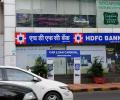
The Delhi Police Cyber Cell has arrested 12 people, including three HDFC Bank employees, for allegedly trying to withdraw money from the account of an NRI, officials said on Tuesday.

Axis Bank, IndusInd Bank, HDFC Bank, State Bank of India, Kotak Mahindra Bank and UltraTech Cement were also among the big gainers. Adani Ports, ITC, Bharti Airtel and Asian Paints were among the laggards.

Credit card spending in September recorded strong growth of 25 per cent year-on-year (Y-o-Y), marking the highest increase in six months. Even as many banks saw higher slippages during the July-September quarter of 2024-25, spending growth exceeded 20 per cent for the first time since February. According to the latest data released by the Reserve Bank of India (RBI), September spending reached Rs 1.76 trillion, compared to Rs 1.42 trillion in the same period a year ago. In August 2024, credit card spending was Rs 1.68 trillion.

The country's largest private sector lender HDFC Bank on Tuesday announced a 0.35 per cent hike in lending rate. The hike, which comes a day ahead of the RBI's scheduled policy review, is the second such move from the lender in as many months, taking the cumulative hike to up to 0.60 per cent. The RBI had surprised all with a 0.40 per cent hike in key interest rates on May 4 to tame the inflation situation and is widely expected to follow up with further tightening of the policy on Wednesday.
