
From the 30-share Sensex pack, Hindustan Unilever, NTPC, Nestle, IndusInd Bank, Power Grid, Adani Ports, Tata Motors and Bajaj Finserv were the major laggards. Reliance Industries, Kotak Mahindra Bank, Tech Mahindra, Mahindra & Mahindra and HDFC Bank were among the gainers.

Purchase health insurance early while you are disease-free. 'It might become very difficult to get a comprehensive health cover for someone who has already had cancer.'

From the 30-share Sensex pack, NTPC, Asian Paints, HDFC Bank, State Bank of India, Tata Motors, JSW Steel, Maruti and Power Grid were among the major laggards. On the other hand, Sun Pharma, Infosys and ICICI Bank were the gainers.
Global rating agency Moody's on Monday said HDFC Bank's multiple digital outages are credit negative as such recurring incidents could lead to moderation in revenue and flight of customers to other banks. The recurring outages also risk hurting the bank's brand perception among a growing and increasingly digitally savvy customer base, and increases the potential that clients switch to other banks, which would lead to a reduction in revenue and low-cost retail funding, Moody's said in a statement.

The Indian insurance industry is set to focus on customer-centric technological adoption and expansion into rural areas to drive growth in 2025.
Eight months after barring the country's largest private sector lender HDFC Bank from selling new credit cards, the Reserve Bank of India (RBI) has lifted the ban, banking sources said on Tuesday. However, the ban on launching new technology initiatives remains, the sources said. In December last year, the RBI had come out with an unprecedented

Ask rediffGURU and PF expert Nitin Narkhede your mutual fund and personal finance-related questions.

HDFC and HDFC Bank were the biggest losers in the Sensex pack, plunging 5.09 per cent and 3.32 per cent, respectively, after the private bank reported a rise in non-performing assets.

From the 30 Sensex pack, ICICI Bank climbed 3 per cent after the private sector lender posted a 14.5 per cent growth in standalone profit to Rs 11,746 crore for the second quarter ended September 2024. JSW Steel, Mahindra & Mahindra, Adani Ports, Tata Steel, Sun Pharma, Hindustan Unilever, Tata Motors and State Bank of India were the other big gainers from the pack.

Given gains in equity prices, it is not surprising that the earnings of asset management companies (AMCs) are growing quicker. The earnings momentum looks set to continue. Good fund performances have thus led to AMC earnings upgrades although valuations are high. Recent market performance and net flow trends have led to earnings upgrades by between 3-8 per cent for FY25-27.

'If you are not prudent, you may exceed your budget, and if it happens too often, you may end up in debt.'

Stock investors have become richer by Rs 10.47 lakh crore in two straight days of gains in markets as benchmark Sensex jumped 2 per cent. At close on Wednesday, the market capitalisation of BSE-listed companies surged by Rs 10,47,565.48 crore to Rs 4,52,58,633.53 crore ($5.37 trillion) in two days of gains. "The feel good factor of Trump's win in the US election had a rub-off effect on world equity markets, including local indices as domestic investors resorted to value buying, especially in IT stocks, which pushed the benchmark Sensex above the 80k mark.

From the Sensex stocks, Power Grid, NTPC, HDFC Bank, Nestle India, Adani Ports and Special Economic Zone, Maruti Suzuki India and Reliance Industries were the major gainers. In contrast, Mahindra and Mahindra, Tata Steel, Bajaj Finserv, State Bank of India, Larsen & Toubro and Tata Motors were the laggards.

From the 30 Sensex firms, Mahindra & Mahindra, Infosys, Kotak Mahindra Bank, JSW Steel, Adani Ports, Tata Motors, Adani Ports, ITC and Titan were the major laggards. HDFC Bank, Bharti Airtel, Reliance Industries, Asian Paints and State Bank of India were the gainers.

HDFC Bank on Monday said it aims to regain the two per cent market share in the credit card market it ceded to rivals during a recent ban, within a year by aggressively tapping into its existing depositor base. The bank will also focus on forging new partnerships to sell more cards and will not deviate from its conservative approach on taking credit risks as it goes aggressive in the market, its group head for payments and consumer finance, digital banking and IT, Parag Rao, told reporters. On August 17, RBI lifted the ban on HDFC Bank which had prevented it from issuing new credit cards from December 2020.

From the 30-share Sensex pack, Mahindra & Mahindra, Larsen & Toubro, State Bank of India, Reliance Industries, ICICI Bank and Bajaj Finance were the biggest gainers. JSW Steel and Infosys were the laggards.
From the 30 Sensex firms, Larsen & Toubro, Reliance Industries, Axis Bank, Asian Paints, Tata Motors, Bajaj Finance, Maruti, Bajaj Finserv, Kotak Mahindra Bank, Titan, Adani Ports and HDFC Bank were the major laggards. JSW Steel emerged as the only gainer.

Benchmark Sensex closed above the 85,000 level for the first time while Nifty scaled the 26,000 peak at close on Wednesday as fag-end buying in banking and power shares helped stock markets recoup early losses. After a see-saw trade during the day, the 30-share BSE Sensex rose by 255.83 points or 0.30 per cent to settle at an all-time high of 85,169.87. During the day, it surged 333.38 points or 0.39 per cent to hit a record intra-day peak of 85,247.42.

From the 30-share Sensex pack, Tata Consultancy Services and Infosys jumped over 4 per cent each. HCL Technologies, Tech Mahindra, Adani Ports, Larsen & Toubro, Maruti and Reliance Industries were also among big gainers. Titan, IndusInd Bank, Hindustan Unilever, Axis Bank and HDFC Bank were the laggards.

The Reserve Bank of India (RBI) is expected to cut interest rates for the first time in nearly five years in Governor Sanjay Malhotra's first monetary policy committee (MPC) meeting on Wednesday. The meeting of the six-member MPC, which will culminate on Friday, aims to boost sluggish economic growth, which is seen falling to a four-year low. Malhotra took charge as the 26th RBI governor in December last year.
Zomato emerged as the biggest gainer, followed by Reliance, Nestle, Asian Paints and Power Grid.

The volume of new fund offerings (NFOs) in 2025 will fluctuate based on market conditions. However, innovation is expected to continue unabated. With an increasing number of fund houses aiming to establish a presence in the 'factor' investing space and changes in fund-of-fund taxation providing more opportunities, several industry-first offerings are anticipated.
The housing finance major issued non-convertible debentures and warrants to raise another Rs 4,000.03 crore.

A sharp fall in the equity market made investors poorer by Rs 5.29 lakh crore on Tuesday when the BSE benchmark Sensex tumbled over 800 points. A host of negative triggers -- muted quarterly earnings, continuous foreign fund outflows and weak trends in Asian and European markets -- dragged the benchmark indices lower. The BSE benchmark gauge tumbled 820.97 points or 1.03 per cent to settle at 78,675.18.

'Retail investors have to stick to their asset allocation plans and continuously do portfolio reviews.'

From the 30-share Sensex pack, Tech Mahindra, HCL Technologies, Tata Consultancy Services, Asian Paints, Infosys and Maruti Suzuki were the biggest laggards.

Equity benchmark Sensex rallied 478 points on Monday after gains in index majors HDFC, Infosys and Kotak Bank despite a negative trend in the global markets.

Ask rediffGURU and PF expert Nitin Narkhede your mutual fund and personal finance-related questions.
If the entire amount of Rs 24,000 crore is raised, then it would be the biggest fundraising exercise by any Indian company ever.
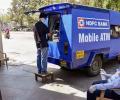
Private sector lender HDFC Bank on Thursday said the Reserve Bank of India (RBI) has asked it temporarily stop all launches of its upcoming digital business-generating activities and sourcing of new credit card customers after outage at its data centre which impacted operations last month.
The bank has decided to embark on a 'Technology Transformation agenda' to provide its customers smoother, faster, and better banking experience.
With slippages increasing every quarter, any derailment on growth or change in customers' repayment behaviour after moratorium may impact the overall asset quality. Correction, though, presents attractive buying opportunities, given the bank's sustained leadership position.

Do you have financial planning or income tax queries? Ask rediffGURU Anil Rego.

The fund will promote domestic shipbuilding of all types and sizes to reduce India's dependence on foreign ships.

Dr Reddy's Laboratories (DRL) share price plunged 6.66 per cent to Rs 1,203.50 per share on the NSE during Friday after analysts remained cautious on the company's Q3 performance and differed on its growth outlook. DRL's Q3 performance was viewed as subdued by some analysts when they adjusted it for one-time grants and incomes that the company received during the quarter.

Gold prices slumped for the second straight session by Rs 1,150 to Rs 78,350 per 10 grams in the national capital on Monday on frantic selling by stockists and retailers, the All India Sarafa Association said. The precious metal of 99.9 per cent purity closed at Rs 79,500 per 10 grams on Friday.

The share of life insurance policies sold by top private insurers in the rural areas declined in the financial year 2023-24 (FY24) compared to previous year. SBI Life, HDFC Life, ICICI Prudential Life Insurance -- the top three players from the private sector-- have seen the share of insurance policies sold in rural areas drop in FY24 as compared to the previous financial year. Max Life Insurance's share of rural policies recorded an increase in FY24.

From the 30-share pack, Hindustan Unilever, Tata Motors, Axis Bank, Nestle India, Asian Paints, ITC, Reliance Industries, Mahindra & Mahindra, IndusInd Bank and State Bank of India were among the laggards. Larsen & Toubro, Tata Steel, JSW Steel, HDFC Bank, Adani Ports, Kotak Mahindra Bank, Bharti Airtel and PowerGrid were among the gainers.

Sensex drops 138 points on foreign fund outflow
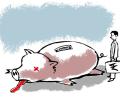
Most lenders that have reported their April-June business update posted slower growth in deposits sequentially as compared to the loan growth in the April-June quarter of 2024-25 (FY25). Current and savings account (CASA) deposits continue to face pressure. Private-sector lenders YES Bank, Bandhan Bank, and RBL Bank saw their deposit growth contract by 0.5 per cent, 1.5 per cent, and 2 per cent, respectively.
