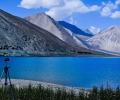
'The use of military power to settle disputes is not always preferred and is the last preferred option, but it certainly remains an option.'
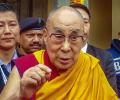
'The logical step is to challenge the very legitimacy of the Chinese claim over Tibet,' recommends Inspector General Gurdip Singh Uban (retd).

'I don't see how any Indian government or any Indian military leadership can now ask the soldiers to patrol without weapons.'
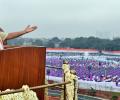
He made a reference to the clash between Indian and Chinese troops in Ladakh's Galwan Valley in June this year. "What our jawans can do, what the country can do, the world has seen in Ladakh," he said.

'The fatal mistake for the USSR was the invasion of Afghanistan.' 'Quite possibly the fatal mistake for the Chinese empire is the assault on Ladakh,' observes Rajeev Srinivasan.

'Could the Chinese have taken a leaf out of our book?' 'That their unprecedented build-up is their attempt at coercive diplomacy with India?' 'And if so, what is it that they could be expecting as a quid pro quo?' asks Shekhar Gupta.
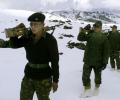
'It is a miracle how a soldier handles the lack of oxygen, stands his post and also confronts the Chinese at 14,000 feet where survival itself is a challenge.'

'Our people are crazy about cricket, but they are more crazy about their country, and their armed forces.' 'To the people of India, there is nothing that is above the nation, not even cricket.'
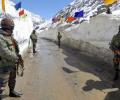
'They cannot use firearms.' 'They have to be restrained.' 'It is a game of patience and chess board moves.' 'It is not like India and Pakistan where bullets get fired and people get killed.'

'China was a relationship from which Mr Modi had expected the most it seems.' 'It showed in a string of summits, and somewhat breathless celebration of Xi Jinping.' 'It was hasty and simplistic,' observes Shekhar Gupta.
