
India has its share of both large tech companies and large national laboratories, but why is it that these don't seem to be at the forefront of any innovation news headlines? asks Ajit Balakrishnan.
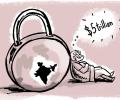
It would be a difficult task for the Indian economy to reach the $5-trillion mark a year before the International Monetary Fund (IMF) projection of 2026-27. Pankaj Chaudhary, minister of state for finance, said in the Rajya Sabha on Tuesday that the government is taking steps to make the country a $5-trillion economy at a date earlier than the IMF's projection. In that context, it would not be difficult to meet the projection in the third quarter of FY27.

Indian economy is in a sweet spot, with a mix of solid growth and moderating inflation, Moody's Ratings said, forecasting a 7.2 per cent GDP growth in the 2024 calendar year and 6.6 per cent in the next. In its Global Macro Outlook 2025-26, the rating agency said the global economy has shown remarkable resilience in bouncing back from supply chain disruptions during the pandemic, an energy and food crisis after the Russia-Ukraine war began, high inflation and consequent monetary policy tightening.

It's always been a struggle for economists and statisticians to forecast India's gross domestic product (GDP) correctly, and say where the economy is headed before the official numbers come out. If estimating the GDP is tough, forecasting it in real time is complicated. It involves looking at tens of indicators, such as industrial production, electricity consumption and exports, to arrive at a number.

'If our Budget allows, we may implement both measures -- making income up to Rs 10 lakh tax-free and introducing a 25 per cent slab for income between Rs 15 lakh and Rs 20 lakh.'

Citing the massive surge in Omicron infections and the resultant impact on overall economic activities in the March quarter, Swiss brokerage UBS Securities has revised downwards its India's growth forecast for the current financial year to 9.1 per cent from 9.5 per cent earlier. However, UBS Securities does not see the third wave impact extending to the next financial year as it has revised upwards its real GDP forecast to 8.2 per cent, up from 7.7 per cent earlier, expecting the real GDP growth to remain well above the historical average. The World Bank pegs it at 8.3 per cent, unchanged from its June assessment, saying the recovery is not broad-based yet.

I'...additional concessions, such as opening government procurement, reducing agricultural subsidies, weakening patent protections, and allowing unrestricted data flows -- demands India has resisted for decades.'

The share of equity and investment funds in the total financial wealth of households increased by more than 50% between 2011-2012 and 2022-2023.

India's current account deficit (CAD) may dip further in the March quarter of FY24 as pressure from the negative net exports during the January-March period eased to an 11-quarter high. A part of the gross domestic product (GDP) data, net export- which is usually negative for India - captures the difference between exports and imports of both goods and services, while the CAD data, released by the Reserve Bank of India (RBI), also factors in private transfer receipts.

Looking under the hood, I see India on the terrible, but commonplace, road to prosperity failure, warns Rathin Roy.

S&P Global Ratings on Tuesday said the Indian economy is set for "resilient growth" in 2025 and projected inflation pressure to recede which will lead to "modest" easing of the monetary policy by the RBI. In its India outlook for 2025, S&P also retained India's growth forecast for current fiscal at 6.8 per cent, followed by 6.9 per cent growth in 2025-26.

China's GDP grew by 4.9 per cent in the third quarter, down from 7.9 per cent in the second, confirming the slowdown of the world's second-largest economy which was under pressure from the crisis-hit property sector, curbs on energy and tardy recovery from the Covid-19 pandemic.

India's current account slipped into a deficit of $9.6 billion or 1.3 per cent of GDP in the September quarter, the Reserve Bank said on Friday. The current account, which records the value of exports and imports of both goods and services along with international transfers of capital, was in a surplus mode both in the quarter-ago and year-ago periods. India's current account surplus had stood at $6.6 billion or 0.9 per cent of GDP in the April-June 2021 quarter, while in the year-ago period (Q2FY22), the surplus had stood at $15.3 billion or 2.4 per cent of the GDP, the data said.

Dominic Xavier asks if it is right to blame coronavirus and the lockdown for India's economic decline.
Fitch Ratings on Tuesday said the FY25 Budget demonstrated the government's ongoing commitment to reducing fiscal deficit and ensured policy continuity during the NDA government's new term. Finance Minister Nirmala Sitharaman on Tuesday presented the first Budget of the Modi 3.0 government in which she revised the deficit target for current fiscal lower to 4.9 per cent of the GDP, from 5.1 per cent projected in the interim Budget.

'As we navigate uncertain waters, a conservative approach to largecap investing could provide a strategic advantage.'

'There will be no change of seats for Delhi, Assam and Maharashtra.' 'Andhra, J&K, Kerala, Punjab, Karnataka, Tamil Nadu, Odisha, West Bengal and Telangana will lose seats while there will be an increase for MP, UP, Bihar, Haryana, Gujarat and Chhattisgarh.' 'It is a big mistake if you make it a north-south issue.'

'Inflation is not good for industry. Nor for the economy as a whole.'

Fiscal deficit for 2021-22 worked out to be 6.71 per cent of the gross domestic product (GDP), lower than 6.9 per cent projected by the Finance Ministry in the revised Budget Estimates, according to government data released on Tuesday. Unveiling the revenue-expenditure data of the Union government for 2020-21, the Controller General of Accounts (CGA) said that the fiscal deficit in the absolute terms was be Rs 15,86,537 crore (provisional).

Domestic ratings agency Icra on Monday forecast a 2 per cent GDP growth in the fourth quarter of 2020-21, and a 7.3 per cent contraction for the full fiscal year. From a GVA or gross value added perspective, the agency pegs Q4 growth at 3 per cent and the full year contraction at 6.3 per cent. According to the agency, the 2 per cent projected GDP growth will help the economy avoid a double-dip recession as indicated by the National Statistical Office (NSO) for Q4. Icra's projection is better than the 8 per cent contraction forecast by the NSO as it sees Q4 growth at only 1.1 per cent.
The Centre's fiscal deficit at the end of the first five months of the current fiscal touched 27 per cent of the full-year target, government data showed on Monday. In absolute terms, the fiscal deficit -- the gap between expenditure and revenue -- was at Rs 4,35,176 crore as of August-end, according to data released by the Controller General of Accounts (CGA). The deficit stood at 36 per cent of the Budget Estimates (BE) in the corresponding period of 2023-24.

'If it doesn't, it will continue with measures to infuse liquidity, signalling a new cycle,' predicts Tamal Bandyopadhyay.

'Suddenly we had a new comprehension of affairs, which reminded that the luxury of politics floated atop a foundation by economics.' 'Along with this, finance ministers became crucial in molding the perception and reputation of Union Cabinets.' 'Governments couldn't afford a wrong person in that portfolio,' asserts Shyam G Menon.

Quick commerce (qcom) industry is poised to lead gig workforce hiring in 2025, propelled by a surge in demand for faster deliveries, expansion by existing players, entry of new competitors, and evolving consumer preferences in the post-pandemic era, according to industry experts. The qcom industry currently employs nearly 260,000 people - around 200,000 delivery personnel and 60,000 dark store workers, according to TeamLease Staffing.
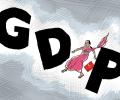
India's gross domestic product (GDP) growth slowed to 4.1 per cent in January-March 2022 period, while for the full year 2021-22 the growth stood at 8.7 per cent, according to the government data released on Tuesday. GDP at constant (2011-12) prices in Q4 2021-22 is estimated at Rs 40.78 lakh crore, as against Rs 39.18 lakh crore in Q4 2020-21, showing a growth of 4.1 per cent, as per the National Statistical Office (NSO) data. India's GDP growth has slowed for the third straight quarter.

If growth reverts to the pre-Covid level, a lot of people may have to temper their rosy optimism, points out Debashis Basu.

India's steel market is out of step with global trends. Global demand is weak with China at a huge supply surplus to its domestic demand, pushing down global steel prices. India's domestic demand for steel is strong, given the continuing infrastructure push and is likely to accelerate as urbanisation improves, and the auto sector continues to grow alongside the infrastructure push.

The pre-budget Economic Survey, which is tabled in Parliament ahead of the Union Budget to present the state of the economy and suggest policy prescriptions, quite often misses on the GDP forecast, sometimes by a significant margin. This time, Finance Minister Nirmala Sitharaman will table the Economic Survey for 2021-22 in the Lok Sabha on Monday soon after the President's address to both Houses of Parliament. She will present the Union Budget for the next financial year beginning April 1, 2022, on Tuesday.
The country's gross domestic product (GDP) is likely to grow at 5.8 per cent in the third quarter of fiscal 2022, according to an SBI's research report- Ecowrap. The country's economy expanded by 8.4 per cent in the second quarter of 2021-22, to cross pre-pandemic levels. However, the GDP growth in July-September period was slower than the 20.1 per cent expansion in the previous quarter.

'India's output contraction in the previous year was among the worst in the world!'

From the 30-share blue-chip pack, Zomato cracked nearly 7 per cent. Power Grid, Adani Ports, Tata Steel, NTPC, Tata Motors, Tech Mahindra, Mahindra & Mahindra, Asian Paints, Sun Pharma and UltraTech Cement were the other major laggards. In contrast, Axis Bank, Hindustan Unilever, Tata Consultancy Services and IndusInd Bank were the gainers.
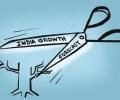
The International Monetary Fund (IMF), in its latest World Economic Outlook report, has slashed its forecast for India's FY23 gross domestic product growth to 8.2 per cent from 9 per cent, saying that higher commodity prices will weigh on private consumption and investment. This was one of the steepest cuts for emerging economies compared to the IMF's January WEO forecasts. Saying that global economic prospects have worsened significantly due to commodity price volatility and disruption of supply chains caused by the war in Europe, IMF cut its global growth outlook for calendar year 2022 to 3.6 per cent from 4.4 per cent, and said both Russia and Ukraine could experience large GDP contractions.

The government's capital expenditure in the April-November period of financial year 2024-25 (FY25) continued to contract with a 12.3 per cent decline year-on-year (Y-o-Y), according to data released by the Controller General of Accounts on Tuesday.

All eyes will be on whether Sitharaman provides the much-expected tax relief for the middle class, leaving more money in their hands, as there is tax buoyancy

India's services sector growth touched a four-month high in December, supported by new business inflows on strong demand conditions and easing inflationary pressures, a monthly survey said on Monday. The seasonally adjusted HSBC India Services Business Activity Index, rose from 58.4 in November to 59.3 in December, highlighting the strongest rate of expansion in four months.

'Challenge is basically near-term growth as the outlook has turned a bit adverse.'

'Spend, but create assets, spend but make sure that people benefit from it.' 'This has been a beautiful guiding principle. And I think as a finance minister I owe so much to the prime minister for keeping this path clear before us.'

The most striking features of this Budget was its focus on simplification and improving the ease of doing business in India, asserts Kaku Nakhate.

The Asian Development Bank (ADB) on Wednesday slashed India's GDP growth forecast for FY23 to 7 per cent from the earlier estimate of 7.2 per cent mainly on account of higher inflation and a tight monetary policy. India's economy grew 13.5 per cent year-on-year in the first quarter of 2022-23, reflecting strong growth in services, ADB said in its second supplement to Asian Development Outlook Report 2022 (ADO 2022). "However, GDP growth is revised down from ADO 2022's forecasts to 7 per cent for FY2022 (ending March 2023) and 7.2 per cent for FY2023 (ending March 2024) as price pressures are expected to adversely impact domestic consumption, and sluggish global demand and elevated oil prices will likely be a drag on net exports," ADB said.

Fitch Ratings has revised India's GDP forecast to minus 9.4 per cent in the current fiscal year from a previously projected contraction of 10.5 per cent after the economy staged a sharper rebound in the second quarter. In its Global Economic Outlook, Fitch said the coronavirus-induced recession inflicted severe economic scarring and the country needs to repair balance sheets and increase caution about long-term planning. "We now expect GDP to contract 9.4 per cent in the fiscal year to end March 2021 (plus 1.1 percentage point) followed by plus 11 per cent growth (unchanged) and plus 6.3 per cent growth in the following years," the rating agency said.
