
Select the exact category by matching your investment horizon to the portfolio duration, suggests Sanjay Kumar Singh.

This is a key reason for the finance ministry's objection to fixing the tenure at 100 years, as it is pushing PSBs to be self-dependent and raise funds from the market, reports Hamsini Karthik.

Amid fears of a third wave of coronavirus pandemic and hardening of retail inflation, the Reserve Bank is likely to maintain status quo on interest rate and watch the developing macroeconomic situation for some more time before taking any decisive action on monetary policy. The RBI is scheduled to announce its bi-monthly monetary policy review on August 6 at the end of the three-day meeting -- August 4-6 -- of the Monetary Policy Committee (MPC). The RBI Governor-headed six-member MPC decides on the key policy rates.

The Indian economy is on the path of a durable recovery on the back of conducive monetary and credit conditions, the global headwinds notwithstanding, said a Reserve Bank of India (RBI) article on the state of the economy. Domestically, there have been several positives on the COVID-19 front, in terms of reduced infections and faster vaccinations, the article published in the RBI Bulletin November 2021 added. The Indian economy, the article said, is clearly differentiating itself from the global situation, which is marred by supply disruptions, stubborn inflation and surges of infections in various parts of the world.

The government can issue recapitalisation bonds, or the RBI's huge reserves of over $127 can also be dipped into to help the state-owned bank's recapitalisation needs.

The government on Wednesday asked the Reserve Bank to maintain retail inflation at 4 per cent with a margin of 2 per cent on either side for another five-year period ending March 2026. To control the price rise, the government in 2016 gave a mandate to the RBI to keep the retail inflation at 4 per cent with a margin of 2 per cent on either side for a five-year period ending March 31, 2021.

As the central bank continues to increase forex reserves by running down the forward book which totalled $42 billion as of end-July, signalling its strong resolve to build a bigger reserve cushion to aid its expansionary, unorthodox monetary policy, the reserves are set to top the $655-billion-mark by March, according to a report. The forex kitty declined by $2.10 billion to $619.36 billion for the week to August 13 due to a fall in the core currency assets and gold, showed the latest RBI data. The reserves had risen to a lifetime high of $621.46 billion in the previous reporting week ending August 6.
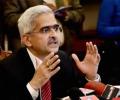
The Reserve Bank of India on Friday decided to leave benchmark interest rate unchanged at 4 per cent but maintained an accommodative stance as the economy faces heat of the second Covid wave.

'Everyone is still trying to understand the quantum of impact demonetisation will have on the economy.'

Observing that there is liquidity overhand of Rs 13 lakh crore in the system, RBI Governor Shaktikanta Das said on Friday that the exceptional measures undertaken during pandemic will be dealt in sync with macroeconomic developments to preserve financial stability. Since the onset of the pandemic, the Reserve Bank has maintained ample surplus liquidity to support a speedy and durable economic recovery, he said while announcing the outcome of the Monetary Policy Committee (MPC) meeting. The level of surplus liquidity in the banking system increased further during September 2021, with absorption under fixed rate reverse repo, variable rate reverse repo (VRRR) of 14 days and fine-tuning operations under the liquidity adjustment facility (LAF) averaging Rs 9 lakh crore per day as against Rs 7 lakh crore during June to August 2021, he said.
The Reserve Bank of India hiked key interest rates by 0.25 per cent each in the last two reviews to tame inflation.

Post office savings deposit, recurring deposit accounts and the senior citizen savings scheme account have shown the highest growth in the current financial year.

Top losers in the Sensex pack included Yes Bank, IndusInd Bank, Tata Motors, RIL, ONGC, Bajaj Auto, Vedanta, Tata Steel, TCS, HDFC Bank and ICICI Bank, which fell up to 3.29 per cent.
'A strong foreign exchange reserve is the best safety net against global spillovers.'


Not many takers for debt funds with longer maturity.

The RBI governor's assurance should give investors enough confidence to start believing in the NBFC sector again, say bankers.

Being market-linked, the public provident fund corpus can no longer be predicted over the long term.

Retail investors may safely invest in shorter-duration funds, suggests Sanjay Kumar Singh.

'It is going to be a tough balance for the RBI to manage economic stability and ensure smooth government borrowing.'

'Increased allocations for MNREGA could have provided the much needed push to rural demand and consumption at a time when recovery continues to remain uneven.'

Short-term lending rate unchanged at 7.75 pc.

The local currency had lost 119 paise in the past five sessions on rising worries over current account gap and fears that withdrawal of US stimulus will hit inflows from overseas.
Gilt funds are nothing but debt funds that primarily invest in government securities (G-Secs). However they differ from conventional debt funds in that, while a traditional debt fund invests in all types of debt instruments, gilt funds have narrow investment objective. They just focus on G-Secs.
In the face of continuing uncertainty in the domestic stock markets, the government and Reserve Bank of India may look at allowing foreign institutional investors to temporarily park their funds in the domestic debt market, a top Sebi official said. Presently, FIIs are allowed to park upto $8 billion in the domestic debt markets, which includes upto $5 billion in the government securities and upto $3 billion in the corporate bonds.

As yields rise, bond prices fall. Higher yields not only translate into losses for investors, it also pushes up borrowing cost for companies as well as government

Rajan said there was full understanding between him and the Finance Minister Arun Jaitley on setting up of the PDMA

Theoretically, the currency with the public should expand in sync with the nominal income, which again moves in relation to the nominal growth rate of the economy. But the correlation breaks easily when other factors come into play, says Anup Roy.
Financial planning expert G K Balaji offered some valuable tips to our readers.

Bank of America (BofA) Securities expects India to be the third-largest economy in the world by 2031. The economic rise could become a reality by 2028, but the Covid pandemic delayed the pace, BofA Securities economists Indranil Sen Gupta and Aastha Gudwani wrote in a report.

Instead, 2019-20 could be the base from which the Budget estimates for next year are calculated.

Trading such scenarios takes discipline.

'One can start accumulating economy driven stocks in the next few months with a two-three year view.'

Senior officials in the MF industry say while the finance ministry and regulators communicate regularly, this is one of the very few instances in many years where an issue between the two has come out into the open.

For longer tenure products, they offer higher returns compared to other instruments. But for shorter tenures, things are getting tighter for investors.

This is aimed at improving liquidity in all schemes and would help them to meet sudden redemption pressures, said Sebi chairman Ajay Tyagi.
Investors' fears regarding bank stocks are becoming a reality, impacting investor sentiment towards the banking sector stocks.
Investors need to identify banks which have a proven track record of growth mainly in terms of their advances.
A Parliamentary committee has asked Reserve Bank of India to direct banks to channelise more funds to industry and other sectors instead of investing excessively in risk-free government papers.\n\n\n\n
Warning banks on interest rates risks, high transaction costs and NPAs, ICRA said Indian banks are yet to attain global standard in profitability and productivity despite posting over 40% growth in net profit in the first half of this fiscal.
