
Eighteen of India's 28 states exceeded the fiscal deficit ceiling of 3 per cent of GSDP in FY25, a deterioration comparable to the Covid year of 2020-21, according to the Comptroller and Auditor General (CAG). The report also noted a decline in states reporting a revenue surplus, with Bihar, Mizoram, and Telangana moving into deficit.

India's wholesale price-based inflation surged to 11.39 per cent in September, up from 9.92 per cent in August, primarily driven by increasing prices of food, manufactured items, and fuel and power.

India's exports saw a significant 23 per cent increase, reaching USD 44.4 billion in September, while the trade deficit narrowed to USD 30.21 billion, according to recent government data.

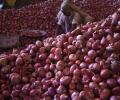
India's retail inflation surged to 5.54 per cent in September, primarily due to a significant increase in onion and other food prices, remaining just within the Reserve Bank of India's tolerance band. This marks the highest inflation since the new series with base year 2024 took effect in January.

India's services sector experienced its strongest growth in three months in September, with the HSBC India Services PMI Business Activity Index rising to 55.2, driven by a sharp increase in new orders and strengthening domestic demand.

Chief Economic Advisor V Anantha Nageswaran stated that the second half of the current fiscal year (FY27) is expected to be challenging due to increased downside risks to global growth and rising interest rates worldwide.
Parliament on Tuesday approved the long-awaited fiscal responsibility legislation after Finance Minister Jaswant Singh promised there would be no lowering of developmental expenditure.

Moody's Ratings has sharply increased India's GDP growth forecast for fiscal 2026-27 to 7 per cent, making it the fastest among G20 economies, driven by economic resilience despite the Middle East conflict. However, the agency flagged significant inflation risks stemming from elevated oil prices and potential El Nino disruptions.

Finance Minister Nirmala Sitharaman stated that the Reserve Bank of India (RBI) will persist in its efforts to prevent excessive volatility in the rupee, which has significantly depreciated against the US dollar due to global uncertainties, despite India's strong macro-economic fundamentals.

The FCNR (B) stratagem relies on using public money to defend the rupee. The State subsidises foreign borrowing to attract dollars. This tool requires large-scale borrowing to make a material difference against a gross external flow of $11 billion a day. A commensurately large fiscal cost falls upon the exchequer. The ministry of finance will choose how much it is willing to spend in exchange for this round number, points out Ajay Shah.

Tata Chemicals has stated its commitment to resolving outstanding issues with the Kenyan government after President William Ruto reportedly ordered its subsidiary, Tata Chemicals Magadi Ltd, to cease operations, citing a lack of benefit to citizens.

BRICS members have expressed 'serious concerns' over the unilateral imposition of trade and finance-related measures, including higher tariffs and non-tariff barriers, stating these actions distort trade and are inconsistent with WTO rules. The grouping also highlighted elevated risks to the global economic outlook due to geopolitical tensions, trade fragmentation, and protectionism.

India is making a significant push to establish itself as a global semiconductor manufacturing hub, driven by strategic investments and policy support. The upcoming SEMICON India 2026 event will showcase the country's advancements and ambitions in this critical industry, which underpins virtually all modern electronic devices and has faced global supply chain vulnerabilities.
India's fiscal deficit is projected to reach 4.5 per cent of GDP for the current fiscal year, exceeding the budgeted target, as the government's policy responses to the West Asia conflict are expected to strain public finances, according to research firm BMI.

BRICS finance ministers and central bank governors have called for increased representation of emerging-market and developing economies in the IMF and World Bank, while also criticising unilateral tariffs and trade measures, as the expanded bloc aims to bolster financial cooperation amidst global fragmentation.

The Reserve Bank of India (RBI) is widely expected to keep its benchmark repo rate unchanged in the August monetary policy review, with economists citing elevated inflation risks and the pending closure of the FCNR(B) deposit scheme as key factors. Most anticipate a 'Neutral' policy stance but with a hawkish tone due to geopolitical tensions, high crude oil prices, and an uneven monsoon.

The forthcoming Budget could think of maintaining public capital expenditure at 3 per cent so that domestic resources are available for private investments, points out N R Bhanumurthy.

'Chandrasekaran wanted a five-year extension, but the Tata Group has a policy of 65 years as the retirement age for its executive chairman.'

The Congress party has accused the Modi government of creating a "deep crisis" in India's job market due to its "flawed" economic and employment policies. Citing a media report on a 27% decline in new jobs at major companies, the opposition party stated that the government is engaged in "headline management" and "politics of distraction" instead of addressing the youth employment crisis.

A new white paper released by the Tamilaga Vettri Kazhagam (TVK) government reveals that Tamil Nadu's direct debt has nearly doubled to an alarming 10 trillion in the past five years, exposing significant fiscal strain and a substantial debt burden on every citizen.
The Confederation of Indian Industry (CII) has proposed a 20-point policy agenda to the finance ministry, including a conflict-linked emergency credit line guarantee scheme and tax rationalisation on energy inputs, to support MSMEs, exporters, and energy-intensive industries affected by the ongoing West Asia war.

The Reserve Bank of India (RBI) has maintained its benchmark policy rate at 5.25 per cent for the fourth consecutive meeting, prioritising clarity on inflation trends, particularly concerning energy costs and geopolitical developments.

ITC reported a 16.2 per cent year-on-year drop in consolidated net profit to 4,394.13 crore in Q1 FY27, primarily due to a significant increase in taxes on its cigarette business. Consolidated net revenues also declined by 11.1 per cent to 19,114 crore, missing analyst estimates.

Ashok Lahiri, a distinguished economist with experience in government, the private sector, and electoral politics, has been appointed as the new Vice-Chairman of NITI Aayog, tasked with strengthening India's reform trajectory and policy-making.

'After that the burdens of an ageing population will be upon us, and the share of working age population will shrink.'

In the throes of a financial crisis, the state's ruling Congress government has little to be triumphant about as Assembly elections approach next year, points out Aditi Phadnis.

Leading Fast-Moving Consumer Goods (FMCG) companies in India are expressing strong optimism for the current fiscal year, anticipating robust consumption trends, significant growth, and improved profit margins. This positive outlook is largely driven by resilient demand and the expected easing of elevated input costs, despite ongoing inflationary pressures and potential weather volatility.

Pakistan has increased its defence budget by 17.6 per cent to PKRs 3,000 billion for the upcoming fiscal year, as announced by Finance Minister Muhammad Aurangzeb. The federal budget, estimated at PKRs 18,771 billion, targets 4 per cent GDP growth, with significant allocations for debt service and pensions. Prime Minister Shehbaz Sharif highlighted economic stability and ongoing discussions with the IMF, while the opposition protested Imran Khan's incarceration during the budget session.

India's Central government is likely to see its fertiliser subsidy bill double to a record 3.4 trillion in FY27, up from the Budget estimate of 1.7 trillion, due to surging global fertiliser prices exacerbated by the West Asia war. This significant increase, coupled with revenue losses from excise duty cuts for oil-marketing companies, is straining the government's fiscal space, though capital expenditure plans remain unchanged.

India's manufacturing sector experienced a moderation in growth during June, with the HSBC India Manufacturing Purchasing Managers' Index (PMI) falling to 54.2 from 55.0 in May. This slowdown is attributed to softer increases in new business orders and international sales, leading to reduced expansions in buying levels, employment, and output.

Global oil prices fell on Thursday to their lowest levels since before the outbreak of the Iran conflict, offering a significant economic tailwind for India, the world's third-largest crude importer, by easing inflation risks, reducing the import bill and improving the government's fiscal position.

'Why not aspire for 8 or 9 or even 10 per cent?'

Dubai-based Danube Group plans to launch projects with a combined sales potential of approximately $4 billion in fiscal year 2026-27 (FY27), adopting a more selective approach to new developments as the Emirati property market enters a correction phase.
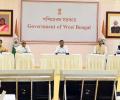
West Bengal Chief Minister Shuvendu Adhikari has directed senior officials to ensure transparency, accountability, and strict adherence to rules in governance. He emphasised the importance of honest opinions and actions for the state's development, urging officials to restart stalled centrally sponsored schemes and implement promises from the BJP's election manifesto.

Loss-making Air India has introduced a new 'Basic Fare' category for select domestic flights, which does not include complimentary meals, as part of its efforts to trim expenses amid rising operational costs.
Following through announcements with enforcement of measures is key, as a run through recent Indian economic history shows, points out A K Bhattacharya.
