
Indian benchmark indices, Sensex and Nifty, saw an early rebound after significant losses, driven by value buying, though elevated oil prices and anticipation of the US Federal Reserve's policy decision tempered gains. Track Sensex, Nifty on September 16.

Indian benchmark indices Sensex and Nifty ended flat on Tuesday, with the Sensex dipping nearly 70 points, as investor sentiment turned cautious ahead of crucial global central bank policy meetings and a significant sell-off in Asian markets.

US Federal Reserve Chairman Kevin Warsh has picked former RBI governor Raghuram Rajan, Harvard University economics Professor Raj Chetty and Microsoft XBOX CEO Asha Sharma to be part of task forces constituted to examine the central bank's approach to monetary policy and propose transformational changes.

Indian benchmark indices, Sensex and Nifty, closed nearly flat on Thursday, influenced by the US Federal Reserve's interest rate hike and indications of further monetary tightening. Despite some intraday gains, caution prevailed, with foreign institutional investors continuing to offload equities. Meanwhile, the National Stock Exchange of India's (NSE) mega initial public offering opened for subscription, garnering 39 per cent subscription on its first day.

Gold and silver prices are anticipated to maintain a positive trajectory in the coming week, with market volatility expected to remain high due to ongoing developments in West Asia and upcoming global economic data, particularly the Federal Reserve's FOMC meeting minutes.

Indian benchmark indices, Sensex and Nifty, traded marginally higher in early trade despite the US Federal Reserve's recent rate hike and indications of further tightening, with the National Stock Exchange's much-anticipated Rs 22,569-crore IPO also opening for subscription.

The benchmark BSE Sensex rebounded by 362 points, ending a four-day losing streak, driven by strong buying in metal, private banking, and oil and gas shares, while the broader NSE Nifty saw modest gains despite paring some advances in the closing session.

Indian benchmark equity indices, Sensex and Nifty, experienced declines in early trade due to renewed tensions in West Asia, which led to a rebound in crude oil prices, coupled with weak global market trends and foreign fund outflows.

Indian benchmark equity indices, Sensex and Nifty, rallied in early trade, driven by positive global market trends and easing crude oil prices, despite the US Federal Reserve's hawkish stance tempering overall sentiment. Track Sensex, Nifty on September 18.

Indian benchmark equity indices, Sensex and Nifty, rebounded in early trade after two days of losses, driven by strong buying in blue-chip IT stocks and a rally in global markets.
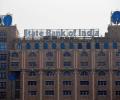
State Bank of India's latest report highlights a 'chalk and cheese' divide in the Reserve Bank of India's recent policy communications, with the Monetary Policy Committee minutes showing a hawkish tone while the Governor's statements are more data-dependent, leading to market uncertainty regarding future interest rate hikes.
Indian stock markets closed lower due to selling in IT and FMCG shares, triggered by renewed tensions in West Asia which led to a rally in crude oil prices and concerns over inflation and interest rates.
Indian benchmark equity indices, Sensex and Nifty, rebounded after a two-day losing streak, driven by strong buying in blue-chip IT stocks and positive global market cues, with the Sensex climbing 330.92 points.

Indian-origin golfer Sahith Theegala is in contention for a Top-10 finish at the Wyndham Championship, the final regular-season PGA TOUR event. Despite a mixed third round, he remains close to the leaders, aiming for a strong performance to boost his FedExCup Play-offs chances. Beau Hossler and Michael Brennan currently share the lead.

Analysts predict that crude oil prices and the ongoing US-Iran conflict will be the primary drivers of stock market movements, with investors also closely watching the Jackson Hole symposium for cues on interest rates.

The FCNR (B) stratagem relies on using public money to defend the rupee. The State subsidises foreign borrowing to attract dollars. This tool requires large-scale borrowing to make a material difference against a gross external flow of $11 billion a day. A commensurately large fiscal cost falls upon the exchequer. The ministry of finance will choose how much it is willing to spend in exchange for this round number, points out Ajay Shah.

'Every period of excessive optimism eventually gives way to a correction, while periods of extreme pessimism often create the best investment opportunities.'

The question for the next 20 years is not whether India can become a $5 trillion or $10 trillion economy. Those are attractive targets, but the real question is whether India can create enough productive jobs, educate its children properly, make its cities liveable, and give hundreds of millions of people a substantially better life, asserts Ramesh Menon.

A new report by Motilal Oswal Financial Services Ltd (MOFSL) indicates that inflation, interest rates, and monetary policy have become more significant drivers of gold prices than traditional geopolitical conflicts, with markets increasingly focusing on these economic factors.

Indian benchmark indices closed marginally higher, with the Sensex gaining over 43 points and the Nifty remaining flat, as a spike in crude oil prices due to geopolitical uncertainties tempered risk appetite.
Indian benchmark equity indices closed higher on Thursday, with the Sensex gaining 273.55 points to 77,928.15 and the Nifty rising 66.95 points to 24,317.15, driven by bargain hunting and short-covering in IT and auto sectors.

Indian benchmark indices, Sensex and Nifty, closed lower due to profit-taking after a four-day rally, influenced by weakness in Asian markets, with Trent shares tumbling over 12 per cent.

Poor families, she said, cut corners on their own needs to pay for coaching and fees, and when their child clears JEE, it's the happiest day the family has had in years. So why, she asked, her voice already starting to climb, does the same system that we're told is the best in the country keep pushing those very students toward what she called 'institutional deaths'?

Indian benchmark indices Sensex and Nifty recovered early losses to trade higher, supported by encouraging developments on the geopolitical front, specifically the US-Iran peace deal, and easing crude oil prices.

Analysts predict that the ongoing conflict in West Asia, crude oil price fluctuations, and the US Federal Reserve's interest rate decision will significantly influence the Indian equity market this week.
Indian stock market benchmark indices Sensex and Nifty closed nearly one per cent higher, extending their winning streak for a second day. This rally was driven by softening crude oil prices, positive geopolitical developments, and significant buying in blue-chip IT stocks, despite a broader global tech sell-off.
Indian benchmark equity indices, Sensex and Nifty, extended their rally for a fifth consecutive session, driven by optimism surrounding a potential US-Iran peace deal and a significant drop in crude oil prices. Despite hawkish remarks from the US Fed, investors remain hopeful that easing energy prices could temper inflationary pressures.

Former HDFC Bank chairman Atanu Chakraborty cites misselling of AT-1 bonds and underperformance as key reasons for his resignation, dismissing personal differences as a major factor.

Equity benchmark indices Sensex and Nifty rebounded sharply by nearly 1 per cent on Monday, driven by strong buying in power, banking, and financial stocks.

Thousands and thousands and thousands of adults owe their lives to the commitment and medical fervour of Dr Armida Fernandez, who a grateful nation honoured with the Padma Shri this year.

Equity markets fell on Monday, with benchmark indices recording their worst session in over two months amid caution ahead of the US Federal Reserve's (Fed's) policy announcement and renewed uncertainty over the US-India trade deal. Sustained selling by foreign portfolio investors (FPIs) also weighed on sentiment.
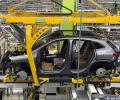
India's total automobile retail sales recorded a significant 9.55 per cent year-on-year growth in May, reaching an all-time high of 25,31,067 units, driven by strong performances in three-wheelers, passenger vehicles, and tractors, despite prevailing heatwave conditions and fuel price pressures.

West Bengal Chief Minister Suvendu Adhikari announced that Bangladeshi infiltrators detained in the state will be directly handed over to the BSF for deportation, bypassing court appearances, following a new rule.

Benchmark Sensex tumbled 1,236 points or 1.5 per cent while Nifty closed near 25,450 on Thursday following an across-the-board sell-off amid escalating geopolitical tensions between the US and Iran.

Indian benchmark stock indices, Sensex and Nifty, closed nearly 1 per cent lower due to surging crude oil prices, weak global market trends, and significant foreign fund outflows, with geopolitical tensions and inflation concerns further dampening investor sentiment.

West Bengal Chief Minister Suvendu Adhikari announced that Bangladeshi infiltrators detained in the state will be handed over to the BSF instead of being produced in courts, following a new rule. Instructions have been issued to the police and RPF to directly transfer detainees to the BSF at the Bangladesh border, with weekly reports submitted to the CMO.
Indian stock markets are expected to remain highly sensitive to geopolitical developments, particularly the US-Iran situation, and crude oil prices this week, with analysts also highlighting the influence of the rupee-dollar trend, foreign investor activity, and upcoming inflation data.

Among the Sensex constituents, Asian Paints, Tech Mahindra, HCL Technologies, Tata Steel, Maruti Suzuki India, Sun Pharmaceuticals, Tata Consultancy Services, ICICI Bank, Bajaj Finance, UltraTech Cement, Mahindra & Mahindra and Tata Motors Passenger Vehicles were the laggards. However, Eternal, Titan, Adani Ports, Bharat Electronics Ltd, State Bank of India, Bajaj Finserv, NTPC and Bharti Airtel were among the gainers.

'When we start describing somebody as an enemy that is the start of politics and emotion after which no business can take place.' 'We need to get out of this, allow Indian businessmen to do business with China.'

The Indian stock market is poised for a volatile week, influenced by the Reserve Bank of India's monetary policy decision, crucial global macroeconomic data, and the escalating geopolitical tensions in West Asia, according to market analysts.
