
The Reserve Bank of India (RBI) has projected that crude oil prices will average USD 85 per barrel and the rupee will weaken to 94 against the dollar by FY27, according to its bi-annual Monetary Policy report.

Investors are set to monitor quarterly earnings, crude oil prices, the Jio Platforms initial public offering, and foreign investor activity in the upcoming holiday-shortened week, according to market analysts.
India's passenger vehicle (PV) industry is projected to experience moderated growth in FY27, following a strong rebound in H2FY26, primarily due to the high base effect, absorbed pent-up demand, and the lingering impact of geopolitical tensions in West Asia.

IT services major LTM is set to introduce a new pricing framework, 'Blueverse Credit', in the first quarter of FY27, aiming to align monetisation with the growing adoption of agentic artificial intelligence.

State-owned enterprises in India are projected to significantly increase their overseas borrowings, potentially exceeding $15 billion in FY27, driven by the Reserve Bank of India's new concessional forex swap facility which offers a 3 per cent funding-cost advantage.

India's state-run oil marketing companies (OMCs) are projected to incur under-recoveries of approximately Rs 80,000 crore on liquefied petroleum gas (LPG) sales in FY27 if current loss levels persist, according to rating agency Icra.

India's net direct tax collection witnessed a robust 13.21 per cent increase, reaching approximately Rs 13.38 lakh crore between April 1 and October 14, primarily fuelled by a strong performance in corporate tax mop-up.

India's toll collection growth is projected to moderate to 5-7 per cent year-on-year in FY27, a 150-200 basis points reduction, primarily due to the economic impact of the West Asia conflict and a slowdown in commercial traffic, according to Crisil Ratings.

Indian benchmark equity indices, Sensex and Nifty, significantly recovered from sharp early losses, driven by buying in State Bank of India and Reliance Industries, alongside fresh foreign fund inflows, despite declines in Axis Bank and HDFC Bank.

India's leading IT companies are anticipated to report subdued revenue growth and largely stable margins for the July-September quarter, as clients maintain tight discretionary budgets, with analysts closely watching the conversion of strong bookings into revenue and the impact of AI on traditional services.

The Centre has spent 28 per cent of its FY27 capital expenditure budget of Rs 12.21 trillion in the first three months against around 24.5 per cent during the corresponding period a year ago.

Growth in India's currency in circulation (CiC) has reached a five-year high, primarily due to deposits under the Foreign Currency Non-Resident (Bank), or FCNR(B), scheme, leading to a robust increase in reserve money, according to the Reserve Bank of India's (RBI) 'State of the Economy' report.

Godrej Properties reported a significant 62 per cent decline in consolidated net profit to Rs 154.15 crore for the September quarter, primarily due to higher expenses, while its sales bookings also fell by 6 per cent to Rs 8,008 crore.

Automobile dealers in India are reporting healthy bookings ahead of Navratri and Dussehra, with the Federation of Automobile Dealers Associations (Fada) indicating strong confidence in a pickup in deliveries from mid-October, despite a high base from last year's GST-led surge.

Indian benchmark indices Sensex and Nifty saw an early rebound, driven by strong performances from blue-chip HDFC Bank and major IT firms like HCL Tech, which reported a significant rise in net profit. Track Sensex, Nifty on October 13.

A significant structural shift is underway in India's gold market, with investment purchases projected to account for 35-40 per cent of total consumption by FY27, driven by geopolitical uncertainty, price momentum, and portfolio diversification.

India's cement industry is on the brink of an oversupply situation as aggressive capacity expansion by major players is set to outpace demand growth over the next two financial years, potentially leading to pricing pressures and moderated utilisation rates.

The Asian Development Bank (ADB) has revised down India's GDP growth forecast for fiscal year 2026-27 (FY27) to 6.6 per cent from an earlier 6.9 per cent, primarily attributing the change to elevated energy prices stemming from the Middle East conflict. Despite this moderation, India is still expected to remain the world's fastest-growing major economy.

A new report by TeamLease Digital highlights a significant AI-ready talent gap in India's technology industry, with shortages of 53-60 per cent in Generative AI and cloud skills. The report indicates that only 16 per cent of IT professionals possess AI skills, leading to rising salary premiums for AI-core roles and a projected demand for over 10 lakh GenAI roles by 2026.

HCL Technologies remains under pressure after missing Q4 expectations and issuing cautious FY27 guidance. Analysts highlight weak margins, soft demand, and muted growth outlook.

Hyundai Motor India Ltd (HMIL) is set to launch a localised mass-market SUV built on a dedicated EV platform, expanding its EV portfolio beyond the IONIQ 5 and CRETA Electric, while also significantly boosting its charging infrastructure and training its workforce.

Reliance Industries' digital arm, Jio Platforms, may see its initial public offering (IPO) delayed to the second half of fiscal 2027, according to CreditSights. The delay is primarily attributed to ongoing geopolitical tensions in the Middle East, which could impact market conditions and investor sentiment.
HDFC Bank, India's largest private-sector lender, has revised its FY27 growth trajectory, stepping back from earlier guidance to align with a more measured 12 per cent year-on-year expansion, citing geopolitical uncertainties.

India's largest private-sector lender, HDFC Bank, is undergoing a significant leadership transition with several long-serving executives, including Deputy Managing Director Kaizad Bharucha and outgoing MD & CEO Sashidhar Jagdishan, set to depart, leaving incoming MD & CEO Anup Bagchi to oversee a major overhaul.

A dozen companies, including major players like Jio Platforms and Zetwerk Manufacturing Business, are poised to launch Initial Public Offerings (IPOs) in October, continuing India's strong fundraising momentum in the primary market. These offerings span diverse sectors, reflecting sustained investor interest in businesses with robust growth prospects.

Indian benchmark indices Sensex and Nifty closed higher for the second consecutive day, primarily driven by robust buying in IT stocks following strong quarterly results and positive global trends. Tech Mahindra notably surged over 8% after reporting a significant jump in net profit.

At least four to five privately placed infrastructure investment trusts (Invits) are expected to transition to public listings by the end of the 2026-27 financial year, significantly increasing the number of publicly traded Invits to 12-14, according to N S Venkatesh, CEO of the Bharat Invits Association (BIA).

Indian listed companies experienced their fastest revenue growth in 15 quarters during Q1FY27, with combined net sales rising 18.4% year-on-year, while net profit grew 16%, primarily driven by mining, metals, and banking sectors, despite a contraction in operating margins due to higher input costs.

SBI General Insurance aims to achieve a 10 per cent market share among private and standalone health insurers within approximately five years, up from its current 7.17 per cent, said Naveen Chandra Jha, managing director and chief executive officer, SBI General Insurance.

'In investing, poor sentiment is always a good vintage to build a portfolio.'

Leading private banks in India, including HDFC Bank, ICICI Bank, and Axis Bank, experienced a decline in net interest margins (NIMs) during the second quarter of the financial year due to significant deposit mobilisation under the Foreign Currency Non-Resident (Bank), or FCNR (B), scheme. However, banks anticipate a recovery in margins in the coming quarters as these funds are deployed and the interest-rate cycle supports lending yields.

Moody's Ratings has downgraded India's growth forecast for financial year 2026-27 (FY27) to 6 per cent from 6.8 per cent, attributing the revision to weaker consumption and industrial activity, elevated energy prices, and rising input costs stemming from the West Asia conflict.

The Indian IPO market recorded its highest monthly fundraising in September, with 34 mainboard companies raising 39,309 crore, despite a significant decline in the Nifty 50 index.

State-run Bharat Petroleum Corporation Ltd (BPCL) plans a significant capital expenditure of 25,000 crore for the financial year 2026-27, primarily for ongoing expansion projects. The company also stated that the recent 4-per-litre price hike in petrol and diesel has provided some financial relief amidst volatile crude oil prices and mounting losses.
Indian stock markets witnessed a significant rebound, with the Sensex rallying 1,109 points and the Nifty closing above 22,720, driven by strong performances in IT and financial sectors, a recovering rupee, and Finance Minister Nirmala Sitharaman's comments on long-term capital gains (LTCG) tax.

The Indian Centre has spent 37 per cent of its ~12.22 trillion capital expenditure target in the first four months of FY27, marking a 30 per cent year-on-year increase, while simultaneously keeping the fiscal deficit under control at 27 per cent of the Budget Estimate.

Citron, a brand under Stellantis, anticipates that three-fourths of its sales in India will originate from Tier-II, Tier-III, and smaller cities within the next five years, a significant increase from its current 55 per cent, as it expands its retail network beyond major urban centres.

Indian benchmark indices Sensex and Nifty rebounded on Wednesday, driven by a decline in crude oil prices below USD 100 per barrel and optimism surrounding a potential de-escalation of the conflict in West Asia.
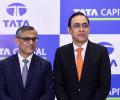
Tata Capital remains confident in its 23-25 per cent growth guidance, driven by strong momentum in Retail and SME segments, despite facing pressures from rising funding costs and potential impacts from new RBI regulations on revolving credit.

Tata Motors Passenger Vehicles (TMPV) reported Q1FY27 results showing significant margin pressures at both Jaguar Land Rover (JLR) and its domestic operations, despite strong volume growth in the India business. Analysts expect these margin headwinds to persist, potentially offsetting gains from increased sales and new launches.
