
Non-resident Indians (NRIs) in the Gulf region are increasingly purchasing term life insurance policies from India, driven by geopolitical uncertainties in West Asia and the significant cost advantages offered by Indian products, with the GCC region now contributing over half of the total NRI demand.

Not a single retail outlet ran dry. Every household that wanted a cylinder got one. India faced neither a 1991 moment nor a 2013 one. Macroeconomic stability held. This was not an accident, and it was not luck alone. It was the work of a government that chose to act as it had during the pandemic -- deliberately and gradually, building one measure upon another rather than reaching for a single dramatic lever, explains V Anantha Nageswaran, chief economic advisor to the Government of India.

Hyundai Motor India Ltd reported a 22.22 per cent decline in consolidated profit after tax to Rs 1,255.63 crore in the March quarter, primarily due to higher expenses, despite an increase in total revenue from operations.

Domestic gold jewellery consumption is likely to decline by 9-10 per cent in 2025-26, mainly due to a 33 per cent surge in gold prices, a report said on Thursday. The consumption of bars and coins increased 17 per cent and 25 per cent, respectively, in FY24 and FY25, reflecting investor preference for safe-haven assets amid global macroeconomic uncertainty and heightened geopolitical and trade tensions, Icra said in the report.

Tata Motors' MD and CEO, Girish Wagh, has identified rising diesel prices as the most significant threat to India's commercial vehicle (CV) industry recovery, despite the sector recently surpassing its pre-FY19 wholesale peak. Diesel costs account for 25-50% of a truck operator's total cost of ownership, making any increase a critical concern for fleet economics.

API Holdings, the parent company of online pharmacy PharmEasy, has significantly reduced its debt from 1,800 crore to 1,050 crore and refinanced it at lower interest rates under CEO Rahul Guha, shifting its focus from 'growth at any cost' to profitability and aiming for a debt-free balance sheet before a potential stock market listing.

Global financial institutions, including Goldman Sachs and Citigroup, have invested Rs 963 crore in One 97 Communications (Paytm's parent company) through open market transactions, acquiring a 1.34 per cent stake from SAIF Partners and Elevation Capital.
The Enforcement Directorate has reported a staggering 170 per cent surge in asset attachments, reaching 81,422 crore in the last financial year (FY26), underscoring its intensified efforts against financial crimes and its significant role in restituting funds to victims.
HDFC Bank, India's largest private-sector lender, has revised its FY27 growth trajectory, stepping back from earlier guidance to align with a more measured 12 per cent year-on-year expansion, citing geopolitical uncertainties.

Indian hotel companies are experiencing a sharp correction in share prices due to the Iran war and broader geopolitical tensions, leading analysts to cut operating profit expectations and valuations, despite structurally positive medium-term prospects.

Indian paint majors, including Asian Paints, Berger Paints, and Kansai Nerolac, reported better-than-expected performance in Q4FY26, driven by steady demand, improved product mix, and strategic price hikes. The sector is also benefiting from reduced competitive intensity as new players also increase prices, narrowing the gap with incumbents.

HDFC Life Insurance reported a 4 per cent year-on-year increase in net profit to Rs 495.6 crore for Q4FY26, while its parent, HDFC Bank, announced a Rs 1,000 crore preferential share issuance to raise its stake to 50.5 per cent.

These offers provide some relief to engineering students impacted by the uptake in artificial intelligence (AI) tools.

New demat account additions in India reached an 11-month low in March, with only 2.15 million new accounts opened, significantly below the 12-month average. This slowdown is attributed to a sharp decline in equity markets, escalating West Asia tensions, and increased crude oil prices impacting India's economic outlook.

Tata Consultancy Services (TCS) Chairman N Chandrasekaran announced that the company anticipates having as many artificial intelligence (AI) agents as its human workforce, currently half a million, while assuring that no staff downsizing is planned.

Krutrim, India's first AI unicorn, has successfully repositioned itself as a focused domestic AI Cloud Services provider, reporting its first annual net profit in FY26.

State-owned Life Insurance Corporation of India (LIC) has reported a net profit of over Rs 23,400 crore for the January-March quarter, making it the highest profit-making firm in the Indian financial sector during this period, surpassing major banks like SBI and HDFC Bank.

There are hopes of a turnaround in overall corporate earnings after six quarters of single digit growth.

Maruti Suzuki India reported a significant 147 per cent year-on-year increase in mini-car sales (Alto and S-Presso) during April-May 2026, reaching 32,341 units, driven by eased production constraints and a surge in demand for CNG vehicles amidst rising fuel prices.

Despite a strong 7.8 per cent growth in the first quarter, the Indian economy is expected to grow at 6.5 per cent in the current financial year as the impact of US tariffs on Indian exports will reduce prospects, particularly in the second half, ADB said on Tuesday.
Coforge believes that the rapid adoption of AI is disrupting the traditional labour model but also creating new high-margin opportunities in the IT services industry.

Ed-tech unicorn PhysicsWallah is strategically targeting a 30% revenue improvement by FY27, leveraging AI-led automation, aggressive expansion into southern Indian markets, and a strong focus on student learning outcomes and enrolment growth.

"Policy sales will be one of the focus areas for the company because looking at the large insurance gap, large number of people being uncovered. The only right way to go is to increase the number of policies," said Amit Jhingran, MD & CEO, SBI Life Insurance.

Why would a country that requires close to $90 billion in net foreign capital annually to create jobs, build productive capacity, and sustain rapid growth permit $30 billion of capital to flow abroad, thereby contributing to pressure on the rupee? asks Debashis Basu.

India's toll collection growth is projected to moderate to 5-7 per cent year-on-year in FY27, a 150-200 basis points reduction, primarily due to the economic impact of the West Asia conflict and a slowdown in commercial traffic, according to Crisil Ratings.

NPCI BHIM Services Ltd is expanding the BHIM app to feature phones to increase financial inclusion and diversify revenue through financial product distribution. The app aims to double its market share and is focusing on partnerships with banks and new features like UPI Circle.

India has emerged as the largest global market for Nestle's iconic KitKat chocolate-coated wafer bar, surpassing other nations due to strong consumer penetration, product innovation, and aggressive marketing investments.

Amul, India's leading dairy brand, has achieved a historic turnover of Rs 1 trillion in FY26, marking an 11 per cent growth. This milestone is attributed to aggressive domestic distribution, product diversification, and strategic international expansion into markets like Europe, the US, Africa, and Southeast Asia.

India is on track to exceed the $4 trillion milestone in 2025-26 (FY26), surpassing the $3.9 trillion gross domestic product (GDP) mark recorded at the end of March 2025, Chief Economic Adviser (CEA) V Anantha Nageswaran said on Tuesday.

What we will not do is discount deeply, neither will we compromise on product substance, says Managing Director and Chief Executive Officer (MD&CEO) Santosh Iyer.

Infosys' board has approved annual performance-based stock grants worth Rs 51.75 crore for Chief Executive Officer and Managing Director Salil Parekh, aligning with his tenure ending in March 2027.

The Reserve Bank of India (RBI) is anticipated to make its highest-ever dividend payment to the government this year, providing a significant fiscal boost to address challenges, including those stemming from the ongoing Middle East crisis.

India's Central government is likely to see its fertiliser subsidy bill double to a record 3.4 trillion in FY27, up from the Budget estimate of 1.7 trillion, due to surging global fertiliser prices exacerbated by the West Asia war. This significant increase, coupled with revenue losses from excise duty cuts for oil-marketing companies, is straining the government's fiscal space, though capital expenditure plans remain unchanged.

IT services major LTM is set to introduce a new pricing framework, 'Blueverse Credit', in the first quarter of FY27, aiming to align monetisation with the growing adoption of agentic artificial intelligence.
InterGlobe Aviation (IndiGo) is experiencing significant financial pressure, with its stock falling 18 per cent since the start of the Iran war, due to rising Brent crude prices, a weakening rupee, and disruptions to its West Asia and European flight networks caused by geopolitical tensions.

Tata Consultancy Services (TCS) has extended 25,000 offers to freshers for the current fiscal year (FY27), with future hiring decisions contingent on the demand scenario, according to CEO K Krithivasan.
Fintech giant One97 Communications, which operates Paytm, has decided against applying for a Non-Banking Financial Company (NBFC) licence, favouring its existing partnership model.
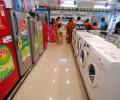
Increased input costs due to geopolitical conflict in West Asia and unseasonal rain in March negatively impacted volumes of consumer durables makers, particularly air conditioners, in Q4FY26, leading to projected declines in EBITDA and APAT despite revenue growth.
Deloitte India on Thursday projected India's economy to grow 6.7-6.9 per cent in the current fiscal amid buoyant demand and policy reforms. Indian economy grew 7.8 per cent in the April-June quarter of current fiscal.

India's consumption stocks, which have outperformed the broader market, are now facing significant pressure due to a gradual rise in fuel prices and the potential for higher inflation. Analysts warn that companies may be forced to pass on increased input costs to consumers, potentially hurting demand across both staples and discretionary categories, with a looming threat of deficient monsoon rainfall further exacerbating inflationary concerns.
