
The country's gross domestic product (GDP) is expected to grow at around 18.5 per cent with an upward bias in the first quarter of the current financial year, according to SBI research report Ecowrap. This estimate is lower than the Reserve Bank of India's GDP growth projection of 21.4 per cent for the April-June quarter. "Based on our 'Nowcasting' model, the forecasted GDP growth for Q1 FY22 would be around 18.5 per cent (with upward bias)," the report said. Higher growth in Q1 FY22 is mainly on account of a low base.

The asset quality of non-banking financial companies (NBFCs) deteriorated in April-September 2021 (H1FY22) owing to the second wave of the pandemic. Their gross non-performing assets (NPAs) rose to 6.8 per cent in September 2021 from 6 per cent in March 2021. The Reserve Bank of India's (RBI's) annual Trend and Progress report (FY21) said the sector might have to grapple with higher delinquencies as and when policy measures unwound. The pandemic posed significant challenges to NBFCs during the first wave (2020) also.

The company, which in the previous quarter announced former Capgemini top executive Thierry Delaporte as its new chief executive officer and managing director, is looking at improving its performance in coming quarters.

Zomato said it has consistently gained market share over the last four years to become the category leader in the food delivery space in India in terms of gross order value from October 1, 2020 to March 31, 2021.

The move towards indigenisation of defence procurement creates new opportunities for India's military industrial sector. The Government of India (GoI) has so far released five lists of items for positive indigenisation - these should be manufactured in India, rather than imported. Each item on these lists represents an opportunity for some local firm.

Nepal's decision to ban the import of non-essential items amid depleting forex reserves may hit Indian exports. The country's central bank - Nepal Rastra Bank - last week instructed commercial banks not to open letters of credit (LCs) for importing non-essential items. This is to prevent further decline of the country's foreign exchange reserves. However, it has not issued any formal communication yet.

SBI Research has projected the Indian economy to grow at 7.5 per cent in 2022-23, an upward revision of 20 basis points from its earlier estimate. As per official data, the economy grew by 8.7 per cent in FY22, net adding Rs 11.8 lakh crore in the year to Rs 147 lakh crore, the report said, adding this was however only 1.5 per cent higher than the pre-pandemic year of FY20. "Given the high inflation and the subsequent upcoming rate hikes, we believe that real GDP will incrementally increase by Rs 11.1 lakh crore in FY23. "This still translates into a real GDP growth of 7.5 per cent for FY23, up by 20 basis points over our previous forecast," SBI chief economist Soumyakanti Ghosh said in a note on Thursday.

India's primary deficit (Centre and states) for FY21 is assumed to be 6.8 per cent of GDP, according to the Economic Survey tabled in Parliament on Friday. It said the Covid-19 pandemic has created a significant negative shock to demand. Active fiscal policy -- one that recognises that fiscal multipliers are disproportionately higher during economic crises than during economic booms -- can ensure that the full benefit of seminal economic reforms is reaped by limiting potential damage to productive capacity.

Days after cutting the salaries and other allowances of MPs and ministers, the government has passed instructions to all departments to reduce their expenditure by as much as 60 per cent from their first-quarter spending plans.

Private hospitals, especially smaller standalone ones, are staring at a crisis that they were not prepared for. Analysts say larger corporate chains have to brace up for at least six months for business to return to normal.

Revenue from divestment has fetched Rs 40,000-50,000 crore against target of Rs 2.10 trillion.

'Our focus on fresher induction is high, given that they come in with certain advantages.' 'They do not have an unlearning process as seen in senior employees.'
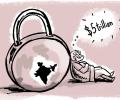
India will need $8 trillion (around Rs 588 lakh crore) of gross capital formation or new greenfield assets to become a $5 trillion (around Rs 368 lakh crore) economy by FY2027, a report said. The report by Deloitte said despite the COVID-19 disruption, FDI inflow into the country provides necessary optimism and display underlying strengths of the Indian economy. In FY2020-21, FDI inflows (including equity, re-invested earnings, and capital) amounted to a record $81.72 billion, 10 per cent higher than the previous financial year, it said.

Without exception, the top four majors beat Street estimates across all parameters - revenues, profitability, or net profit growth. However, what stood out were the large deal wins reported by the big two, TCS and Infosys.

Fundraising activity in the upcoming financial year 2022-23 may even surpass FY22 when 52 Indian companies raised a record Rs 1.11 trillion via initial public offerings (IPOs). According to a note by PRIME Database, 54 companies (including LIC) plan to raise Rs 1.4 trillion and currently hold the Securities and Exchange Board of India's (Sebi's) approval. Another 43 companies, the note said, are looking to raise about Rs 81,000 crore but waiting for Sebi nod.

Pegging the cost of the covid-19 lockdown at USD 120 billion (approximately Rs 9 lakh crores) or 4 per cent of the GDP, analysts on Wednesday sharply cut their growth estimates and stressed on the need to announce an economic package. The Reserve Bank of India (RBI), which is scheduled to announce its first bi-monthly policy review on April 3, is set to deliver a deep rate cuts and it should also be assumed that the fiscal deficit targets will be breached, analysts said.

IndusInd Bank, L&T, ITC, HUL, Reliance Industries and Sun Pharma were among the gainers. On the other hand, HCL Tech, Axis Bank, Asian Paints, UltraTech Cement and Infosys were among the laggards.

Fitch Ratings on Monday cautioned that the Indian government has little fiscal headroom at its disposal to respond to possible shocks to growth given the country's lowest investment grade credit rating with a negative outlook. "India's public debt/GDP ratio, at about 87 per cent in FY21, is well above the median of around 60% for 'BBB' rated sovereigns. "We revised the Outlook on India's rating to Negative, from Stable, in June 2020, partly owing to our assumptions about the impact of the pandemic on public finance metrics. "The government has little fiscal headroom at its current rating level to respond to possible shocks to growth," it said in a report.

Developers are cautious about the timing of launches in the near term, given the relative uncertainty in demand pick-up and logistical challenges during the lockdown. However, affordable housing projects slated for the first quarter (Q1) of 2020-21 (FY21) may get launched this quarter itself.

Banks are set to sell dud-loans worth Rs 90,000 crore of 22 firms in the first tranche to the National Asset Reconstruction Company (NARCL). It's reason for cheer given that such sales to asset reconstruction companies (ARCs) have been poor in recent times. In fiscal 2020, their assets under management (AUM) contracted by 4 per cent; and in fiscal 2021, it fell by another 100 basis points to Rs 1.07 trillion. So, why are we where we are?

Experts expect a net loss of Rs 26.7 billion for IndiGo and Rs 10.1 billion for SpiceJet in Q1FY21 driven by low traffic volume, low fleet utilisation and poor coverage of fixed costs.
India is much better placed today to deal with future waves of the pandemic relative to the first wave, RBI deputy governor Michael Patra said.

IndusInd Bank was the top gainer in the Sensex pack, rallying over 7 per cent, followed by SBI, ICICI Bank, HDFC twins, Axis Bank, Bajaj Finserv and UltraTech Cement. NSE Nifty soared 245.35 points to 14,923.15.

The forthcoming budget needs to delay fiscal consolidation, instead should focus more on supporting the pandemic battered-economy and boost consumption demand by offering income tax soaps and cutting fuel taxes, says a report. In a pre-budget report, India Ratings said it expects the new budget to consolidate and strengthen the plan set out in the last budget, rather than trying out new things by continue with the revenue and capital expenditure pattern of FY'22 to provide stability and consolidation to the past/ongoing efforts, and to focus on boosting demand by generating employment opportunities in areas/sectors that have been impacted more by the pandemic. The report therefore expects the finance minister to delay fiscal consolidation and make it to be a gradual and calibrated process, thus ensuring the necessary fiscal support that the economy needs is available till the recovery acquires its own momentum.

Backed by the China-plus-one policy, India's textile and apparel exports have seen a 53 per cent growth during the April-November period of the current fiscal year at around $26 billion. This compares to the figure of $17 billion during the same period in FY21. According to Wazir Textile Index, all major companies including Welspun, Vardhman, Trident, KPR Mills, Indo Count, RSWM, Filatex, Nahar Spg and Indorama have posted higher sales during the first half of the current fiscal year compared to the pre-pandemic year.

House economists at the nation's largest lender State Bank of India (SBI) have urged the government to budget for nursing the pandemic-ravaged economy and not to focus too much on fiscal consolidation as there is a need for more stabilisation measures to sustain the fledgling recovery. And one of the best way to begin the new fiscal is to complete the share sale of LIC this fiscal. This can go a long way in repairing the overstretched balance sheet which in turn will bring down fiscal deficit to a much lower 6.3 per cent in FY23 as the public coffers will be left with a cash surplus of at least Rs 3 lakh crore to begin the new fiscal, SBI chief economist Soumya Kanti Ghosh said in a pre-Budget note on Wednesday.

Piramal Enterprises (PEL) on Wednesday said it has completed the acquisition of Dewan Housing Finance (DHFL) by paying Rs 34,250 crore to creditors of the housing finance company. The company said the creditors of DHFL, including fixed deposit (FD) holders, would recover an aggregate amount of Rs 38,000 crore from the resolution process of DHFL. The amount comprises approximately Rs 34,250 crore to be paid by Piramal Capital and Housing Finance Ltd (PCHFL) as a combination of cash and NCDs, and an amount of approximately Rs 3,800 crore which is the entitlement of creditors as per the resolution plan from the cash balance available with DHFL, the company said.

'We tightened our risk frameworks once the Covid crisis started.' 'We are slowly lightening this as we see economic activity pick up, salaries getting restored, and people getting back into jobs.'

To counter the pandemic, air transport was suspended from March 25 till May 24 which rendered zero traffic at AAI airports. Even after resumption of flights, traffic is yet to pick up at airports due to quarantine measures implemented by states and an overall fear of flying.

With the stock market turning choppy, fintech start-up MobiKwik, which had filed a draft red herring prospectus (DRHP) to raise around $250 million through an initial public offering (IPO), is now looking to raise money from the private market. "We will raise private money but we are not in dire need. "The business was profitable for the first time in the December quarter on a top line of around Rs 150 crore and that will be maintained in the March quarter also. We are generating cash," said Upasana Taku, co-founder of MobiKwik.

'Investors should reduce cash gradually and look for value investing.'

Analysts attribute the surge to a host of factors, particularly the interest shown by the retail investors in these two market segments.

2.75 million of the 3 million Covid-related health claims were settled.

Reserve Bank of India (RBI) Governor Shaktikanta Das on Thursday said the country's economy has recovered stronger than expected from the initial impact of the COVID-19 pandemic, but there is a need to be watchful of demand sustainability after the end of festivities. Speaking at the annual day event of Foreign Exchange Dealers' Association of India (FEDAI), Das said there are downside risks to growth across the world and also in India. It can be noted that the Indian economy contracted by 23.9 per cent in the first quarter of the fiscal year, and the RBI expects the economy to shrink by 9.5 per cent in FY21.

The country's gross domestic product (GDP) is likely to grow more than 9.5 per cent in fiscal 2021-22, an SBI research report-Ecowrap said. The economy grew at 8.4 per cent in the second quarter of the current fiscal, according to data released by the National Statistical Office (NSO) on Tuesday. The growth in the April-June quarter of this fiscal stood at 20.1 per cent. In October's monetary policy review, the Reserve Bank of India had retained its projection for real GDP growth at 9.5 per cent in 2021-22, consisting of 7.9 per cent in Q2; 6.8 per cent in Q3; and 6.1 per cent in Q4 of 2021-22.

'While most companies were bullish before the second wave of double-digit sales growth in FY22, that may not be the case now.'

India's harsh lockdown has left companies grappling with temporary closure, chaotic supply chains and depressed demand. Consequently, business plans have been modified.

'Favourable product mix, sales recovery, and cost saving initiatives are expected to support margins going ahead while focus on debt reduction (target of debt free by FY24) will aid balance sheet strength'
The rating affirmation reflected RIL's strong business profile - a large-scale refinery with a capacity of around 1.2 million barrels a day and dominant market position in petrochemicals.

For FY21, CSB is looking at growth of around 25 per cent and is confident of doubling it in two years. And it is also exploring options to acquire a mid-size bank with a good client base and branches in the north to acquire an all-India presence.
