
Finance Minister Nirmala Sitharaman announced that India's real GDP grew by 7.8 per cent in the April-June quarter, surpassing the RBI's forecast. She attributed this strong performance to government reforms and agile economic management, reaffirming the government's commitment to expanding economic opportunities.

The National Payments Corporation of India (NPCI) stated that the Merchant Discount Rate (MDR) "is distributed only amongst the UPI ecosystem, to further invest into infrastructure resilience, innovation, cybersecurity (protecting the UPI infrastructure with banks and non-banks) and customer service."

The government is introducing a 0.4% Merchant Discount Rate (MDR) on UPI person-to-merchant payments above Rs 2,000, effective October 15. This move ends the zero-MDR regime, aiming to fund UPI infrastructure and sustainability, as the previous government subsidy was insufficient to cover operational costs. Payments between individuals and most everyday merchant transactions will remain free.

'These limits will change. Very soon restrictions, restrictions will come.'

A new Merchant Discount Rate (MDR) on UPI transactions above Rs 2,000, effective October 15, could force small merchants and price-sensitive consumers to revert to cash, according to economic think tank GTRI. The move, which introduces a 0.4 per cent MDR with a Rs 300 cap and concessional rates for specific categories, is questioned by GTRI founder Ajay Srivastava, who suggests it's not a revenue issue for the government but potentially a response to US pressure regarding UPI and RuPay's preferential market position.

The BCCI's member units have authorised office-bearers to make a decision regarding the extension of chief selector Ajit Agarkar's contract, which is set to expire early next month, and to fill vacancies in the junior selection committee.

Prime Minister Narendra Modi celebrated India's 7.8 per cent GDP growth in the April-June quarter, attributing it to the collective strength of the people despite global uncertainties. He criticised "doomsayers" as the economy showed resilience, exceeding expectations even amidst international conflicts and supply chain issues.

The Congress party has strongly refuted claims by Parliamentary Standing Committee on Finance Chairperson Bhartruhari Mahtab that opposition MPs supported levying a Merchant Discount Rate (MDR) on UPI transactions. Congress MP Manish Tewari termed Mahtab's remarks "erroneous and fallacious," clarifying that the committee's recommendation was to "explore" revenue models, not to implement MDR. The party accused Mahtab of misleading due to his recent switch to the BJP.

Ajit Agarkar has informed the BCCI he will not continue as chief selector, prompting the board to begin searching for his successor as his contract ends October 4.

Economists widely anticipate the Reserve Bank of India's Monetary Policy Committee will increase the repo rate by 50 basis points, likely split between the October and December meetings, as retail inflation is projected to peak at 6.1 per cent in the third quarter, exceeding the RBI's tolerance limit.

The political confidence required to place high-end Japanese aircraft and personnel on Indian soil is itself a data point.
It indicates a level of trust that would have been difficult to imagine when India-Japan defence ties were largely symbolic, explains Varun Arya.

The Asian Development Bank (ADB) has revised down India's GDP growth forecast for fiscal year 2026-27 (FY27) to 6.6 per cent from an earlier 6.9 per cent, primarily attributing the change to elevated energy prices stemming from the Middle East conflict. Despite this moderation, India is still expected to remain the world's fastest-growing major economy.

Brokerages are forecasting a strong first quarter (April-June/Q1) for Reliance Industries Ltd (RIL) in FY2026-27, with double-digit revenue growth, Ebitda increases of around 12 per cent, and net profit rising up to 10 per cent, primarily driven by its oil-to-chemicals (O2C), retail, and Jio businesses.

Tata Steel plans to invest approximately Rs 20,000 crore in capital expenditure during the current financial year (FY27), a significant increase from the previous year, with 60 per cent of this allocation directed towards its India business for expansion, new technologies, and sustainability.

Hyderabad-based SETL, a precision engineering company, has acquired a 51% majority stake in GScale Energy Private Limited, an AI Datacenter Engineering infrastructure specialist. This strategic move involves an initial investment of Rs 190 crore, with a total commitment of Rs 500 crore, marking SETL's expansion into the rapidly growing AI Datacenter sector and leveraging its expertise from pharmaceutical and chemical industries.

Taxpayers should reconcile returns with AIS, Form 26AS and maintain all supporting records.

Reliance Industries has delivered the first batch of solar modules from its green energy complex in Jamnagar, Gujarat, marking the operational rollout of its New Energy business. The company is developing an integrated clean energy manufacturing ecosystem, including solar modules, batteries, green hydrogen, and bio-energy infrastructure.

India's gross GST collections increased by 3.2 per cent to over Rs 1.94 lakh crore in May, driven by improved supplies of goods and services and a continued expansion in collections from imports.

Elevated global crude oil and natural gas prices, driven by geopolitical developments in West Asia, could significantly influence the Government of India's fiscal position for 2026-27, according to a report by ratings agency Icra.

The Indian central government has reduced its total expenditure by approximately 60,000 crore in FY26, below its revised estimate, to successfully achieve the fiscal deficit target of 4.4 per cent of gross domestic product (GDP), according to the latest data from the Controller General of Accounts (CGA).

Domestic passenger vehicle dispatches in India rose 25.4 per cent year-on-year to 4,37,312 units in April, continuing the strong demand momentum from the previous fiscal year, according to SIAM.

The OECD projects India's GDP to grow at 7.6% in the current fiscal year and 6.1% in 2026-27, despite global economic challenges stemming from the Middle East conflict and energy price volatility.

'We want to become India's topmost integrated studio, working in different languages.'

India's fiscal deficit is projected to reach 4.5 per cent of GDP for the current fiscal year, exceeding the budgeted target, as the government's policy responses to the West Asia conflict are expected to strain public finances, according to research firm BMI.

With Income Tax Act 2025 in force, your tax choice can quietly cost you big money if you're not paying attention. Ramalingam Kalirajan explains how

Despite recent share price dips, Bharti Airtel is strategically positioned for growth, driven by investments in data centres via Nxtra, a potential tariff hike, and strong performance in Africa, alongside efforts to deleverage and expand its subscriber base in underpenetrated rural markets.

The Indian government has maintained the interest rates on small savings schemes, including PPF and NSC, for the eighth consecutive quarter, starting April 1, 2026.

The 16th Finance Commission, led by Arvind Panagariya, has recommended maintaining the states' share in central taxes at 41% for the five-year period starting April 1, 2026. The government has accepted this recommendation, with Rs 1.4 lakh crore allocated to states for FY 2026-27 as Finance Commission Grants.

Net inflows into equity mutual fund schemes moderated in FY26, falling by 27 per cent to about 3 trillion till February, as choppy markets and global uncertainties prompted investors to shift towards safer options like hybrid funds and gold ETFs.

The Indian IPO market is experiencing a significant surge in preliminary filings, with 38 companies submitting papers to SEBI in March 2026, driven by a combination of improved issuer confidence, strategic regulatory compliance, and private equity investors seeking exits amidst volatile market conditions.

A key mistake would be continuing to rely on provisions of the Income-Tax Act, 1961, where the new law now applies, and vice versa.
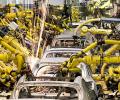
Passenger vehicle sales in India reached a record high of 4.7 million units in FY26, boosted by strong performances from major automakers and the implementation of GST 2.0.

India's eight core infrastructure sectors experienced a slowdown in production growth, reaching a two-month low of 4% in January. Crude oil and natural gas output declined, while refinery products remained flat. Overall growth for the April-January period was also lower compared to the previous fiscal year.

The Punjab government has allocated Rs 11,577 crore to home affairs, justice, and jails in the 2026-27 budget, focusing on strengthening institutional capacity, technology-driven surveillance, and prison security.
The Indian economy recorded a six-quarter high growth of 8.2 per cent in July-September, as factories churned out more products in anticipation of a consumption boost from the GST rate cut, according to government data.
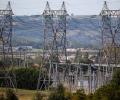
The government on Wednesday put out the draft of a new policy that projects the country's power sector will need Rs 50 trillion in investments by 2032 and Rs 200 trillion by 2047, proposing ambitious reforms in generation, transmission and distribution.

Finance Minister Nirmala Sitharaman announced a fiscal deficit target of 4.3% of GDP for FY27, continuing the path of fiscal consolidation. The government aims to reduce the debt-to-GDP ratio to 55.6% by BE 2026-27 and further to around 50% by March 2031.

Texas Governor Greg Abbott has directed state agencies and public universities to suspend new H-1B visa petitions through May 2027, a move likely to affect Indian professionals. The order comes amid ongoing debate over skilled immigration and potential impacts on academic research and innovation.
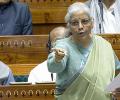
Finance Minister Nirmala Sitharaman launched a strong attack on Rahul Gandhi and the Congress party, accusing them of compromising India's interests on the world stage and selling out farmers and the poor during their time in power.

After a year of muted single-digit growth, hiring intent has returned to double digits at 11 per cent, up from 9.75 per cent last year, supported by formalisation and regional expansion, says a report. According to the India Decoding Jobs 2026 Report, launched by digital recruitment platform Taggd in collaboration with the Confederation of Indian Industry (CII), sectors such as BFSI, manufacturing, and infrastructure are set to drive hiring momentum.
