
S Mahendra Dev, chairman of the Economic Advisory Council to the Prime Minister, expressed confidence that the rupee would stabilise around the 92-93 level against the US dollar, despite geopolitical tensions, and that foreign investment flows would return.

The new Index of Industrial Production (IIP) series, which shifts the base year from 2011-12 to 2022-23 and is scheduled for release on June 1, will, for the first time, track rare earths and minor minerals, piped natural gas (PNG), and water supply, sewerage and waste management.

The NDA government has gradually nuanced its position on the issue of demographic challenge.

India has established a high-level inter-ministerial body, the AI Governance and Economic Group (AIGEG), to steer the country's national AI governance strategy. The AIGEG will coordinate policy across ministries and oversee cross-sectoral governance issues, supported by a Technology and Policy Expert Committee (TPEC).

'Leadership is about understanding how a business works, how it is shaped, built, and expanded.'

A top Swiss official has emphasised the growing importance of science and technology in international affairs, leading Switzerland to prioritise anticipatory science diplomacy in its foreign policy. Collaboration with India reflects a shared vision between two global innovation leaders.

India needs to increase the investment rate to 34-35 per cent from 31-32 per cent currently to achieve a growth rate of 7 per cent and above, said S Mahendra Dev, chairman, economic advisory council (EAC) to the Prime Minister, on Wednesday.

External Affairs Minister S Jaishankar addressed the Rajya Sabha on India's position regarding the escalating conflict in West Asia, emphasising the need for peace, dialogue, and the safety of civilians, while also prioritising India's energy security and trade interests.

The University Grants Commission's (UGC) new regulations on promoting equity in higher education institutions have sparked protests and legal challenges. This article explains the regulations, the concerns raised, and the government's response.

The 'rescue' operation occurred within kilometres of Iran's underground tunnel complex at Isfahan, assessed by the IAEA and US intelligence as holding a substantial portion of the country's 60 per cent enriched uranium stockpile. Retired senior US military officers have highlighted that the mission's footprint -- hundreds of special operators, multiple heavy-lift aircraft deep inside Iran -- appears outsized for recovering a single airman. Prem Panicker continues his must read blog on the Iran War.
Experts warn that air pollution in India is a major public health crisis, leading to a surge in undiagnosed airway diseases and cardiovascular issues. They urge for urgent action, early detection, and treatment.

For MSMEs the transition could mean higher wage bills and tougher compliance -- unless strong handholding follows reports Auhona Mukherjee.

Civil society groups, led by the NREGA Sangharsh Morcha, are planning a nationwide protest -- similar to the farmers' stir a few years ago -- starting December 19 demanding scrapping of the new Viksit Bharat-Guarantee for Rozgar and Aajeevika Mission.

India Inc on Sunday hailed the Union Budget 2026-27 as a 'structural shift' in the country's technology landscape, noting that the government is moving beyond fragmented pilots to build foundational layers where AI serves as a 'horizontal enabler' for the entire economy.

'Our problem is not a budget deficit but a trust deficit. We need to trust our institutions and industries to innovate and lead. That is the way forward for India.'
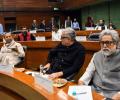
India's Parliament is set to begin its Budget session on Friday, with opposition parties poised to demand a discussion on the alleged mismanagement of the Maha Kumbh festival in Prayagraj, where 30 pilgrims died in a stampede. The opposition also accused the government of politicising parliamentary committees and pushing its agenda through its majority. The session will start with President Droupadi Murmu addressing both houses of Parliament. Finance Minister Nirmala Sitharaman will present the Union Budget on Saturday for the eighth consecutive time.
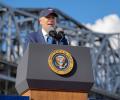
On Friday, Biden announced his intent to appoint 14 people to the advisory committee, which provides overall policy advice to the United States trade representative on matters of development, implementation, and administration of the US trade policy.

The Advisory Committee on International Economic Policy meets four times a year. It is possibly for the first time that the committee held a discussion on India-US economic relationship.

Simplifying GST rates, removing exemptions, easing disputes, and speeding up refunds can boost investment in India and offer the best reply to Trump's tariffs, observes V S Krishnan, former member, Central Board of Indirect Taxes and Customs.
With inflation still ruling above the 9 per cent mark, Prime Minister's Economic Advisory Committee (PMEAC) on Wednesday suggested that the Reserve Bank should continue to focus on controlling the rising prices.

India needs to limit its reliance on multinational corporations (MNCs) for strategic audits and consulting in order to strengthen its economic sovereignty and achieve the goal of Atmanirbhar Bharat, the Ministry of Corporate Affairs (MCA) said in an office memorandum released on Wednesday.

The government on Friday appointed Suman K Bery as the vice chairman of Niti Aayog, following the sudden resignation of Rajiv Kumar.
The government on Tuesday appointed three external members -- Ram Singh, Saugata Bhattacharya and Nagesh Kumar -- to the RBI's rate-setting Monetary Policy Committee for four years. The central government has reconstituted the Monetary Policy Committee (MPC) of RBI, the finance ministry said in a statement. Ram Singh is the director of the Delhi School of Economics, Saugata Bhattacharya is an economist, and Nagesh Kumar is the director and Chief Executive, Institute for Studies in Industrial Development, New Delhi.

Ranade was earlier removed from the position on September 14 by the then chancellor Bibek Debroy, after a fact-finding committee concluded that his appointment as the GIPE's VC did not conform to the UGC regulations on minimum qualifications for the appointment of teachers and other academic staff.

The opposition on Sunday asked the Centre to allow discussions in the Parliament on the United States prosecutors' bribery charges against the Adani Group even as Union minister Kiren Rijiju made it clear that the matters to be taken up in the two Houses will be decided by their authorised committees with the consent of the respective Chair.

'The focus of the legislation will be to minimise user harm and increase the accountability of platforms, while also promoting innovation.'
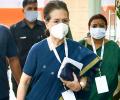
The Congress president also announced that a compact task force will be set up to drive the process of internal reforms that are essential.

Debroy is expected to have a role and responsibility similar to the erstwhile chairman of the Prime Minister's Economic Advisory Council
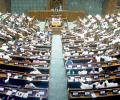
Parliament's approval of the Waqf (Amendment) Bill, a contentious piece of legislation aimed at reforming Waqf bodies, has sparked strong reactions from the opposition, who allege that the bill was "bulldozed" through Parliament. The bill, considered the government's most consequential legislation in its third term, was passed with comfortable majorities in both the Lok Sabha and Rajya Sabha despite opposition claims of a lack of consultation and an intrusion into religious affairs. Other notable bills approved during the session included the Finance Bill, Appropriation Bill, Immigration and Foreigners Bill, and Tribhuvan Sahkari University Bill. The session, which saw high productivity, also witnessed debates on issues such as economic distress, delimitation, and the three-language policy. While the government touted its achievements, the opposition criticized the government's approach and vowed to challenge the Waqf bill in court.

Foodgrain production in current is fiscal is likely to fall by at least 10%, if not more. It may be better to be realistic in our estimates than give unrealistic positive spin to these figures, says Himanshu Thakkar.
India grew at 6.7 per cent in 2008-09. For the current fiscal 2009-10, the Economic Survey projected a 7 per cent growth rate plus/minus 0.75 per cent.

Competition from Nepalese teas -- which has duty free access to the Indian market -- has emerged as a lower-cost alternative to Darjeeling tea, challenging its viability.

Finance Minister Nirmala Sitharaman will present the Union Budget on Tuesday as the Monsoon Session of Parliament gets underway next week with the united opposition set to corner the National Democratic Alliance government on issues ranging from the NEET paper leak case and railway safety.
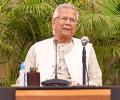
The chief adviser's decision to stay in office came two days after he told student-led National Citizen Party (NCP) leaders that he was mulling resignation as he felt "the situation is such that he cannot work", citing difficulties in working amid the failure of political parties to find common ground for change.

Reserve Bank of India (RBI) is unlikely to cut the benchmark interest rate at its upcoming monetary policy review meeting, taking place soon after the announcement of the Lok Sabha election results, amid inflation challenges, said experts. The Monetary Policy Committee (MPC) may also refrain from rate cut as economic growth is picking up, notwithstanding the elevated interest rate of 6.5 per cent (repo) prevailing since February 2023. The meeting of the Reserve Bank Governor Shaktikanta Das headed MPC is scheduled for June 5 to 7.

Subramanian's paper comes at a time when concerns have been raised in various quarters about the official economic growth numbers. The Economic Advisory Council-PM said the Base Year of India's income calculations were shifted to 2011-12 on the basis of recommendations of several committees with experts in national income accounting.
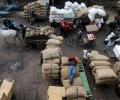
The economy may grow by around 7 per cent this financial year as estimated by the Monetary Policy Committee (MPC) of the Reserve Bank of India (RBI), say economists with various organisations. The first advance estimates for 2023-24 will be released on Friday by the National Statistical Organisation (NSO), an exercise done for calculating ratios such as the fiscal deficit. The interim Budget will be presented on February 1.

Using the debt-to-GDP ratio as a fiscal anchor aligns with efforts to promote fiscal transparency through proper disclosure of off-budget borrowings.

During the monsoon session, which began on Monday, the Opposition is seeking to corner the government on its handling of the standoff with China along the Line of Actual Control in Ladakh, the COVID-19 situation, economic downturn and unemployment, and is pressing for discussions on these issues.

Finance Commission has got new team who are committed to growth initiatives.
