
The Payments Council of India has confirmed that Unified Payments Interface (UPI) services will continue to be free for consumers and small merchants, despite a recent Lok Sabha Bill. This clarification addresses concerns about potential charges, emphasising that while a sustainable financial model for UPI infrastructure is being developed, transaction charges will not be passed on to users or small businesses.

The Finance Ministry has clarified that the 0.4 per cent Merchant Discount Rate (MDR) on UPI transactions above Rs 2,000, effective October 15, is not expected to increase cash transactions or cause inflation. The ministry also dismissed allegations of US pressure influencing the decision, asserting that the policy aims to promote RuPay credit cards within the UPI ecosystem, and a monitoring mechanism will ensure the MDR burden is not passed on to consumers.
The BJP has accused the Congress of spreading "fake news" regarding UPI transaction charges, asserting that the government has clarified that consumers will not be levied merchant discount rate (MDR) charges. This comes after the Congress criticised a government notification, alleging it paves the way for imposing fees on UPI transactions. The BJP has strongly refuted these claims, highlighting that most UPI transactions remain free and the government provides incentives to maintain a charge-free ecosystem for users.

The Indian government has introduced a 0.4% transaction fee on Unified Payments Interface (UPI) payments exceeding Rs 2,000 for merchants, effective October 15, marking the end of nearly six years of free service. Person-to-person transfers and small-value transactions below Rs 2,000 remain free. The new Merchant Discount Rate (MDR) is capped at Rs 300 for transactions above Rs 75,000, with differentiated rates for essential sectors and investments, and safeguards to prevent costs from being passed to consumers.

The National Payments Corporation of India (NPCI) stated that the Merchant Discount Rate (MDR) "is distributed only amongst the UPI ecosystem, to further invest into infrastructure resilience, innovation, cybersecurity (protecting the UPI infrastructure with banks and non-banks) and customer service."

The government is introducing a 0.4% Merchant Discount Rate (MDR) on UPI person-to-merchant payments above Rs 2,000, effective October 15. This move ends the zero-MDR regime, aiming to fund UPI infrastructure and sustainability, as the previous government subsidy was insufficient to cover operational costs. Payments between individuals and most everyday merchant transactions will remain free.

Indian banks and non-banking financial companies (NBFCs) are undertaking a comprehensive review and reset of their engagement terms with fintech firms, driven by the Reserve Bank of India's (RBI) draft Guidance on Regulatory Expectations for Data Governance and the stringent compliance requirements of the Digital Personal Data Protection (DPDP) Act, 2023, and its 2025 Rules.

India Inc's first-quarter earnings season was significantly impacted by the West Asia conflict, leading to rising costs, calibrated price increases, and margin pressures across various sectors including FMCG, automotive, steel, and cement. Companies are implementing price hikes to protect profitability, with many anticipating further escalations if input costs remain elevated.

The Indian government has introduced a 0.4% Merchant Discount Rate (MDR) on UPI person-to-merchant (P2M) transactions exceeding Rs 2,000, effective October 15. This move ends nearly six years of fully free UPI payments, though person-to-person (P2P) transfers and small P2M payments remain free. The charges aim to bolster investment in UPI infrastructure, with specific exemptions and caps for essential sectors.

The Indian Medical Association (IMA) has issued a public health advisory on the seasonal surge in Influenza A (H1N1), or swine flu, urging people not to self-medicate with antibiotics and antivirals and advising immediate medical attention for severe symptoms.

At the heart of the decision is concern over the survival of Meghalaya's neighbourhood retailers.

The Indian government has approved the introduction of one billion polymer banknotes in Rs 10 and Rs 20 denominations for field trials, aiming to enhance durability. This move comes as the Finance Minister also addressed Parliament on declining retail inflation, GST reforms, and other fiscal measures taken to support the economy and household consumption.

Researchers at Delhi's Indraprastha Institute of Information Technology have developed 'MutAIverse', a generative AI platform designed to decode DNA damage and identify potential causes of cancer. Tested on head and neck cancer patients in Guwahati, the platform successfully traced exposure to smokeless tobacco as a contributing factor. This innovation aims to shift focus from just diagnosis to understanding causative factors, potentially aiding in prevention and protection.

The Advertising Standards Council of India (ASCI) has released draft guidelines for responsible labelling of synthetically generated Artificial Intelligence (AI) content in advertising, proposing a risk-based framework to ensure transparency and protect consumers.

'In case a particular industry has not passed on the benefits and if we receive complaints, we will take up the matter with the industry body concerned.'

'What exactly is on the prime minister's mind, we do not know. But it feels like the government wants the country to be prepared for unseen challenges ahead.'

Medical negligence arises when a medical professional deviates from reasonable standards of care, causing injury to the patient.

India may adopt a "calibrated" and a "step-by-step" approach to easing norms on investments originating from China, Union Commerce and Industry Minister Piyush Goyal said on Tuesday. He was in a conversation with A K Bhattacharya on Day 1 of Business Standard's two-day annual event, Manthan 2026. The minister said foreign direct investment (FDI) from China was certainly not "banned", but it goes through an approval process. "The government's approach at the moment is to accelerate the approval process."

'The West Asia or the Gulf crisis has shown that what we develop as national infrastructure when things are not as bad as they could be, we forget to plan for adversities.'

Both sides have now revealed a preference for escalation over strategic defeat, and each new provocation narrows the space for the next pause. The Touska seizure, Iran's refusal to negotiate under blockade, Israel's strikes on Iranian oil infrastructure -- all of these add up to an increasingly untenable situation. This makes the wild card -- Trump and his motormouth -- more consequential than ever, notes Prem Panicker in his must read blog on the Iran War.

Quota-based duty concessions granted by India to New Zealand for apples, kiwifruit, and Manuka honey are linked to the delivery of agriculture productivity action plans committed by the island country under the free trade agreement.

Bangladesh's newly-elected Prime Minister Tarique Rahman pledged to strengthen the rule of law and ensure the country is a safe land for people of all faiths, while also addressing corruption and improving law and order.

Israel and the United States had a plan. Iran punched back. And now the Gulf is reeling, the world is beginning to feel the pain and, as on date, no one in Washington or Tel Aviv appears willing to admit that the punch has landed, notes Prem Panicker, continuing his must-read blog on the war in the Middle East.

Recent years have been turbulent for the insurance industry due to direct and indirect tax reforms, regulatory overhaul and other external pressures. The events cumulatively slowed growth rate to single digits from the high teens seen earlier.

'IndiGo will receive a sharp rap on the knuckles -- a punishment, a huge penalty. 'I look towards them creating a compensation fund.' 'I would like to think they would do that for all the passengers who are affected on every single day since cancellations began.'

Consumers can easily file cases against e-tailers now.

The panel will examine the reasons behind the emergence of dummy schools and their role in encouraging full-time coaching at the cost of formal schooling, and will suggest ways to mitigate the issue.

'Some cases do not get a single hearing for 6 to 8 months, while some have been pending for as long as 8 years.'

In absolute terms, both types of cars must cut emissions by about 28-29 g/km. But in percentage terms, the lighter 900-kg car must reduce emissions by 27 per cent, while the 1,500-kg car needs a 22 per cent cut. And the target becomes progressively stringent for both -- but, once again, the tightening is sharper for the 900-kg car than for the 1500-kg car.
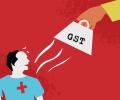
Reduction of GST on health insurance premium from 18% to 0% looks like a straight 18% reduction in what consumers pay. The truth, however, is...

The proposed 'Next Gen GST' with sweeping reforms, lower tax rates, and just two slabs, aims to boost the economy amid tariff threats and set the stage for a single tax rate regime by the time India becomes a developed nation, government sources said.


Given that a sizeable part of this money is part of the coveted current accounts and savings accounts, it is surprising that banks are not in a hurry to revive these accounts, notes Tamal Bandyopdhyay.

India's internet economy is estimated to reach $1 trillion by 2030, primarily due to e-commerce, which is expected to be worth $325 billion and rank third globally, according to industry experts. Last year marked a crucial turning point for India's e-commerce sector, with notable changes in consumer trends, technology, and regulations. InGovern Research Services, a leading corporate governance advisory firm, hosted a virtual roundtable to deliberate on the notable developments in India's e-commerce sector in 2023, with a particular focus on the essential role of customer trust in fueling its ongoing expansion.

What has surprised the industry is that the Bill has been tabled without any consultation. Critics warn the ban on real-money gaming could fuel black markets, endanger 200,000 jobs and billions in tax revenue.

In an interview with rediff.com's Shobha Warrier, consumer rights activist S Pushpavanam talks about the spate of rail accidents in the last few days and what the civil society can do about this.
In an interview with rediff.com's Shobha Warrier, consumer rights activist S Pushpavanam talks about the spate of rail accidents in the last few days and what the civil society can do about this.
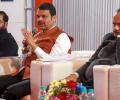
Shiv Sena's Dadaji Bhuse is the new school education minister while Uday Samant continues to be the industries minister.

The US retaliatory tariffs are a major setback for the Indian gems and jewellery exports, apex industry body GJEPC said on Thursday as it urged the government to take steps to secure the long-term interest of the sector. The US has announced 27 per cent reciprocal tariffs on India saying New Delhi imposes high import duties on American goods, as the Donald Trump administration aims to reduce US' trade deficit and boost manufacturing.

Suddenly, the legendary advertising line -- a diamond is forever -- is losing its shine.
